
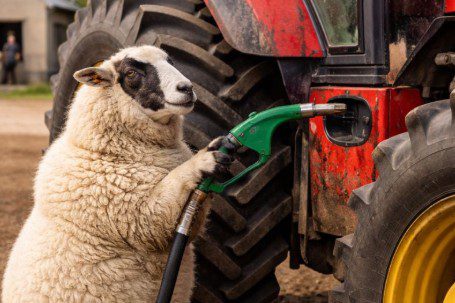
An AI-generated sheep has been enlisted by Sheep Producers Australia to promote the RMAC fuel survey. Image – SPA, LinkedIn.
AUSTRALIA’S red meat sector has called for urgent government action on rural and regional fuel supply and access.
The Red Meat Advisory Council today warned soaring fuel prices and supply access issues are putting Australia’s red meat industry at risk.
Urgent action is needed to protect food security and animal welfare, as producers across the country struggle with limited fuel availability, RMAC said in a release from chair John McKillop
“We need strong government leadership to safeguard the food supply chain, including assurances that adequate liquid fuel reserves will be maintained,” he said.
“If fuel shortages or rationing occurs, businesses involved in the production, transport, and sale of food and livestock must be given priority.
“Our peak industry bodies report that some producers are traveling 1,000 km for fuel, only to be denied permission to fill drums or containers,” Mr McKillop said.
“Others are struggling to keep water flowing to livestock because pumps run on diesel, and in some cases, humane slaughter may become the only option when animals cannot be watered, fed, or transported to processing centres should the situation be prolonged.”
RMAC said it acknowledged the government’s commissioning of a new National Food Supply Chain Assessment under the National Food Security Strategy, but stressed that immediate action is needed, with the interim report still a month away.
RMAC said Australian Lot Feeders Association members are feeling the immediate impacts of the fuel shortage.
ALFA chief executive officer Christian Mulders said feedlots require uninterrupted inputs to maintain animal health, welfare, and productivity.
 “There is no redundancy in the system, and no capacity to ‘pause’ operations without immediate consequences for animal welfare and supply chain continuity,” Mr Mulders said.
“Without coordinated early intervention, the situation could escalate, affecting domestic food supply, export commitments and animal welfare.
“Feedlots alone need more than 1 million litres of diesel a day for essential operations including feed manufacturing and feeding regimes, pen maintenance, and livestock transport,” he said.
Mr McKillop said the Australian red meat industry must be prioritised in fuel supplies to protect food security and animal welfare, ensuring the ongoing supply of quality red meat to domestic and international consumers.
“The Red Meat Advisory Council calls on government to act immediately to secure reliable fuel for the red meat supply chain.
“This is critical to safeguard animal welfare, food security, and the sectors growth, sustainability and profitability.”
RMAC survey on fuel use
Regional fuel shortages have prompted the launch of a nofuelhere platform by the federal Coalition and a red meat industry survey on fuel use by RMAC.
RMAC said the survey will assess fuel availability and essential fuel requirements across Australia’s red meat sectors in light of national fuel supply pressures and ongoing geopolitical disruptions.
Information will be aggregated to support industry engagement with government and supply chain partners.
Sheep Producers Australia has promoted the survey on its LinkedIn page, stating that fuel keeps the red meat supply chain moving from paddock to processor.
“The stronger the response, the stronger the case to government on fuel security, access and planning,” SPA said.
Click here to complete the survey.
Coalition launches nofuelhere platform
The Coalition has launched a nofuelhere platform is designed to map fuel shortages across regional Australia and give Australians a direct line to their local Members of Parliament.
Nationals Leader Senator Matt Canavan said the platform was a direct response to the government’s failure to acknowledge the depth of the crisis in regional areas.
“The Albanese Government keeps telling regional Australians there’s no problem, that fuel is f lowing and reserves are holding.
“But that’s not what we’re hearing in our communities. People are lining up for $50 worth of petrol. Farmers can’t secure diesel deliveries. Some towns are running on fumes,” Senator Canavan said.
“We launched www.nofuelhere.com.au because we believe regional Australians deserve to be heard.
“Every report submitted tells us where the crisis is real, where it’s urgent, and where the government needs to act.”
The Coalition said Australia imports about 90 percent of its refined fuel, and holds up to 38 days of reserves across fuel types. But more than 107 service stations in New South Wales have reported diesel shortages, with similar patterns across Australia. Regional communities that lack access to public transport and are often long distances from the next service station have been disproportionately impacted, the Coalition said.
Shadow Minister for Infrastructure and Transport Senator Bridget McKenzie said regional Australians have no alternative to private fuel-powered transport.
“The government has released up to 762 million litres from domestic reserves – only equivalent to approximately one week of national supply.
“There is no public transport option. Some residents are commuting 100 kilometres per day to work – fuel is not a luxury, it’s a necessity,” she said.
“Farmers face critical diesel shortages affecting planting, harvesting and freight. The NFF have predicted that food prices could rise by up to 50% if diesel shortages persist and halt freight.
“This website will help Members and Senators continue to put pressure on Labor to help the regions.”
The Coalition is calling on the government to:
- Prioritise fuel supply to regional and agricultural communities
- Accelerate the drawdown of strategic reserves to rural areas, not just capital cities
- Develop a national fuel security plan with mandatory reserve targets that are actually met
- Ensure independent regional fuel distributors are not locked out of emergency supply arrangements Australians can report fuel shortages at: www.nofuelhere.com.au
VFF gets no joy on request for free public transport
Meanwhile in Victoria, a request from the state’s peak farmer body to the Victorian Government to provide more public transport services, and supply them free of charge, until fuel supply stabilises, is yet to yield results.
The Greens party has also called for free public transport, and the initiative has been supported by the Better Buses for the West campaign.
Victorian Farmers Federation president Brett Hosking said fuel shortages affect rural communities very differently to metropolitan households, where farming operations rely solely on critical fuel to grow their products.
“For most Victorians, a fuel shortage means cancelled plans, longer queues and a tighter weekly budget.
“For farmers, timing is everything. Farming runs on narrow weather windows, and if the tank is empty at the wrong moment you can’t just wait for prices to settle, you lose the opportunity, and sometimes the entire crop,” he said.
“Keeping farmers moving is in everyone’s interest. Victorian farmers grow almost a quarter of Australia’s food and feed millions more across the globe,” Mr Hosking said.
The VFF said small changes in commuting behaviour across Melbourne could make a meaningful difference.
“If just one in five Victorian car commuters shifted to public transport, the fuel saved would be enough to plant roughly half of Australia’s wheat, barley, canola and lentil crop.
“A little would go a long way,” Mr Hosking said.
“Even taking one or two trips a week on the train, tram or bus instead of driving can leave more fuel in the system for the jobs that keep supermarket shelves stocked.”
HAVE YOUR SAY