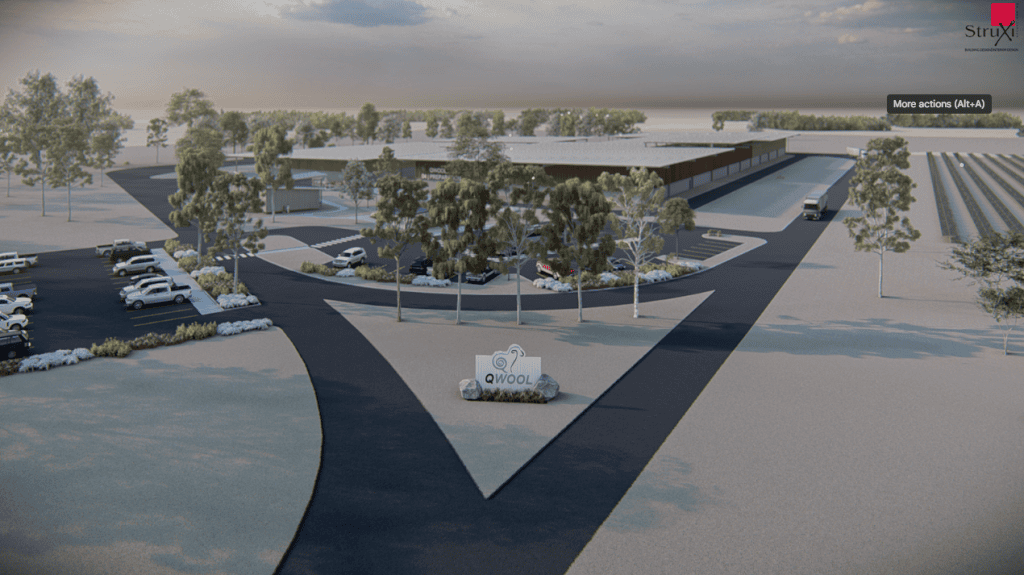
An impression or render of the proposed QWool scouring plant planned for Blackall in Queensland. Supplied – QWool.
QUEENSLAND and Tasmania are ranked as Australia’s lowest wool-producing states – but that hasn’t stopped grower-backed start-up QWool from thinking big.
The Queensland based company yesterday announced a A$775 million development vision to de-couple the Australian wool industry from Chinese processors, who currently buy 95 percent of Australia’s wool.
The consortium of Australian wool producers said it is one step closer to reshaping the economics of Australia’s iconic wool industry with an Australia-Vietnam plan that will enable wool producers to bypass Chinese scours and target higher value markets further into the value chain.
QWool said it now has environmental approvals to develop early-stage wool processing or scouring in Australia, with plants planned for Blackall in Queensland and further operations in New South Wales. Construction of the Blackall plant is scheduled to start in early 2027, with the first wool scoured in mid-2028.
QWool executive director Jonathan Pavetto said the group’s plan is “not just a vision.”
“The chairman (John Abbott) was in Vietnam last week and we’ve selected a (top-making) site in Vietnam, we’re close to selecting construction partners.
“We’ve got letters of intent offtake from wool spinners in Vietnam, so it’s very much a real thing and it’s not just a pipedream.”
 The project’s first stage includes plans for green energy powered scour in Blackall and the tops plant in Vietnam, stage two is a scouring site in New South Wales, most likely Deniliquin, and stage three is a third scour, possibly In Moree, NSW.
“The tops plant in Vietnam is why it all works because we can supply the non-Chinese parts of the supply chain.”
Innovation and integration are keys to competing
QWool executive chair John Abbott said innovation in the plant design, simpler supply chains and integration between scouring and top making were the key to competing with the world’s largest wool processing country.
“For thirty years, the industry has been told Australia can’t scour wool at a competitive cost.
“Our plant design and integration with a topmaking plant that we will control changes that,” he said.
“The wool scour we will be building will be quite different to past scouring operations in Australia.
“By rethinking the scouring process from the ground up and leveraging the natural resources available from the Great Artesian Basin in Blackall, we’ve delivered a step-change in the cost of production and a much simpler supply chain,” Mr Abbott said.
“By building and owning our own tops making plant allows us to control of the second stage of processing (wool tops), which ensures supply chain security, and eliminates the risk exposure of the current wool industry in Australia.
“This also ensures the ongoing financial viability of the Australian scours.”
Although Blackall is not situated within Australia’s major wool production areas, Mr Abbott said site selection was driven by the requirements of a viable manufacturing operation rather than wool-growing activity, as future energy, water and waste disposal cost posed a greater threat to viability than transport cost.
“Blackall presents a unique opportunity for a new wool scour.
“It has access to geothermal resources that produce water at the ideal temperature and chemical composition for scouring and some of the best solar energy opportunities in the world,” he said.
“Cheap land also allows us to irrigate effluent into a fodder crop, turning what is a cost elsewhere into a revenue opportunity.
“For example, our plant design means we have totally eliminated ongoing energy, water and waste costs, the key costs that made Australian scouring operations unviable 30 years ago,” Mr Abbott said.
“These competitive advantages combined means we can scour wool here in Blackall and compete with China on cost.
“We are only able to do this because of access to geothermal energy and water from the Great Artesian Basin and very high solar energy resources in Western Queensland.”
Mr Abbott said QWool’s planning for subsequent scour sites in New South Wales is supported by the NSW Department of Primary Industries and Regional Development.
“Our supply chain will also be much simpler; we expect to reduce the number of logistics steps in half, compared to the current supply chain through China.
“This is a huge saving of logistics costs that are current passed onto wool producers, one way or another.”
Mr Abbott said scouring would also unlock a high-value byproduct – lanolin – that is re-imported to Australia at high cost after it is separated from Australian wool in China.
“Lanolin, the natural grease we remove from the wool, is a premium ingredient for the pharmaceutical and cosmetics industries.
“Today China captures that value. With QWool, it stays here.”
QWool will return value to growers – McDonald
Blackall wool producer Graeme McDonald said producers had watched too much of the value of their wool go offshore for too long.
“We produce the best wool in the world, and then we let China capture most of its value in processing.
“QWool will let producers like us hold onto more of the value of what we produce.”
“This isn’t just about the next wool cheque; it’s about building something our kids and grandkids can carry forward,” he said.
“That’s the legacy we want to leave.”
“This vision may start in Blackall, but it will benefit the whole wool industry.”
Chair of the rural lobby group AgForce’s Sheep, Wool and Goats Committee Boyd Webb said returning early-stage processing to Australia was a long-held ambition that would make whole sheep and wool industry more resilient and deliver much-needed confidence boost to wool producers about the industry’s future.
“Exporting greasy wool isn’t just a missed opportunity, it’s also a major risk.
“If we ever suffer an ovine disease like foot and mouth, we will lose market access to China overnight. Scouring wool onshore considerably reduces this risk.”
He said adding value to raw wool before it leaves the country is exactly the kind of diversification the sheep and wool industry needs.
Mr Pavetto said the project was an opportunity to disrupt China’s current dominance in the global textile value chain and economic control of the Australian wool industry.
“We know that China re-exports a considerable volume of Australian wool to third markets, such as Vietnam, South Korea, Japan and the Eurozone.
“Most non-Chinese textile companies we have spoken with in those markets have indicated a strong desire to de-couple, or at least diversify their purchasing from Chinese suppliers,” he said.
“We have already received a letter of intent from a globally significant spinner and we are working to move this to an offtake agreement.
“We are also speaking with many other spinners in Europe, East Asia and South East Asia that use and love Australian wool and there is a strong level of interest in a direct non-China relationship,” Mr Pavetto said.
“This doesn’t mean China won’t be an important export destination for Australian wool, it always will be.
“But it does mean that China won’t have monopoly control over the Australian wool industry as the only export destination for Australia’s high-quality wool,” he said.
“Reducing the Australian industry’s reliance on Chinese buyers also reduces risk of political intervention in the supply chain, which many other Australian rural industries that are reliant on China have been subject to over the past five years.”
Queensland Minister for Primary Industries Tony Perrett said QWool reflected the ambition of the government’s Primary Industries Prosper 2050 blueprint.
“Prosper 2050 is an ambitious target of increasing Queensland’s agriculture output to $30 billion by 2030, driving future investment, creating jobs, and unlocking opportunities for producers,” he said.
“QWool is that vision in action.
“That’s why the Queensland Government has provided $940,000 to support QWool’s due diligence and the innovation in its plant design,” Mr Perrett said.
Morgan Gronold, chief executive officer of the central west Queensland local government representative group Remote Area Planning and Development Board said the project would deliver benefits well beyond the wool scour.
“Every job in a town like Blackall supports more jobs around it: at local shops in town, local rural businesses, and even the school and hospital.
“QWool will create 50 direct jobs and support that many again throughout the local economy,” he said.
“That gives Blackall and surrounding communities a real future, and gives young people a reason to stay, or to come home.”
HAVE YOUR SAY