
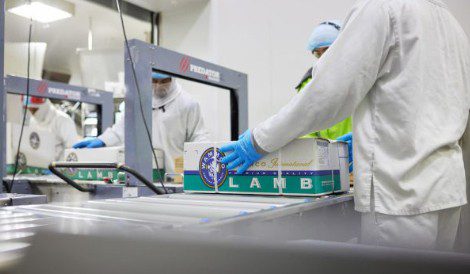
New research has attributed a more accurate carbon footprint to boxed sheep meat. Image – WAMMCO.
A NEW data framework has estimated the carbon footprint of boxed sheep meat to be half that calculated using current methods.
The new framework, developed by Integrity Ag, enables state-level reporting of product carbon footprints for beef, and introduces national estimates of land-use and statistical land-use change (sLUC) emissions attributable to beef, sheep meat and wool.
It also includes new indicators, such as freshwater consumption for sheep and carbon footprints for boxed beef and sheep meat at the commodity level.
A research project to develop the data framework was co-funded by the Australian Meat Processor Corporation, Australian Wool Innovation and the Department of Agriculture, Fisheries and Forestry.
AMPC program manager sustainability Matthew Deegan said it is the first time the industries have been able to calculate emissions at the product level, right to the point of sale.
 “It gives processors a stronger social licence and greater credibility by showing that we are applying science-based, transparent methods to measure and improve performance.”
The study’s results show improvements across all reporting areas. The carbon footprint of beef (live weight) decreased by 4.7 percent compared to the previous reporting period in 2020, down to 12.1 kg CO2-e per kg of live weight and 11.9 kg CO2-e per kg liveweight when dairy beef was included, while sheep meat saw a 7pc reduction to 6.8 kg CO2-e per kg live weight, and wool also decreased 7pc from 26.3 to 24.5 kg CO2-e per kg greasy weight. Boxed beef and sheep meat were reported for the first time, providing a critical benchmark for processors and producers.
The research found that industry-specific, science-based methodologies can produce more accurate emission estimates than global models. For example, boxed sheep meat emissions measured in this project, 15.1 kg CO2-e/kg, were significantly lower than the FAO’s 2024 estimate of 32.4 kg CO2-e/kg1.
Integrity Ag chief scientist Dr Stephen Wiedemann said the work represents significant progress for industry, providing the product-specific emissions results needed for benchmarking value chains, complementing the national inventories’ net emission accounting methodology.
“We are pleased to have developed the capability to attribute land use emissions as required under SBTi’s FLAG target reporting, as well as enabling a more frequent reporting period to communicate industries’ emissions reduction progress.”
AWI program manager eco-credentials Angus Ireland said the importance of accounting for both sides of environmental impact cannot be overstated.
“This project has not only improved the accuracy of GHG emission reporting for wool but also evidences the significant GHG removals arising from regeneration of forest woodlands in Australia’s sheep zones.
“AWI will now progress the incorporation of this improved data in the ‘Wool LCA Dataset’, which it makes freely available to the market, as well as emerging textile rating schemes in France and Europe,” he said.
“It will provide the evidence base needed to promote reporting of not only emissions in such schemes but also the removals – thereby more accurately reflecting the complete picture of sheep farm impacts.”
Mr Deegan said the improved reporting calculations and methods will support the red meat processing industry, with new regulations under the Australian Sustainability Reporting Standards (ASRS) requiring processors to report their Scope 1, 2, and 3 emissions over the coming years.
Dr Wiedemann said the new data framework has implications for national and international sustainability reporting, so it is appropriate to engage with bodies such as FAO regarding their model assumptions and the significant differences in the results.
“AMPC is looking to collaborate with FAO and other bodies further.”
He said industry continues to be proactive in working with government and science partners to develop the best industry and country-specific methods for accounting.
“There are some priority areas, including biogenic carbon accounting and removals accounting.
“Improving our understanding of required methane reductions to meet policy targets is also a priority,” he said.
“It is particularly concerning that some international assessment frameworks, such as the PEF program in the EU, do not allow removals accounting.
“This is a moving space at present, and industry continues to support research, method development and case studies that demonstrate best practice,” Dr Wiedemann said.
“Beyond working on science outcomes, there is a role for advocacy from the relevant groups where domestic and international policy is concerned.”
For more information about the new framework, visit the AMPC website: https://ampc.com.au/research-development/sustainability/sustainability-uplift-report/
HAVE YOUR SAY