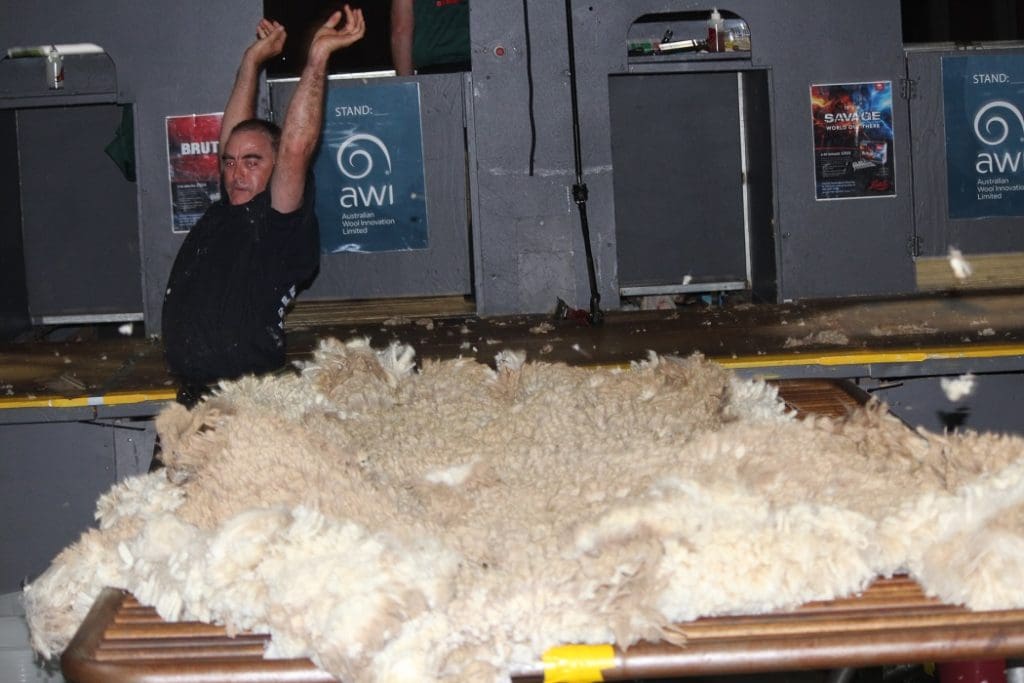
Mark Purcell throws another fleece on his way to victory in a previous open wool handling final at Bendigo.
SHEARER and wool handler entries at Australia’s premier sheep and wool show are struggling this year despite an increase in prizemoney.
Northern Shears president Adrian Tuohey said shearer entries are down by about half and by two thirds for wool handlers, for the Australian Sheep and Wool Show on 17-19 July.
Potential reasons for the entry decline include a lower national sheep flock, travelling and accommodation costs, and the movement of the Victorian shearing championships from Bendigo to the Geelong Show on 15-18 October.
Shearers and wool handlers would traditionally travel to compete at Bendigo to gain selection for the Victorian teams to compete at the next national championships in Geelong. However, competitors at Bendigo this year will still accrue points on Saturday and Sunday for state selection in the 2026-27 season.
Mr Tuohey said with the loss of the state title events, the Bendigo organising committee is now running its Northern Shears event with Merino sheep on Saturday with $15,000 in prizemoney, and a crossbred sheep/wool event on Sunday with $10,000 prizemoney will honor shearing legends John and Mark Conlan who started Sportshear Victoria.
“We’ve even tried to attract the people who only want to shear crossbred and there is still no influx of entries,” Mr Tuohey said.
“And we’re $10,000 (in prizemoney) higher than last because we’ve got two events.”
Mr Tuohey said entries close at Bendigo in 2.5 weeks and the committee is hoping that there will be a late influx of entries to kick off the first shearing/wool handling competition in the 2026 calendar.
“We’re the first event of the calendar year and last year we had 107 shearers and wool handlers.
“This year we’ve got 30 shearers and wool handlers entered,” Mr Tuohey said.
The entries so far include about 15 machine shearers, five blade shearers and ten wool handlers.
Click here for entry details for the Northern Shears and Conlan Bros events.
Travel costs, state selection and a lower flock are factors
SCAA Shearer Woolhandlers Training chief executive officer Glenn Haynes said the drop in the national sheep flock has meant an estimated 20 percent fall in demand for shearers and wool handlers.
But he said shearers and wool handlers would also be considering the cost to travel and stay in Bendigo to compete in events that this year do not count toward state selection. He said most accommodation providers now require payment for a minimum of two nights.
“It’s a very very expensive little episode at the moment and there are a lot of young people who have not been working due to the sheep numbers and are very low on money.
That’s the main reason and the other reason is the state titles are not being held in Bendigo.
“So all of the young ones in the shearer and wool handler development teams – eg novice, intermediate and senior – a lot of them won’t go across to Bendigo because there is no selection events there this year to make the state teams – they will go to Geelong instead.”
Mr Haynes said there has been a drop in demand for shearers and wool handlers due to the smaller national flock. He said workers who are prepared to travel and organize positions early have been able to maintain full employment.
He said some workers have also gone elsewhere for constant work.
Mr Haynes estimated last year that the industry would lose 20pc of its wool handlers – and most likely the good ones, who are money-smart good ones and need consistent work to pay off mortgages and vehicles.
“And I reckon we weren’t far off it, but the shearers hung in there.
“This year there will at least be the same amount of wool handlers leave, but I reckon there will be the same amount of shearers leaving too – 15-20pc – heading off and doing something else.”
The shearing industry workers have headed into mining and energy labouring and manufacturing jobs, he said.
“Whether they will come back, will be another thing.”
Mr Haynes said the training organization and the National Wool Harvesting and Training Advisory Group are keeping a close watch on the industry’s labour requirements in each state.
“So we’ve got an idea of the sheep numbers in every state, what type of sheep and how many people do we need to be training.”
He said the number of shearer schools have been reduced nationally because the industry did not want to be training people that would not get a job.
“But we still want to train people who are definitely going to go into the industry.”
HAVE YOUR SAY