
AUSTRALIA’S biggest sheep state, New South Wales, is one of three states yet to mandate pain relief for mulesing with its farmer body stepping back from 2019 commitments to the practice.
Victoria and Tasmania have mandated pain relief for mulesing, Western Australia’s government recently indicated it would also follow and the South Australia’s peak farmer body Livestock SA claims government support for regulation.
But the state farming organisations of NSW and Queensland continue to oppose mandating pain relief for surgical breech mulesing of lambs to help prevent flystrike.
The NSW Farmers stance on pain relief for mulesing has changed significantly since 2019, when a survey found more than 80 percent of respondents supported mandating pain relief for mulesing.
This was followed by a motion carried at the 2019 annual conference, supporting “the mandating of local anaesthetic/analgesia during mulesing through an industry-led initiative.” However, a subsequent move to legislate a pain relief mandate failed after it was associated with a proposed ban on mulesing.
At the 2025 NSW Farmers conference, a motion signifying a lack of resolve to support mandating pain relief for mulesing was carried.
“AWO1 provides support for pain relief provision in line with industry best practice, as no industry-led initiative for mandating pain relief when mulesing has been developed.”
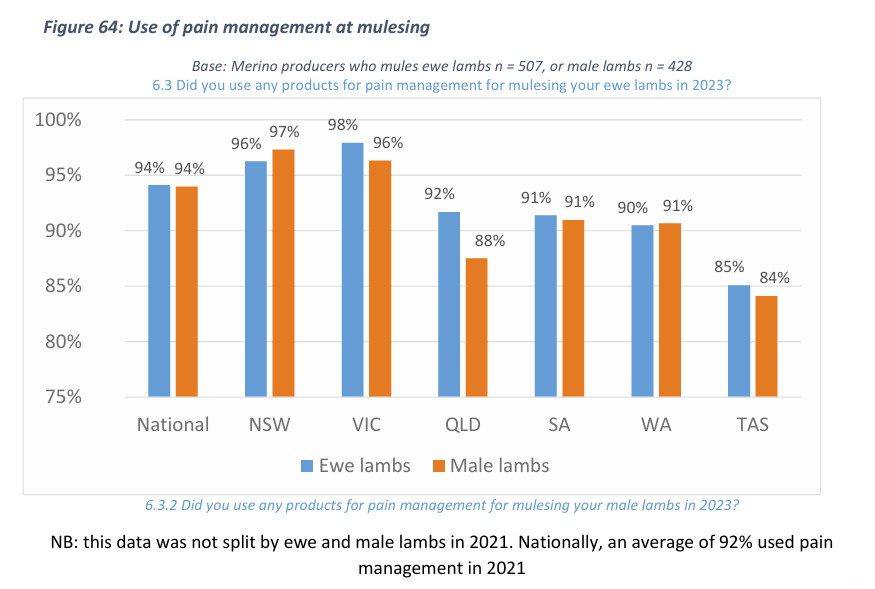
When asked what had driven the change in policy and whether it was true that NSW Farmers believes that market forces should decide whether pain relief is used for mulesing, and despite a 2023 survey indicating 95pc of NSW producers responding to a survey (see table below) used pain relief when mulesing, an unidentified NSW Farmers spokesperson said:
“NSW Farmers recognises consumer demands may influence on-farm practices in Australia; this is a production consideration for individual farmers.”
AgForce opposes regulation of pain relief use
In Queensland, AgForce Sheep, Wool and Goat president Boyd Webb said AgForce SWAG recognises the use of pain relief as best practice when mulesing, and we strongly encourage all producers to follow best practice.
“However, we oppose any further government regulation on this matter.
“There is already a high uptake of pain relief within Queensland.”
Figures released by Tri-Solfen developer Animal Ethics in 2014 show pain relief use for mulesing was highest in South Australia, and lowest in Queensland. The state use figures released by the company were: SA 82pc of lambs received pain relief; Victoria and Tasmania 72pc; NSW 65pc; WA 55pc and Queensland 16pc.
Sheep Central has asked for more recent evidence of the uptake of pain relief for mulesing among Queensland sheep producers.
In Australian Wool Innovation’s Merino husbandry practices survey, 94pc of respondents who mulesed in 2023 used pain management for male and female lambs. Of those using pain management at mulesing, 93pc used an anaesthetic and antiseptic spray such as Tri-Solfen at the surgery site. Of the Queensland producers who responded, 88pc said they used pain relief.
According to the Australian Sheep Sustainability’s 2025 report, in 2024, 89.7pc of Merino producers responding to a survey said they used appropriate pain relief and 96.2pc of non-Merino producers claimed the same. No 2025 data is available.
SA Government committed to mandating pain relief – Livestock SA
Livestock SA chief executive officer Travis Tobin said the body has held a clear position on supporting the mandatory use of pain relief for mulesing since 2020, to ensure that the procedure can be done in accordance with the highest standard of animal welfare.
“That decision followed strong feedback from producers, with close to 70pc of surveyed members supporting mandatory pain relief.
“Since then, we’ve consistently advocated for this position,” he said.
“We secured an initial commitment from the South Australian Government to consider this as part of broader animal welfare regulatory updates.
“However, following the 2022 election, the incoming Government placed a pause on amendments while undertaking a full review of the Animal Welfare Act,” Mr Tobin said.
“Livestock SA’s view remains unchanged: pain relief during mulesing is best practice, widely supported by producers, and should form part of modern, practical animal welfare regulation.
“The government has verbally committed to supporting our policy position and including it in the new Animal Welfare Regulations.”
WA Government is drafting pain relief legislation
Last month in Western Australia’s Legislative Council, in response to a question from Animal Justice Party MP Amanda Dorn, Minister for Agriculture and Food Jackie Jarvis said the WA government is drafting regulations under the Animal Welfare Act 2002 on sheep welfare based on the standards in the Australian Animal Welfare Standards and Guidelines for Sheep.
“These regulations will include requirements relating to mulesing, including the provision of anaesthetic and analgesic in certain circumstances.”
Ms Jarvis said the WA government recognises the significant impact flystrike has on the WA sheep industry and the importance of reducing risk.
“In 2008, the then Department of Agriculture and Food WA was the first research institute nationally to cease mulesing on its research and commercial flocks.
“Since then, the Department of Primary Industries and Regional Development has been actively involved in researching practical methods such as tail docking, chemical application, time of crutching and shearing, and genetics as well as extension activities to help producers manage flystrike and non-mulesed sheep,” she said.
“DPIRD continues to strongly recommend that a registered pain relief product be applied when mulesing.
“In 2022, 90pc of Merino lambs that were mulesed received pain relief.”
The banning of mulesing is inevitable. The dinosaurs that are representing the wool industry will be remembered as those who resisted better on-farm practice and who held the industry back for way too long.
Unbelievable, the dinosaurs with vested interests leading the naive, like lemmings to a cliff. These people live in a parallel universe, disconnected from the reality
of evolving consumer expectations.
It’s no skin off the grower’s nose, but why the indifference to pain for the sheep?
In time, the abolition of mulesing will be inevitable along with mandatory painkillers meanwhile.
Get real.
Hi Andrew,
The Australian wool industry should never expect any reforming leadership out of NSW on anything. For example, where did the rot begin with the collapse of Reserve Price Scheme? Failure to create a non-mulesed Merino? And the current hot top topic of rationalisation of wool selling centres?
NSW has though produced numerous interesting wool industry characters: Peter Taylor, Wally Merriman, and Jock Laurie are three that come immediately to mind.