
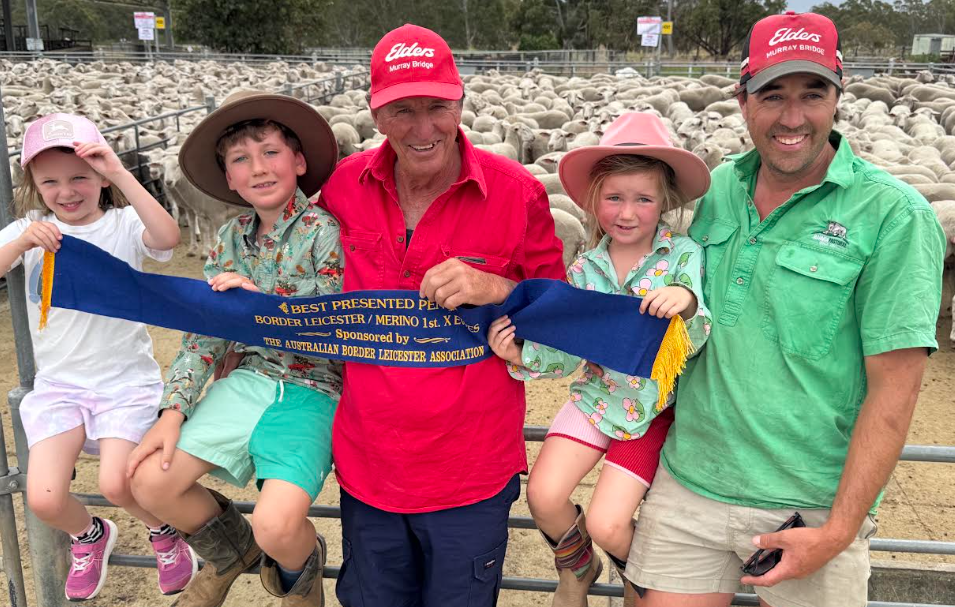
Holding up the blue ribbon for best presented pen at Naracoorte were, from left, Daphne Ellis, Maverick Farley, Ian Farley, Harriet Farley and Dale Farley.
NARACOORTE agents yesterday sold first cross ewes lambs to $462 at yesterday’s blue ribbon sale, but there were plenty of sub-$400 replacement opportunities for producers aiming for an early 2027 joining.
The entire yarding of 28,533 lambs sold for an average of about $354, to mainly repeat local, and south-west Victorian buyers, with few newcomers.
Most 55-65kg liveweight lines made $415-$450, with 50-55 lambs ranging from $370-$410, 40-50 lines$290-$360, and the sub-40kg lambs sold generally from $232-$270.
Jabuk specialist first cross ewe breeders – I.L. & P.J. Farley/Marmon Hill – topped the sale in the Elders run with their ‘best presented pen’ of 130 March-April drop 65kg ewe lambs that sold for $462 to Elders client Blackwood Park.
This equaled the South Australian record, but was well under the $595 paid for ewe lambs at Bendigo earlier this month.
Dale Farley said the family was “over the moon” with their prices, with about 2425 ewes averaging $396, which was best they have achieved.
“It was fantastic to equal the state record and those ewe lambs were probably good value for money when you compare them against the 1.5 year-olds sold the week before.”
After the top pen, the family sold ewes in runs of 215-574 that averaged over 50kg lwt, that made $370-$384.
“I think anyone who bought them got exceptional value, because I think if those had been in the middle of the sale they could have pushed to $400 or more.
“We actually think they were the best sheep we’ve ever had.”
However, despite topping the sale, Mr Farley said the mixed farming enterprises costs are as high as they’ve ever been.
“You need that extra money to be making the same amount of money.”
But Mr Farley said he and his father agreed that they had to “ride the waves, the ups and downs,” to ensure there were sheep for repeat buyers.
“If you go out of it for a year, it might take you 10 years to build your reputation back up, that you are going to be there.”
Mr Farley said the Marmon Hill ewe lambs were weaned onto lucerne pastures and didn’t need as much grain keep them going.
“Ninety percent of what they had this year was paddock feed, good hay and good mineral supplements.”
Mr Farley said he was confident in the future of the first cross ewe, but good big lines of Merino ewes were getting harder to find.
Other Naracoorte agents also topped $430 with several pens, including PPH&S client Wheaton Farms 80 ewes for $450, 103 Farmers Leap ewes for $446 and Z.L. & K.L. Auricht with 194 April-May drop lambs for $444. Southern Australian Livestock sold first line of 140 Altus Pastoral ewes for $452 and a second line of 150 for $448.
Prices up $50, but below expectations
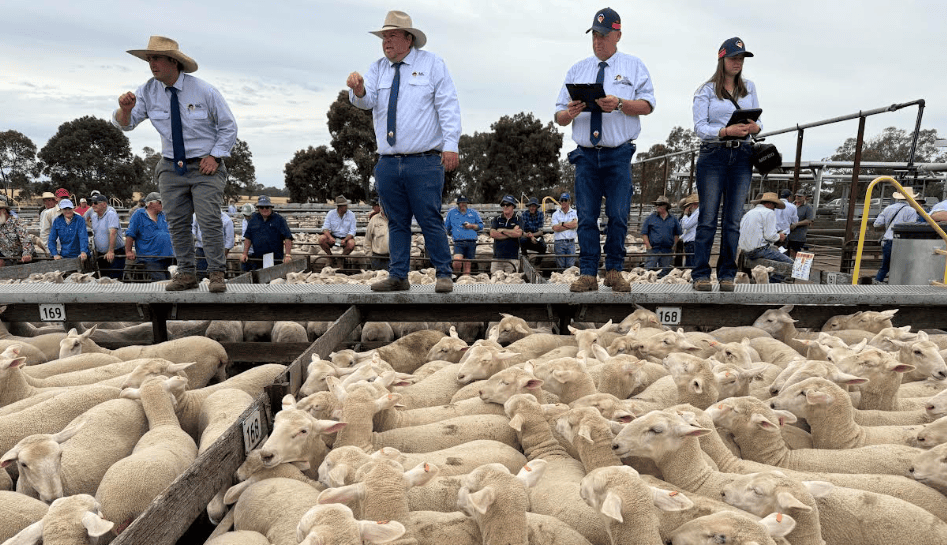
The SAL team sold ewe lambs for up to $420 at Naracoorte.
Southern Australian Livestock Naracoorte livestock manager Will Nolan said the agency yarded the biggest breeder lines of ewe lambs, with about 2830 from local breeders F.B. Lock and Sons that averaged $350 and topped at $420.
Mr Nolan said the agency was happy with the prices for the top end ewes, though expecting more money.
“But we had a very good run of 40-45kg lambs, I thought we were really strong with them, and some of those 35-40kg lambs I thought they were probably cheap enough.”
“Everything else was probably about $50 up on last year – those heavier and mid-weight lambs – but those lighter lambs, if anything, could have been cheaper than last year.”
Mr Nolan said the prices paid reflected the competitive situation with composite ewe sales.
“We are competing now in a market that’s probably got half the amount of buyers because of other breeds and more crop being sown.
“There are also less traders now that are willing to hold the same animal for 12 months as opposed to a terminal that you might only have to hold for 3-4 months,” he said.
Reflecting on the opportunities to put away the lighter ewe lambs for 2027 sale or joining, he said: “Any sort of female in your paddock is a good female and it’s certainly going to be viable and always will be because there are certainly a lot less ewes about the place.”
He said first cross ewes are valuable because they can produce an export weight and quality lamb on grass.
“It’s higher than it ever has been before, but it’s about where it needs to be and there were certainly buyable areas in the sale, so everyone got a chance.”
Good value for those with money
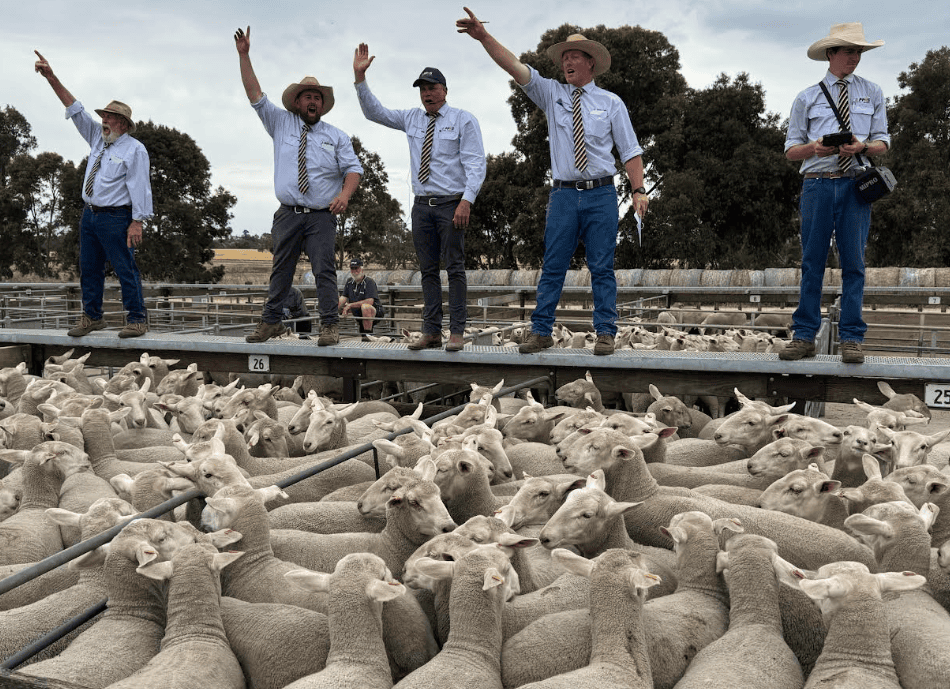
The PPH&S team sold ewe lambs for up to $450 yesterday.
PPH&S director Robin Steen said the agency had a fantastic early sale, but his fellow agents said rates tailed off as the lambs got lighter.
He said PPH&S’s biggest strength was the agency support for its clients. He said for established producers prepared to pay $380-$420 for ewe lambs — having sold a $240 cast for age ewe and $$250-$300 lamb – the sale provided good changeover opportunities.
“The biggest issue I saw is that no one has any money; they are still catching up from two years ago.
“So if you want to super-optimistic, I would have thought all of our heavy ewe lambs should have been making $40-$50 more,” he said.
“As the sale went on there was really really good value for people.”
He said PPH&S averaged $379 over its sale for almost 10,000 ewe lambs and $380-$400 ewe lambs were good value, especially under good management to achieve marking rates of 100-110pc.
Digby producers average under $400 for replacements
Digby producers Heath and Harry Goodman at the Naracoorte sale.
Heath and Harry Goodman from Digby bought 720 ewe lambs through SGL Hamilton at the sale for an average of $389.90.
“I had hoped to buy them under a $400 average, but I didn’t expect to; I was thinking I was going to be spending $420-$430,” Heath said.
“I’d say they were pushing 50kg (average liveweight),” he said.
“There were plenty of ewes there that would do the job for you.”
He said the ewe lambs would get some special treatment before joining in late January next year.
“We always try to stick to around that weight and I normally mark about 100 percent lambs out of my ewe lambs.”
Sale values under expectations
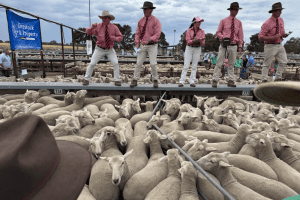
The Elders team selling the Marmon Hill ewe lambs.
Elders sold last on the day and auctioneer Tom Dennis said the sale got cheaper as the sale went on.
“I reckon we were $40 cheaper on the restocker lambs (at $220-$270) than earlier in the day.”
Mr Dennis believed the sale was below agent’s expectations.
“It just didn’t have any heat in it, it sort of bumped along.
“Everybody had their limits and it was very sensible, very measure, no mania,” he said.
This compared to the frantic bidding at earlier first cross sales at Corowa in October with 1.5 year-old ewe making to $641, and at Bendigo this month when a national record of $595 was paid for ewe lambs.
“People came with $550 and ended up spending and ending up spending $580, whereas I’d say they came with $470 yesterday and ended up paying $430.”
He said there were agents there that rang clients who had decided not to come to the sale expecting it to be dear, but then bought ewe lambs for the producers.
“It was that sort of day.”
Mr Dennis said the sale prices reflected that producers had their budgets and were sticking to them.
“They would rather not run sheep if it’s any more than that and they’ll do something else.
“”We’ll run sheep if there is a quid in it, but if there is no quid in it, look out.”
Mr Dennis said processor comments of poor trading conditions “is very dangerous talk if we want to have a future while we are rebuilding.”
“I understand there is a red number for processing at the moment, but there was a pretty green one two years ago.
“Let’s just be careful about how we talk about the sheep and its future and let’s talk about what’s sustainable while we are rebuilding,” he said.
“While we are rebuilding, you have to reward those that want to go again, rebuild or expand, or buy the neighbour’s and run sheep on it and employ extra staff.
“You’ve got to reward those people and they need to be able to say to their accountants and their family that they are doing the right thing.”
HAVE YOUR SAY