
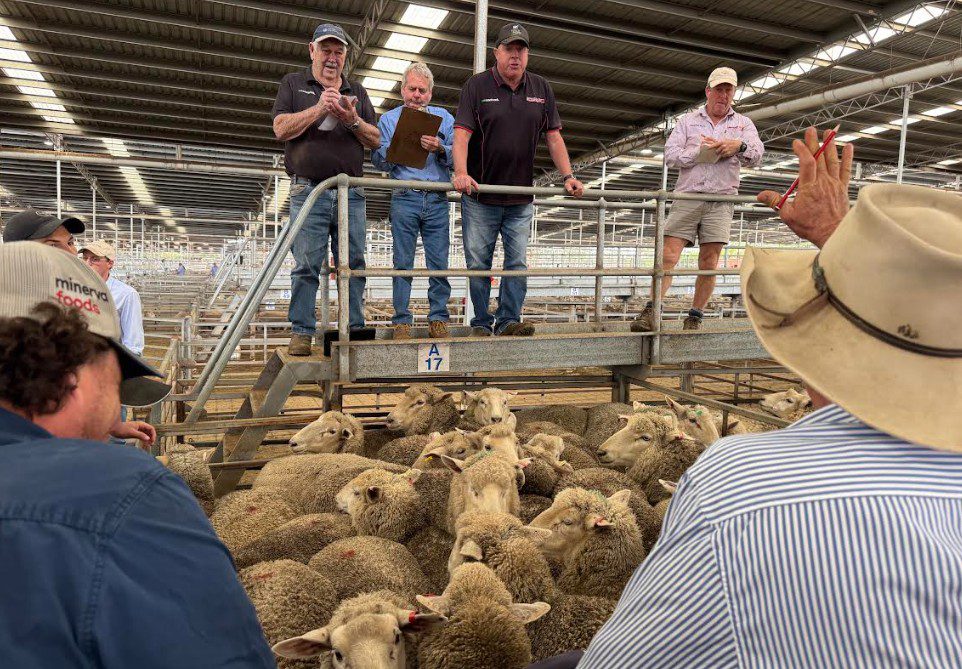
Sheep and lambs are selling for record prices in Australia’s saleyards.
MUTTON prices have hit record levels – averaging above $9/kg cwt and up to $10/kg in some saleyards this week – but there are doubts this can be sustained with supplies scarce and processors already planning for possibly extended winter shutdowns.
Slaughter and export data, and industry feedback, indicates recent mutton price levels have been driven by some exporters seeking to maintain smallstock shifts, but also by demand for premium young mutton at a price point still under lamb values.
Meat & Livestock Australia’s mutton indicator peaked at 889ckg today, closing 34 cents higher than a week ago, and more than 200 cents higher than a year ago.
Stock agents said lamb prices are driving stronger demand for breeding stock – with scanned in-lamb ewes making more than $400 — restricting mutton turnoff, and a lift in wool prices is changing decisions about retention of Merinos. Improved skin prices have also been a factor in higher lamb and mutton prices.
Global AgriTrends analyst Simon Quilty said mutton exports have been dropping to some markets since the Middle East conflicts began earlier this year due to logistic issues and pricing.
However, he said some markets still regard Australian mutton at the higher price levels as a cheaper protein source than lamb and beef.
Elders Bendigo livestock manager Nigel Starick attributed the recent mutton prices to a shortage in supply while processors still had orders to fill, but he was unsure if it was sustainable with some processors going into winter maintenance, possibly for 2-3 weeks.
“So it might only be short-lived to a degree, but it has been at 800-850c/kg for a while and now it has jumped up to $9; I think it is just a true winter situation coming through.
“But if a few plants start to shut down it will be interesting if that will have an effect on it or not.”
Mr Starick didn’t believe the high prices were dragging more sheep onto the market, with Bendigo’s lift in numbers this week attributed to the lack of a sale on the 8 June King’s Birthday holiday in Victoria.
“I don’t know whether they are there, if there any extras to drag out.”
He said lamb prices have also found a new level, and some plants have no killspace available for lambs until July, while some processors have full feedlots and are stocking their pastoral country to guarantee future supplies.
Mr Starick said skin values have increased, but crossbred prices varied by up to $4 between some abattoirs, and Merino skins could be worth $30-$40 depending on the wool length.
VC Reid and Son agent Scott Reid at Forbes said he had never seen mutton prices so high, with some lighter sheep making $10/kg cwt this week and most at $8.50-$9.50/kg cwt, though he doesn’t think the prices are sustainable.
“We had a hatful of heavy full mouth crossbred wethers make $378.”
He said the lack of processors complaints about the high lamb prices indicated they were able to “sell it out the other end.”
“I do think they are trying to top up their kills with mutton to keep their numbers up because the lamb numbers have come back so much, but I think they would to pull the market back a bit.
“It has flushed a lot of sheep out of the system over the last few months, so I think they are going to get very short now; coming into the late winter/spring you are not going to see many old sheep about.”
Mr Reid said producers have been down in sheep numbers because of the dry conditions, but with recent rain the tendency was to retain sheep because it was expensive to restock.
He said at least one processor has indicated they will have four weeks off for winter.
“But whether it has an effect on the mutton job, it’s going to be interesting, but I don’t think it will have too much of an effect.”
The skin job has “gone through the roof”, Mr Reid said, with some 15-16kg cwt crossbred lambs that made $180 with a two-month skin that processors valued at $12-$15.
“Everyone wants to keep their shed going at capacity, but the trouble is the numbers of sheep and lambs are starting to get less and less – they can only do it for so long.
“The lamb job here today was extremely good, but it’s not getting dearer – depending on numbers I can see it firming out or getting a bit cheaper …. but don’t get me wrong it’s still bloody good.”
Dubbo stock agent Andrew Peadon said there is a shortage of sheep with some processors trying to supplement lamb kills.
“I think the shortage of sheep might be long-lived because too many people have gone out of breeding Merino sheep – that’s where it all starts – just too many people have walked away from it, and the sheep are just not there.
“The problem will be long-lived, but I am not sure how the price is going to go though.
“It’s a culmination of wool markets, sheep and lamb prices over previous years and the younger generation not wanting to do the sheep work and not get rewarded for it.”
Mr Peadon believed there might be a flush of sheep onto the market in the new financial year.
“But after that it will be pretty interesting to see how it all goes.
“Supply is at an all-time low, but I don’t think the processors can sustain the mutton price, so something is just going to have to give.”
He has heard that some processors are considering longer winter breaks with a few are working below capacity with more days off for workers.
“I think that has already started; they are having days off because they haven’t got numbers there to kill.
“I think the winter break has already started for some.”
Mutton export volumes are down this year
Australia’s main mutton markets by volume have been China, Malaysia, the United States and the Middle East, but Mr Quilty said global exports have been declining each month this year – totaling a 32pc drop this year — because of a lack of supply.
There were sharp declines in beef, lamb and mutton shipments into the Middle East in March, after the start of the US/Israel-Iran conflict in January-February. But beef shipments are now exporting at higher levels into the Middle East than before the US/Israel-Iran war, lamb shipments have recovered to 80pc of pre-war monthly shipments of about 5000 tonnes (to 3900 tonnes) but ME mutton volumes have not been recovered, with a 44pc fall.
He said this indicates a far greater reliance on shipping for frozen mutton, whereas chilled lamb and beef have benefited from a recovery in the airfreight market.
“But tightness of supply is crucial and I think that as what is keeping mutton prices elevated.”
Mr Quilty said Middle East mutton shipments have traditionally made up 27pc of Australia’s exports — and despite pricing and logistical issues — this has stayed constant, indicating overall global exports are down. He said China remains a crucial mutton market, but shipments have fallen by 27pc.
“I think what we are seeing is that a general lack of supply is the real driver here.”
Since February, American monthly mutton shipments have held steady, but represent only 7-8pc of Australia’s exports. Asian mutton shipments, including Malaysia, have also declined.
However, Mr Quilty said mutton is still regarded as a cheap protein in some markets even at the current price levels.
“They’re price sensitive markets, but if you look at where lamb is at, lamb is still considerably higher in price and I would say that mutton provides a cheaper alternative in the sheep meat world for customers.
“I would argue that pork and chicken is genuinely cheaper in places, but for certain markets and diets they are looking for sheep meat and mutton provides a cheaper alternative to lamb.
“But it’s really clear that certain markets haven’t been able to keep place as well and the overall volume into those markets has suffered and many parts of Asia has shown that – Asia overall is down 25pc.”
Mr Quilty said Australia’s smallstock slaughter — mutton and lamb – has been dropping since February, from 610,000 to 505,000 per week in May.
“An 18 percent fall in that overall numbers obviously transpires into that 32pc fall in mutton exports.”
Mr Quilty said based on normal supply trends any meaningful increase in mutton supply is unlikely to occur until the last quarter, from September on.
“But it will be at a significantly reduced amount.”
Mr Quilty said he has re-adjusted mutton slaughter slaughter predictions with the further liquidation late last year and in the first quarter this year.
“I think the low in the mutton kill will be next year and it will come in at 7.5 million or thereabouts, which is well below the peak of 2024, which was 11.7 million – a 36pc drop because of the exodus of many wool growers out of the system.
“In terms of the challenges for processors, this continues into next year, well into 2027.”
He believes lamb slaughter will also be down next year, but not as dramatically.
“I think lamb will be down to closer to 19.3 million next year, down from the high of 2024 of 26 million.”
He expects mutton prices will settle next year at a higher average level than this year, about 5-10pc higher.
“So the rate of (mutton price) increase is slowing, the low in supply is next year and compared to the 30pc rise in prices this year, next year is far more moderate in the range of 5-10pc.”
Premium young mutton market developing
Processor feedback indicates that as well as the premium hogget mutton market, there is also a developing market for young mutton under 24 months of age with a grid price of up to $9/kg for export into the Middle East.
The gap between the premium young article and the older mutton price has closed recently to about $1/kg as supplies tightened, but one processor said lamb prices have increased interest in mutton as a sheep meat option in some markets.
“It’s an emerging mature market, and it may be replacing what they were accustomed to getting with live export now with the cold store chain development.
“The price too allows them to have a step up from mutton.”
The processor suggested the live export of lamb and younger sheep into the Middle East might have created a taste and demand for younger mutton, and outside the traditional religious festival demand.
“So they are accustomed to consuming a younger sheep.”
The processor said Middle East sheep meat consumers are more price conscious compared to those in other more affluent countries.
The young mutton demand gives those in the wool market an option to cut a two wool clips – as a lamb and hogget — before slaughter under two years-old, he said.
HAVE YOUR SAY