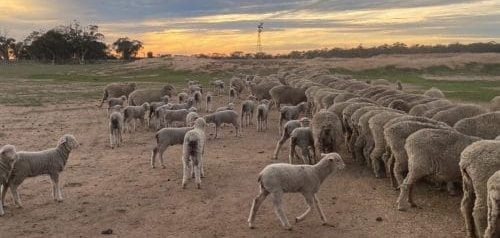
Mulesed Merino lambs with their mothers, Image – The Livestock Collective.
A RENEWED call by animal protection groups for a legislated phaseout of mulesing has been rejected by peak grower body WoolProducers Australia.
Ten animal protection bodies this stepped up their campaign against the mulesing of sheep, outlining an open letter campaign to state and federal governments to legislate a phaseout of the practice they call live animal cutting by 2030.
The 10 groups claim that while Australian industry leaders bicker and squabble, and the Federal Government has ignored its critical role in protecting animals, supporting farmers, and safeguarding trade. Mulesing is the surgical removal of excess skin around the breech of a lamb to prevent flystrike.
The Australian Alliance for Animals, FOUR PAWS, Humane World for Animals, Animals Australia, Animal Kind, Sentient, Voiceless, World Animal Protection and ‘Til The Cows have asked state and federal governments to:
- Commit to an expedited review of the Australian Animal Welfare Standards and Guidelines for Sheep, with a clear mandate to legislate a phase-out of live lamb cutting;
- Legislate a phase out of live lamb cutting by 2030 at the state and territory level and;
- Support wool growers to transition away from live lamb cutting through the use of genetics, ensuring they are not left exposed to global market risks.
However, WPA chief executive officer Jo Hall said WoolProducers rejects the call by the animal rights groups for government intervention on mulesing because the industry is ‘bickering.’
 “In all my time in industry I have never seen the industry more unified on the issue.
“We have collaboration from representatives from the production, broker and exporting and processing sector calling for a strategy to be developed for mulesing and also have agreement from Wool Industries Australia, who represent these sectors along with the service providers AWEX, AWTA, AWI and AWH, to consider a proposal to host a workshop/forum to develop this strategy,” she said.
Ms Hall also said the term ‘live lamb cutting’ is not only inflammatory, but factually incorrect and deliberately designed to mislead the public.
“It is a made-up term used by these groups to get headlines and reflects the seriousness in which these groups should be taken by government and the trade alike.
“For groups calling on legislative reform you would think that they would use terms actually found in legislation, not fictional terminology.”
Ms Hall said WoolProducers welcomes constructive dialogue and evidence-based policy development on this issue.
“However, we reject sensationalist campaigns that undermine the hard work of Australian wool growers and misinform the public – we trust that governments both at a federal and state/territory level do the same.”
Ms Hall said WoolProducers for years has been seeking the revision of the Australian Animal Welfare Standards and Guidelines for Sheep to ensure currency and a requirement for pain relief application for mulesing.
“However, it is stuck at the Animal Welfare Task Group (AWTG) level where it has sat on its work plan for a number of years, with no jurisdiction willing to lead this work.”
Animal protection bodies call for leadership
In their open letter to all Australian state and territory Agriculture Ministers and the Federal Minister for Agriculture, the animal protection bodies call for leadership in the transition away from live lamb cutting.
“Australia is now the last country in the world still routinely mutilating lambs in this way.
“That’s not leadership, that’s a national failure,” they said.
The groups said global brands like H&M, Nike, Zara and Australian brands like Country Road, and Target have already turned their backs on wool from mulesed sheep. They said consumers are demanding better and markets are shifting.
“And still, Australia clings to a practice that’s not only cruel but economically reckless.”
FOUR PAWS Australia programs lead Louise Ward said: “Every year we hear the same excuses, while millions of lambs continue to suffer.”
“The wool industry has had more than two decades to act, and the government has had every opportunity to lead.
“The solution already exists and thousands of producers are doing it – successfully breeding plain-bodied, flystrike-resistant sheep,” she said.
“Yet instead of supporting this transition, governments have chosen delay and deflection.
“It’s time for decisive action, not more broken promises.”
Ms Ward said 21 years of broken promises is 21 years too many.
“If the government won’t lead, then it’s time for the public and the global market to force their hand.”
Program manager for animal welfare at Humane World for Animals Georgie Dolphin said calls for an end to live lamb cutting have never been stronger.
“Phasing out this socially unacceptable lamb mutilation in favour of the proven solution — breeding plain-bodied sheep with natural flystrike protection — would end this.
“Governments must step in before millions more lambs needlessly suffer this outdated practice that sets Australia apart as the only country producing the most painful wool in the world,” she said.
Government pressure needed on AWI to help growers transition
The Australian Alliance for Animals, FOUR PAWS, and Humane World for Animals Australia said they are in ongoing discussions with federal and state MPs – including members of the government, opposition and cross benchers about the urgent need for legislative reform to end mulesing or live lamb cutting.
“These discussions include proposals to strengthen the Australian Animal Welfare Standards and Guidelines for Sheep, as well as the potential for standalone legislation to phase out live lamb cutting within each jurisdiction.
“A review of the national standards is also on the Animal Welfare Task Group’s agenda as a priority,” they said.
“Momentum is building and there is growing political interest in addressing the animal welfare, economic and trade risks of this long-standing issue.”
The bodies also said as an interim measure, they support the Federal Government applying pressure on Australian Wool Innovation to redirect existing funding away from “failed and costly distractions like vaccines and sterile fly research.”
“Instead, those funds should be invested in practical, proven solutions that help wool growers transition to plain-bodied, flystrike-resistant sheep.
“If this shift in investment had occurred years ago, the Australian wool industry would not be facing the reputational and market risks it does today,” the bodies said.
“Ultimately, while interim steps are welcome, they must be part of a clear and time-bound pathway to a state-based legislated phase-out of mulesing.”
Keep the mulesing as it saves thousands of sheep from flystrike ever year. It is a blessing we do this to stop blowfly strike. I’m an ex-farmer and the do-gooders don’t have any idea how much this save the lives of thousands of sheep each year. I wish they had to go and treat the fly-blown sheep and see the agonizing death the maggots cause; then they would realise how wrong they are trying to shut down mulesing.
Having been in the sheep and shearing industries for a very long time, I would prefer a little piece of skin to be removed than have a million maggots eat an animal to death.
Do not talk about something you know nothing about.
The Merino industry has lacked positive leadership for many decades.
It has failed to read the market signals and has continued on a path that has seen a supply collapse with people exiting Merino sheep and wool production.
However, a group have modernised their flocks and are now running a modern Merino. A Merino that is meeting the market with a product that the market wants.
Whilst doing this they are still required to pay a levy to AWI.
It is time for the industry has a close look at itself as organisations are failing and in such markets and supply are being lost.
The bright side is that the work has been done to provide the future and to breed highly productive Merino sheep that don’t need to be mulesed and that meet the market needs with the product that it wants.
Peter Small and Andrew Farran comments are very accurate. The issue of mulesing is always associated with the wool industry. MLA’s recently released final report , “Supporting sheep producers transition to non-mulesed sheep” clearly states “ The practice of mulesing, to reduce susceptibility of sheep to breech flystrike, represents a significant welfare issue that is becoming less acceptable by retailers and consumers. This is an issue for both the red meat and wool industry.”
The sheep industry seriously lacks leadership on traceability and trust on the issue of mulesing and pain relief management.
I feel the headline of this article is misleading. Editor’s note: The original headline read: ‘Mulesing phaseout call rejected by WoolProducers Australia.’
What I have said is that the industry does not need government intervention on the mulesing issue as industry needs to show leadership – fully acknowledging that it is well past time. This is what WoolProducers has been calling for and along with other industry leaders from the brokers and exporters are now actioning as we have to finally start listening to our supply chain. To be very clear though, what WoolProducers will never do is yield to animal rights organisations demands, as we will not negotiate with those that want to ultimately end our industry. Anyone that thinks that these groups are working with our industry’s best interests in mind are sorely mistaken.
Jo, In this article, you state “in all my time in the industry, I have never seen the industry more unified on the (mulesing) issue.”
Yet only seven weeks earlier, on 1st Aug 2025, you were reported as saying “the reality is in our supply chain mulesing is so on the nose, it has been for a number of years and people know that, but yet we haven’t come together to this conversation that is so so desperately needed.”
I know you are better than someone who engages in such hypocrisy. Stop being constrained by bureaucracy and show off the tenacious leadership qualities I know you have and get this thing done.
I continually see campaigns being run overseas telling people not to buy products with Australian wool.
Where is the industry leadership? Twenty-five years ago, the industry promised to abandon mulesing. Twenty-five years later only 25 percent of the clip is declared non-mulesed.
In the meantime, we continue to lose market share. It is not a matter of getting a premium for non-mulesed; it’s all about giving the customer what they want, otherwise they will go elsewhere.
I have never known in my lifetime an industry so devoid of leadership. In the end Jo Hall, if you don’t alert the industry of the urgency of acting then the industry risks having legislation imposed on it. It is not as though it is an impossibility to achieve and AWI, WoolProducers and every reputable breeder knows it.
Why is this so hard? As it says in the performance breeders handbook: select the stock that perform and learn to like them. Don’t select the stock you like and expect them to perform.
Look at the results for clean fleece weight in the latest Peter Westblade Wether Trial. There is only 0.1 kg between most of them. So why not run easy care fertile plain Merinos that don’t need mulesing. Your shearers will thank you and magically they will get finer as well.
Once again we see WoolProducers, and by implication AWI, kicking the mulesing can down the road in the face of wool market opinion, especially overseas where the wool market exists principally.
FOUR PAWS and other animal welfare organisations have it right and read the overall situation in this regard accurately.
Corrective legislation is inevitable given the momentum of public opinion on this issue.
It is best that WoolProducers and their like get on the right side of that opinion before they are bypassed by legislators in jurisdictions where it matters.