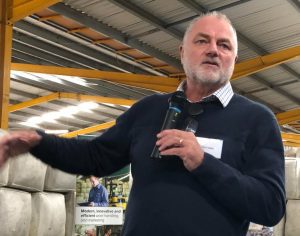
Dr Paul Swan.
AUSTRALIA’S wool industry would get more benefit from increasing levy fund investment in supportive science than from generic fibre marketing, a textile scientist told a growers forum in New South Wales last week.
Former Australian Wool Innovation research manager and AWI election candidate Dr Paul Swan said current world and Australian greenhouse accounting standards misrepresented the biological realities of wool and meat production on farms.
At a Jemalong Wool forum in Forbes last week, he outlined findings from biological life cycle analysis and biogenic carbon accounting for wool production that challenged misconceptions about the fibre’s greenhouse emissions footprint.
Dr Swan said the Australian industry spent a lot of money promoting wool through Australian Wool Innovation and Woolmark.
“We can do the most brilliant campaigns in the world if we like, but I think we are being drowned out by people who dislike wool and dislike farming livestock.
“They’re using eco-credentials as a tool to belt us.”
Dr Swan told growers that retailers and consumers now demand wool growers show how ethical their production is. And wool is also in a reputational battle with polyester, cotton and acrylic, and increasingly a mix of environmental accounting and animal rights issues “coming together,” to influence how people talk about wool.
“We’re in a battle of ideas.”
Dr Swan said all wool-producing countries needed to work together on getting global carbon accounting standards changed.
Supportive research has government and global leverage benefits
When asked what would give the biggest and quickest boost to wool demand – continuing generic wool marketing and promotion or increasing investment in science-based research like biogenic life cycle analysis – Dr Swan initially said he was biased, “I’m a scientist.”
“I also worked for AWI for 16-17 years through numerous AWI boards, changes of managing director or CEO, policy changes, all that sort of stuff.
“I also ran the measurement and evaluation part of the company and I wrote the first monitoring and evaluation framework’,” he said.
“And the challenge has always been to actually be able to build a plausible case that the marketing stuff actually moves the needle in any direction,” he said.
“So I can’t confidently say that spending a million dollars on putting ads in papers or stuff would change a bloody thing, but I can tell you that the money spent on the Make the Label Count campaign definitely succeeded in changing the politicians’ minds about the Higg Index.”
Dr Swan said wool grower levy funds are a “bloody precious resource and they come off your gross – 1.5pc of your gross — whether you are profitable or not.”
He said under the wool levy system, the Federal Government collects it and then provides matching funds for eligible research and development projects.
“The Federal Government matches it up to about 0.5pcof the value of the whole clip, which is historically about $16-17 million dollars.
“Marketing activities are not eligible (for matching funds), so you actually don’t get leverage for those activities, whereas you do — the government, the taxpayers — support you for those science activities,” he said.
“But also, other countries contribute, so the South Africans contribute, the South Americans contribute, the New Zealanders put money in.
“So, admittedly I’m biased, but I definitely think it’s a no-brainer, that we are far better off to focus on science support for the fibre than we are on generic marketing, because you can’t actually measure any benefit from that,” he said.
He said AWI’s Science Support for Marketing program started in 2010 included the baby wear, next-to-skin and sleep research and had been helpful for wool marketing.
Dr Swan said the wool and the meat industries nationally needed to challenge the current narratives around the eco-credentials of livestock agriculture
“It’s about science support for marketing and what we’ll do if we do it, is that other countries will put money on the table for us.”
Current carbon accounting ‘misrepresenting’ reality
Dr Swan was recently contracted to undertake the biogenic life cycle analysis research as part of The International Wool Testing Organisation’s Green Book Project.
He also presented on biogenic carbon accounting at the recent IWTO Congress in France.
At Forbes, he outlined how under the Higg Index for garment labelling, oil-based fibres are ranked as far less environmentally damaging than natural fibres, which had been successfully challenged through the Make the Label Count campaign as a standard for European garment labelling.
However, Dr Swan said an analysis of 102 international case studies on the greenhouse emission footprint of wool found that on average they estimated a kilogram of greasy wool equated to about 25 kilograms of carbon dioxide emissions.
If correct, this meant that a sheep would produce about twice its bodyweight in carbon dioxide emissions during the year, not counting the meat, he said.
“At the end of the day, this is misrepresenting the biological reality.”
Dr Swan said current life cycle assessment rules were perverse and stipulated that any carbon drawdowns had to be permanent and “business as usual” could not be accounted for; there had to be a change from a baseline.
He said this meant that the livestock farming system’s biology — the carbon recycling that happens on farms — is not accounted for under current carbon accounting methods.
“The system is not fair to growers, essentially.”
Dr Swan said a wool growing operation is an example of a biological life cycle built around the reuse of carbon. Livestock farms use solar energy to draw down carbon from the atmosphere into plants to grow biomass in the form of grass, crops, meat and wool. Livestock deposit dung on pasture that becomes “food for life”, he said.
“On our little planet, carbon is energy, it’s food for life.
“In nature, one life nourishes the next, so all wool products are recycled life, the wool jumper I’m wearing was carbon in the atmosphere probably two years ago,” Dr Swan said.
“Nothing is wasted in life, carbon flows from life to life – that process is called biogenesis.
“This process is the number one thing for controlling the carbon in the atmosphere.”
ISO 14067 allows accounting of carbon in wool products
Dr Swan said the Global Carbon Budget website tracked carbon across the world, listing carbon stores and emissions. He said the emissions from land use change is declining and increasing from use of fossil fuels, but apart from reducing fossil fuel use, another way to decrease atmospheric carbon dioxide is to increase photosynthesis to grow biomass to create income and employment – “that’s food or fibre production basically.”
He said biogenic carbon sequestration should be encouraged, along with building soil carbon, ‘but it’s not,” and wool growers — under current carbon accounting methods with permanence and “business as usual” rules – are not allowed to claim credits for the photosynthesis happening on their farms.
Dr Swan said the ISO 14067 standard written in 2018 was the first to explicitly recognise biogenic carbon as separate from fossil carbon, allowing wool producers to count the carbon in their products.
“But there has been curious silence and no one has adopted this, it’s extraordinary.
“The project I am involved in is applying this standard to wool sheep enterprises for the first time.”
However, he said all the current research and accounting on carbon in the wool and livestock industries did not use ISO 14067.
“The conventional way of doing (carbon) accounting is just to assume that it’s like a factory or production line, there is no recycling.”
He said biogenic accounting also involved counting the natural cycling of carbon through urine, dung and respiration into the atmosphere.
Case studies show that with biogenic accounting more than half the carbon consumed by sheep is returned as manure and 23pc is cycled as respiration, but this is not accounted for under current methods, Dr Swan said.
“Emissions from burping or breaking wind is only five percent, but if you look at wool as being bad for the planet you get a totally different picture.”
Dr Swan said including urine carbon cycling reduced the carbon footprint of properties by about a quarter, and including “one in every three sheep pellet (dung)” reduced it further.
“If we count two in every three pellets in sheep dung you essentially reduce the footprint by about 85 percent.”
“Our paper (submitted to the Agricultural Systems journal) is showing that by ignoring biogenesis we are vastly overstating how bad wool is to the plant.”
He said every bale of raw wool has about 300 kilograms of carbon dioxide equivalent – biogenic carbon.
“This jumper weighs about 350-400 grams, about half of it is pure carbon, so we need to get these standards going quickly.”
More work needs to be done
Dr Swan said more work needs to be done to take into account the pasture left after grazing. He said when this and the dung left on pasture is accounted for “you actually end up with more carbon being drawn down than we emit.”
He said the new biogenic accounting system is critical to the wool industry, but more case studies are needed.
“The meat industry is interested now, so Meat & Livestock Australia has called for expressions of interest in biogenic carbon research and modelling.
The cotton industry is also very interested, and the US cotton sector has started its first biogenic LCA, and a global criteria for case studies has been developed, he said. AWI has not funded any of the research to date, but is now “quite interested.”
Livestock impacts
Dr Swan said the current environmental and carbon accounting methods were also damaging the reputation of meat production with consumers, with some restaurants ranking hotel menu items according to their potential for environmental damage.
“Everything that is meat-based is classed as ‘high environmental damage’.
“So what I wanted to flag with you is that some of this misrepresentation, some of this stuff that has been thrown at farming and the wool industry, is also coming your way with livestock.
“The same stuff that is affecting wool is affecting livestock.
“It will also be affecting every other product that involves animal agriculture.”
Dr Swan said there is a huge opportunity and critical for wool to build the science case for biogenic carbon accounting and prosecute that wool production is part of a biogenic system.
“So we need to change the accounting standards – wool can’t do it by itself.
“Australian wool is about 0.25pc of the global textile fibre market, but we’re tiny in Australia compared to the meat industry, yet it is equally affected by this,” he said.
“Grazing animals are part of a healthy planet – you farmers run photosynthetic factories, you recycle carbon, that’s what you do.
You need to be getting recognition for the fact that you cover the soil, you convert visible light into chemical energy.
“You stop a lot of reflective heat going up into the blanket, so we need to change the conversation we’re having.”
Fantastic paper Paul. Thank goodness you are on the case: Carbon, sheep and wool production.
AWI and its marketing cheer squad are almost exhausted, and about time. It has taken far too long.
Scientific research has always been the key to increased productivity.
AWI needs a whole new team to focus on researching the things that matter. Change of direction as Paul submits is the only thing that will save the wool industry from ongoing loss of market share and the carbon guillotine.