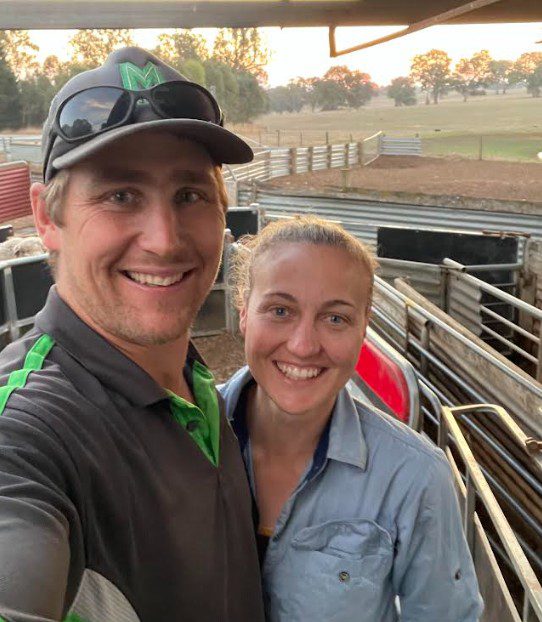
Ricky and Marni Luhrs. Image supplied.
WESTERN District sheep producers Ricky and Marni Luhrs have contracts for their wool and the eggs from their pasture-raised hens – the next phase in their marketing will be being able to contract Mooralla Merino’s lamb production.
Despite winning the LambEx AMPC Feedlot Carcase Competition last year and being known for producing high eating quality lamb, Ricky is not sure when he will be able to forward contract his lamb long-term.
“I would like to think it will be within 10 years, but I don’t think it will be.
“I think producers need to produce a consistent product and the abattoirs need to put out markers as to what that product looks like,” he said.
About 70 percent of MM lambs are already sold under processor grids with the help of containment areas as feedlots. He recognises that Gundagai Meat Processors with its Gundagai Lamb program is setting the pace in providing feedback on preferred high eating quality lamb with their and other processors are working on improving their data collection and feedback systems.
“At the moment all lambs are in demand, but we are getting no indication what the abattoirs and exporters would prefer us to breed.
“If the abattoirs told us what they preferred you would have — like in the cattle industry — people producing different grades of meat for different markets.”
Despite the current mutton prices, Ricky is concerned about the impact on liquidation of the ewe flock.
“The whole system is strong, and it is showing strength, it is now about farmers selecting the right animal while the money is there to perform year-in year-out.”
The Mooralla Merino operation north of Hamilton runs a Poll Merino base flock joined to Merino rams for replacement ewes and terminal lambs for prime lamb production.
He described the Mooralla flock as being balanced Merinos producing carcase and wool under high rainfall conditions using modern tools like Australian Sheep Breeding Values.
Breeding and managing to get more lambs out of fewer ewes for higher value markets “is definitely the way forward for the Merino system,” Ricky said.
On the recent lift in wool prices, Ricky thinks growers should “enjoy the ride and see what comes out of it.”
Full-circle conversation at BestWool BestLamb next week
Next week at the 2026 BestWool BestLamb Conference in Ballarat, the couple will outline how they have utilised knowledge from previous BWBL events, and other industry programs to build a resilient whole farm system.
“It will be a full-circle sort of conversation about the early AgVic field days, BredWell FedWell, Lambs Alive and Evergraze events, and quantifying it at BWBL conferences – hearing the same thing multiple times – and then actioning those thoughts and processes.
“It enabled us to set up a robust business base to create opportunity.”
Ricky recognises that process as helping to set them up with the ability to confidently take on a 10-year contract for their non-mulesed wool with Zentera under its ZQ program.
“We’ve been involved with ZQ with AWN since 2019.”
They contract 80 bales of wool with Zentera, with verbal agreement to grow that as needed.
The Luhrs’ pasture-raised egg enterprise was started as a complementary income opportunity that would utilise available family and local labour and facilitate succession. It started in February with 5000 hens and was raised to 10,000 hens this week, with a three-year contract with Honest Eggs Company.
Agriculture Victoria’s 2026 BestWool/BestLamb and BetterBeef Conferences on 23 and 24 June in The Goods Shed at Ballarat are focused on exploring ways to turn today’s challenges into tomorrow’s opportunities. The packed agenda of keynote addresses and sessions, allowing participants to tailor their day to their interests and needs.
Agriculture Victoria’s Jen Alexander said the BestWool/BestLamb and BetterBeef Networks are long-standing extension programs that continue to support Victoria’s sheep and beef industries with practical, relevant information.
“The networks connect producers through producer groups, and include access to up-to-date research, opportunities for skill development and knowledge building, as well as networking and learning from others,” Ms Alexander said.
“We know the conferences give producers the opportunity to step away from the farm, connect with fellow producers, share experiences and gather fresh ideas for the future.”
The event opens on Tuesday 23 June with the BestWool/BestLamb Conference, followed by a combined industry dinner that evening, and the BetterBeef Conference following on Wednesday 24 June, including a feeder steer masterclass.
“Attendees can expect a mix of keynote addresses and concurrent sessions with a producer focus that will inform and challenge while providing insights from across the sheep and beef industries.
“Industry experts will provide relevant and practical strategies that can be implemented immediately on your farm and share the latest research and innovations that are shaping the industry,” Ms Alexander said
Other keynote BestWool BestLamb speakers will include:
- John Francis (Agrista): Speaking on both days, John will challenge how producers think about risk, revealing why mindset, not markets, may be the biggest driver of profit.
- Professor Peter McGilchrist (University of New England): Peter, one of the feeder steer masterclass speakers, will explore what’s next in beef eating-quality improvement beyond marbling, including red meat yield, tenderness and ageing.
Full program details are available on the conferences webpage and tickets are available at https://www.trybooking.com/events/landing/1553856
The event is delivered by Agriculture Victoria as part of the Victorian Government’s statewide Drought Support Package in partnership with Australian Wool Innovation Extension VIC, supported by Meat and Livestock Australia and the Mortlake BetterBeef Group.
HAVE YOUR SAY