
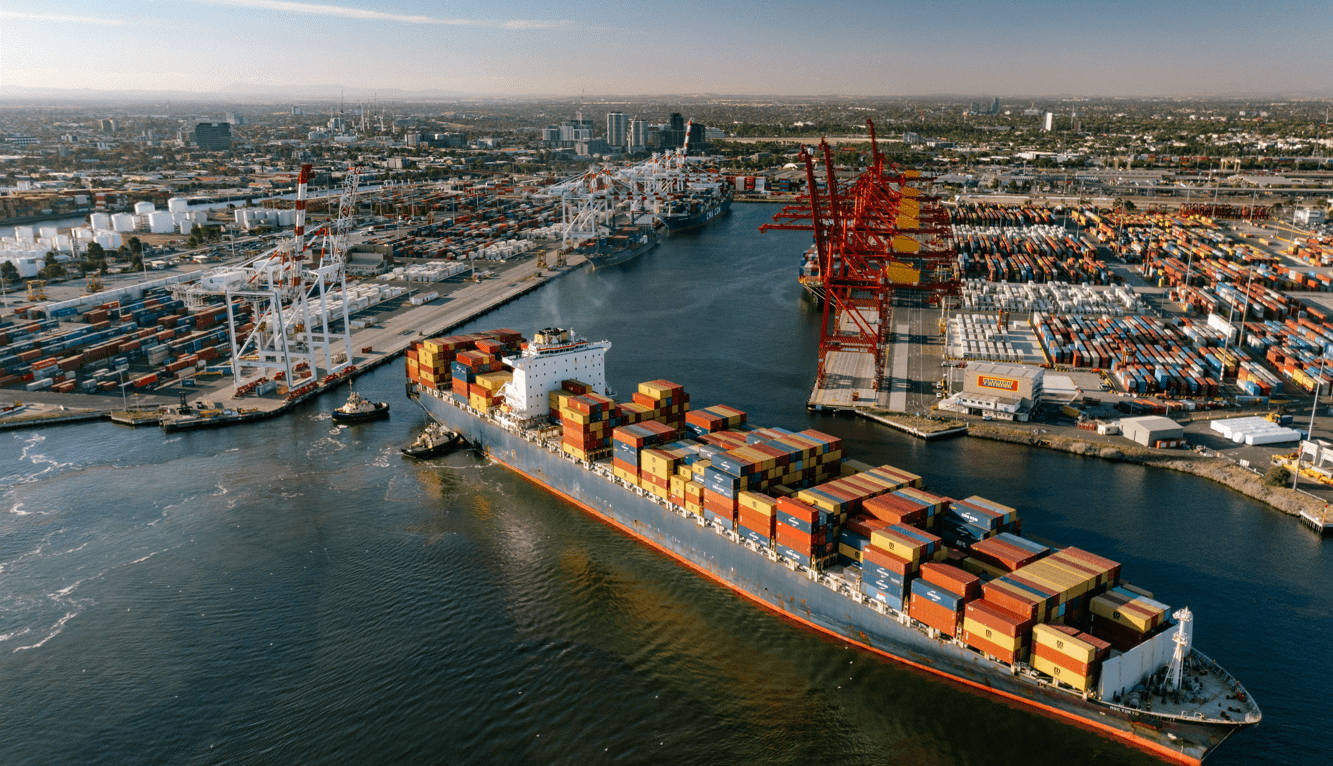
Port of Melbourne is Australia’s leading exporter of containerised grain and pulses. Photo: Port of Melbourne
INDUSTRY is calling for major reform after the Australian Competition and Consumer Commission found stevedores are charging record prices and earning historic profits.
The ACCC’s Container Stevedoring Monitoring Report 2024-25 was released late last year, and called for a “policy or regulatory response” from government to address the “market failure identified” in the operating environment.
It found that stevedoring profits rose for the fifth year in a row, with companies now charging a higher total price per container, in real terms, than at any time since the ACCC began monitoring the container-stevedoring industry 27 years ago.
Over the past five years, the industry’s real operating profit has increased by $457.8 million, or 130.5 percent, to a historic high of $808.6M in 2024-25.
ACCC Commissioner Anna Brakey said the report found that the stevedore’s profitability was high despite “significant spare capacity at ports, stable costs and stable productivity”.
“Typically, we would expect to see excess terminal capacity placing downward pressure on the stevedores’ prices and short run profits,” Ms Brakey said.
“The fact that stevedores are performing better than they were prior to entry of Hutchison, a time when the industry was operating as a capacity constrained duopoly, raises serious concern about how this market is operating.”
TAC as driver of profits
Ms Brakey said landside charges, namely terminal access charges (TAC), were the main driver of these rising prices and profits.
“Over the years, landside charges have gone from a relatively small part of revenue to a major driver of profit for the industry.
“The stevedoring industry began to significantly increase terminal access charges in 2017 and since then, they’ve collected over $3 billion in terminal access charges.
“We are concerned that stevedores can increase these charges, and thereby their profitability, independent of the underlying market conditions.”
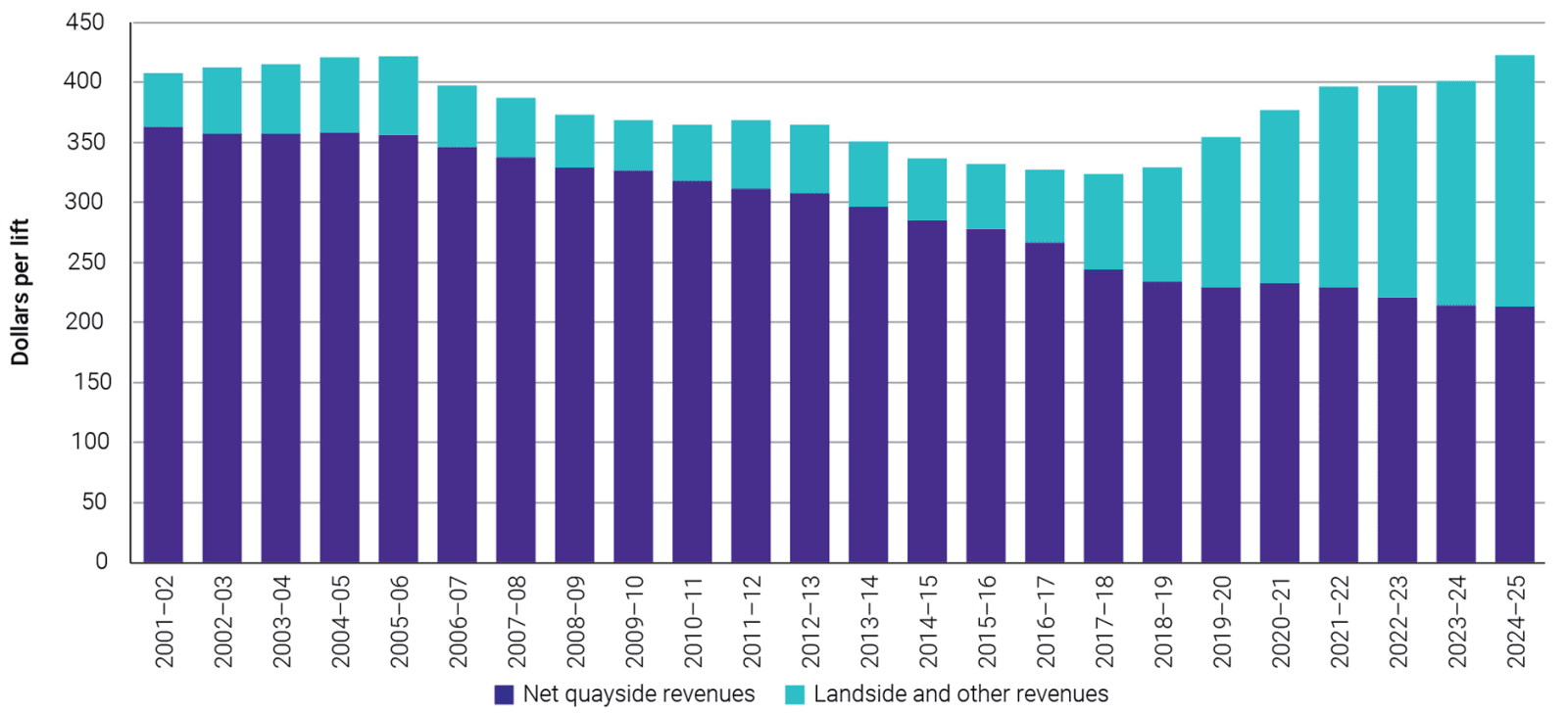
Total revenue per lift for the stevedoring industry, demonstrating the rising proportion of landside and other revenues. Source: ACCC.
In 2024-25, the stevedoring industry collected 49.5pc, or $1.15B, of its revenue from landside charges.
More than $642M of the $1.15B in landside charges revenue came from TAC alone, which stevedores previously described as infrastructure levies.
FTA targets rising TAC
Australian representative body for the international supply chain sector, Freight & Trade Alliance is targeting rising TAC as a key area for reform.
FTA general manager – freight policy and operations Tom Jensen said the rate of increase in the charges did not equal the same increase in service levels.
“In 2010-11, they came into the market at $3.50 a container and…now down the track they’re over $200 per container,” Mr Jensen said.
“They’ve gone up exponentially and basically, what has industry got to show for that?”
Mr Jensen said some higher-value industries, such as white goods, could “pass that cost on to the customers”, while others with different contract structures might struggle to absorb the increases.
“When you’re talking commodities like grain, they’ve already pre-sold those contracts at set rates.
“So if you’re going to now containerise grain and take that hit, it’s coming straight out of your bottom line.”
Calls for mandatory code
Mr Jensen said the FTA was currently working on multiple fronts to help make the TAC system more competitive for all involved.
He said there was some movement in August last year following the Infrastructure and Transport Ministers meeting.
In this meeting, ministers endorsed a plan to nationalise Victoria’s voluntary guidelines for stevedore landside charges.
To be administered by the National Transport Commission, this would include a new requirement for stevedore operators to implement price changes annually on January 1.
The communique published following the meeting said this move would “improve transparency” and “charging behaviour” as well as “maximising freight productivity”.
In addition, the ministers agreed that the Infrastructure and Transport Senior Officials’ Committee would establish a working group to explore options, and recommended next steps in response to findings by the ACCC concerning stevedore charges.
While welcoming the news of the working group, Mr Jensen was less optimistic about the voluntary code.
He said the Victorian code had had little success so far in limiting the power of stevedores.
“It provides a lot of visibility on the government’s end, and the only one benefit out of that was that it now means that they all come out on the 1st of January.
“Outside of that, it hasn’t curbed how much [costs] go up and how much the stevedores actually profit out of us.”
He said the FTA wanted a mandatory code like the arrangement seen in the health insurance industry that gave government ultimate oversight of TAC.
“I’d much rather a mandatory code where at least the government have a say in if they go up and how much each year.
“Think of the health industry and how private health insurance goes up; if we had that in the freight industry, that would be perfect.”

GTA CEO Pat O’Shannassy.
Grains industry support
Grain Trade Australia and GrainGrowers both came out in support of comments made by the ACCC and backed calls for reform.
GTA chief executive officer Pat O’Shannassy said the findings closely align with the experience of containerised grain exporters.
“It is encouraging to see the ACCC acknowledge the scale and incontestability of landside charges and access fees, including those imposed by empty container parks, which our members have been raising for some time,” Mr O’Shannassy said.
However, neither made specific policy suggestions, and GTA urged caution around establishing a mandatory or prescriptive regulatory framework.
“Any response needs to recognise the highly dynamic nature of global trade,” Mr O’Shannassy said.
“Rigid pricing mechanisms, including formal annualised price setting, often embed excessive risk premiums into fees.
“From GTA’s perspective, fees and charges, including landside fees, should in principle align with commercial contracting arrangements across the supply chain, ensuring those who pay the fees can negotiate service productivity.
“This is currently not the case with grain container exporters.
“In our view, exporters should be able to contract directly with shipping lines for services, and shipping lines should then negotiate and contract landside services with stevedores and container parks, as they can apply commercial and operational pressure to ensure efficiency.
“Pricing should be determined through negotiation by parties who can influence service levels and productivity outcomes, rather than being imposed as non-contestable costs on exporters.
“This will lead to a more efficient and productive sector.”
GrainGrowers general manager policy and advocacy Zach Whale said Australian growers had been facing mounting port charges for years, while stevedores continued to post record profits.
“Government intervention is long overdue and steps must be taken before high costs and delays at ports inflict long-term damage on vital export industries,” Mr Whale said.
“These charges have not only dramatically increased costs for Australian growers, they have impacted Australia’s competitiveness and reputation globally.”
Grain Central: Get our free news straight to your inbox – Click here
HAVE YOUR SAY