
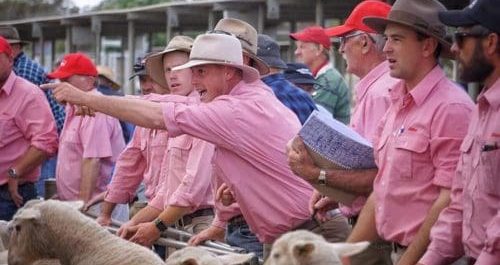
VICTORIAN lamb finishers showed a willingness to pass lines in this week as saleyard bids failed to match processor grid rates and meet producers’ expectations.
The action at the Bendigo Livestock Exchange came as sheep meat processors’ react to higher prices, supply levels and quality in the lead to winter by either limiting slaughter capacity, tightening bid limits or not buying in saleyards.
As indicated by the trade lamb indicator, saleyard buyers have prices below 1200c/kg since mid-May and despite the indicator reaching 1178c/kg on Monday, it dropped to 1152c/kg on Tuesday. The heavy lamb indicator has been kept below 1150c/kg since early May.
At the Bendigo Livestock Exchange on Monday, the National Livestock Reporting Service said at least two agencies passed in grain-fed Merino lambs.
The NLRS said not all buyers attended or operated the plainer and mixed quality yarding of 5500 lambs and 1600 sheep, and the market didn’t gain any momentum from the rain or lower supply.
“There was gaps in the sale and at least two agencies passed in some handy lines of grain-fed Merino lambs.”
Elders Bendigo livestock manager Nigel Starick said the agency passed in a line of about 80 heavy tradeweight Merino lambs after being offered about 80-100c/kg below the hook rate and then a slightly higher price after refusing to sell at about $9/kg cwt, while $10-$10.50 is available over the hooks.
“It did, but we were still not happy.
“We’ll just hook them somewhere else and get the rate they deserve,” he said.
“Because they were local sheep that have been in the feedlot we know our margins and know that even with (the cost of) going to the yards and then home we will still be in front.”
He estimated about 200-300 lambs were passed in across the yarding.
Mr Starick said he had also passed in a client’s 300 sheep recently that will be slaughtered this week.
“They were nearly $2/kg cheaper than the hook rate.
“There are isolated cases (of lots being passed in) happening in the sheep too.”
He knew of at least one processor whose plant’s lamb kill space is fully booked for May, meaning less competition in saleyards.
Mr Starick said the “great unknown” is still how many lambs are being finished on farms and in feedlots.
“But it’s getting tougher and tougher to find lambs.”
He said there are more feedlots on farms giving some producers marketing flexibility.
“But some are just work on a rotational basis; they’ve got to take them and then get them out, and they don’t want to keep them in (the feedlot) over time because that’s when it starts to cost to feed them – a lot of them are only on 60 days; in 60 days they are in and out.”
Mr Starick said the current lamb prices are still “good dough” — crossbred lambs at $11/$11.50/kg and Merinos at $10-$10.50/kg is still good money.
“So you can still budget on those numbers.
“If it can sustain that through winter it would be unreal.”
He believed lamb and sheep supply will be tight for buyers during winter.
“Because I don’t know where they are going to come from – I didn’t see a lot of true spring drop lambs go through the system.
“I think a lot of ewes got killed that were spring droppers, so there doesn’t seem to be a lot of that late lamb about.”
The NLRS said price estimates for crossbred lambs at Bendigo remained in the ballpark range of 1000-1100c/kg cwt for most, with some neater trade types up to around 1150c/kg. Demand for Merino lambs was more subdued than recent sales. Heavier lambs $300 to $350/head for most with just one pen higher to market top of $372/head, and the heavier lambs tended to be in half penlots and without the weight and shorter skin presentation of recent sales, the NLRS said.
The better presented trade lambs $250 to $286/head, and again there wasn’t the real neat domestic pens like last week, the NLRS said. Bidding for feeder and lighter lambs bounced around but were softer at $150 to $240/head for most and but going down to $110/head for small mixed lots. Trade Merino lambs to $258/head, lighter types spreading from $114 to $214 in a sale that didn’t show a lot of spark for the Merino breed and some of the bigger lines were passed-in or sold to feed-on.
The NLRS said prices for sheep with weight were stronger in places but lack of numbers made it difficult for accurate comparisons. Big crossbred ewes made $230-$288/head and better trade sheep $168-$214. Ballpark averages for good mutton 750c to 820c/kg on limited quotes.
Livestock prices are no different to rural property. They are bound to fall in a heap and all the early signs are there to see.
My call is that by the year’s end we will see corrections in rural property values, especially at the silly end; up to 40pc+.
Strap yourselves in Australia as we are in for a hell of a ride.