
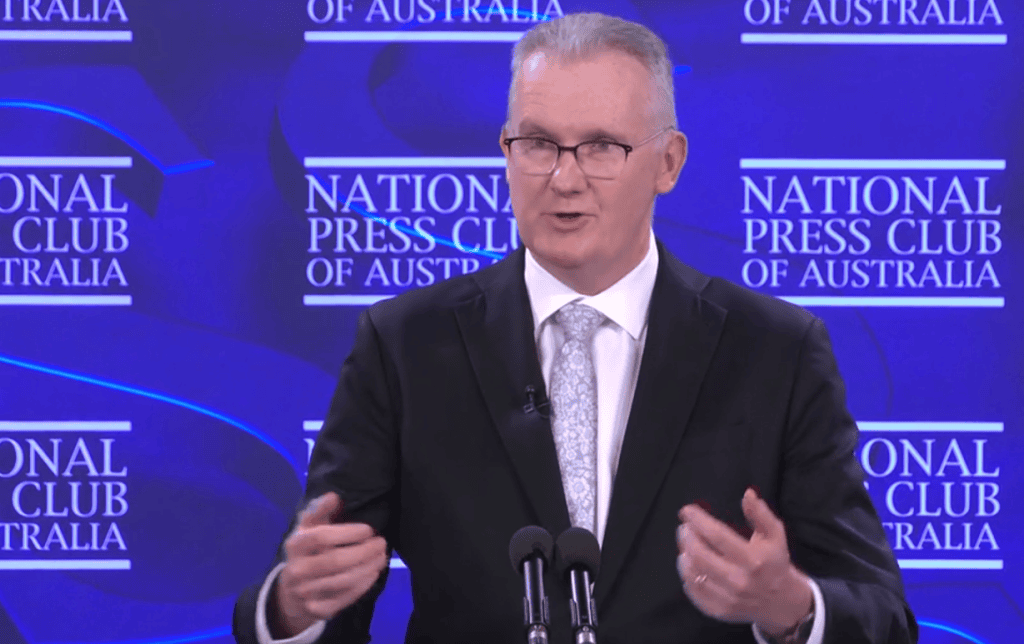
Minister for Home Affairs and Immigration Tony Burke at his National Press Club address today
FARMERS, meat processors and the Coalition remain unconvinced changes to Australia’s visa and immigration system announced today have met the immediate and ongoing labour needs of agriculture.
At the National Press Club today, Minister for Home Affairs, Immigration and Citizenship Tony Burke announced that agriculture and fisheries would be added to the priority list under Ministerial Direction 119 and Working Holiday Maker visa processing would be restored.
The changes will elevate agriculture to a priority sector under the skilled visa processing system, which Mr Burke said will return applications to “normal processing speed”.
However, the changes to the Working Holiday Maker Program will include a ballot system for years two and three where there will be a regional work requirement in support of regional Australia. The government will also stabilise processing times for Working Holiday Maker applications to three months, Mr Burke said in a separate statement.
Mr Burke said adding agriculture and fisheries to the priority list would ensure growers had access to the workers they needed for harvest.
“Working holiday maker processing is now being restored and we’ll be moving through those again effectively,” Mr Bourke said.
However, the government will introduce a ballot for workers seeking to extend their working holiday visas into a second or third year. Under the system, the regional work requirement will remain at 88 days for a second-year visa and six months for a third year, but the number of workers eligible will be significantly reduced.
Mr Burke said a second-year WHM ballot would be capped at 45,000 places, down from the 57,000 people who qualified last year. The third year ballot will cut visas to 5000, with 31,000 people in this group last year.
“[N]ot everybody will get through because we need to have some control and certainty of what those numbers are.”
Three-month WHM processing timeframe ‘a low blow’
The government’s self-confessed ‘slowdown’ in WHM visa processing has contributed to delays in securing overseas workers for the upcoming harvest and the National Farmers Federation president Hamish McIntyre said the three-month processing timeframe — when approvals had previously taken only days – was “a low blow for farmers and the businesses that produce Australia’s food and fibre.”
“ The government’s unilateral slowdown on Working Holiday Maker visas has already caused havoc across agriculture ahead of the busiest time of year for food and fibre production.
“Today’s announcement does not fix the crisis the government created,” Mr McIntyre said.
“A three-month processing target leaves farmers completely stranded with harvest already underway in parts of Queensland and the main season only weeks away.
“Working Holiday Makers fill about one in seven farm jobs making them central to getting food and fibre produced, harvested, packed and into supermarkets,” he said.
Mr McIntyre said the government’s move to introduce a ballot for second and third-year Working Holiday Makers may be a step in the right direction if it protects regional work and keeps workers flowing to the farms and towns that need them.
“However, a ballot will mean little if the system cannot process people in time.”
Mr McIntyre welcomed the listing of agriculture as a priority sector under an uodated Ministerial Direction 119.
However, he said agriculture, fishing and aquaculture should have been given a separate line in Direction 119 and considered by government on the same level as defence and teaching.
“Burying food production in a long list of priorities does not reflect the urgency or scale of the workforce challenge now facing farms, fisheries and regional supply chains.
“Farmers need approvals in days, not months,” Mr McIntyre said.
“For many farms, three months is the difference between harvesting a crop and losing it.
“The government has been asleep at the wheel on this issue and now risks careering off the road at the worst possible time for Australian agriculture.”
AMIC seeks clarification
Australian Meat Industry Council CEO Tim Ryan said AMIC is seeking further clarity from the Department of Home Affairs on the practical implications and timing of today’s announcements, particularly in relation to skilled visa processing and the Working Holiday Maker program.
“AMIC remains concerned about policy settings that could constrain access to workers from key partner countries, including the continued slower processing of some Working Holiday Makers, particularly where meat industry employers can demonstrate genuine vacancies that cannot be filled locally.
“Migration settings need to distinguish between migration that responds to genuine labour and skills shortages and other forms of temporary migration,” he said.
“AMIC is calling for consultation with industry as the reforms are implemented, including consideration of regional workforce needs, employer-sponsored migration pathways, Working Holiday Maker arrangements and processing times for skilled visas.
“The meat industry is one of Australia’s major regional employers and export industries,” Mr Ryan said.
“If we want Australian processing and manufacturing to remain competitive, we need migration settings that recognise where genuine workforce shortages exist.”
Targetting agriculture – Canavan
After Mr Burke’s address, Nationals leader Matt Canavan said the government was targeting agriculture, tourism and other regional industries as part of its plan to bring down migration levels.
“The targeting of the farm sector in Tony Burke’s speech is an outrage on a couple of levels.”
He said it is not the Working Holiday Maker system into the regions that has been the reason for the massive surge in numbers coming to this country.
“So it’s not our nation’s farmers or regional businesses that have contributed to the over-migration problem in this country, but they are being targeted by this government in response to their failure to get the broader system under control.”
NFF chief executive officer Michael Guerin said he represented 80,000 food and fibre producers who are hurting, “really really hurting”.
“Before July this year we had for many years had a system which allowed us to use the workforce and have access to the workforce we need to grow the food and fibre we all rely on in Australia for our food security.
“In July this year without notice without consultation without any warning the Minister slowed that (WHM) processing up so now we have dairy farmers doing 20 hours a day, health and safety risks, animal welfare risks, communities at risk,” Mr Guerin said.
“We have a grains harvest that is actually starting in northern Queensland without the people we need to drive the harvesters, so we better buy our bread quickly while it is still around.”
Australian Tourism Industry Council CEO Erin McLeod said there is a very real risk that lengthy and uncertain visa processing times will reduce Australia’s attractiveness to Working Holiday Makers and make them a less reliable workforce option for regional employers.
“This is particularly concerning as tourism businesses are heading into the summer trading season, one of the busiest periods of the year.
“Businesses need certainty now that they will have the workers they need to operate at full capacity over summer,” she said.
“If potential backpackers are being told their visa could take several months to process, they may arrive too late for the peak season or simply choose another destination.
“Working Holiday Makers are highly mobile and have choices about where they travel,” Ms McLeod said.
“Australia is competing globally for these visitors, and lengthy or uncertain processing times risk damaging confidence in the program.”
HAVE YOUR SAY