
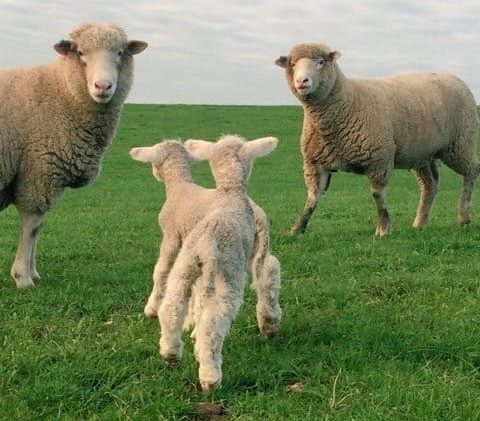
AUSTRALIA’S lamb production is continuing to decline, with slaughter in 2025-26 down 15.3 percent to 22.075 million head year-on-year, according to Meat & Livestock Australia.
However, Meat & Livestock Australia said lamb production by weight declined at a slower rate – down 11.2pc to 554,658 tonnes — as heavier animals drove carcase weights to record levels.
The average national lamb carcase weight reached a record 26.7kg per head during the June quarter with an average of 25.1 for the year.
MLA senior market information analyst Emiliano Diaz said the lamb sector is producing fewer animals than a year ago, but record carcase weights have helped offset some of the decline in slaughter numbers.
The average national lamb carcase weight in 2024-2025 was 24.8kg per head, reaching a peak average of 24.78kg in the June 2025 quarter. The average carcase weights
Based on the latest livestock processing data from the Australian Bureau of Statistics, MLA said despite the year-on-year reduction, the financial year 2025-26 lamb output was the fourth-largest production on record.
In the June quarter, lamb slaughter fell 21.6pc year-on-year to 5.286 million head, while production declined 15.7pc to 140,995 tonnes.
Track the changes in slaughter and average lamb carcase weights over the past 25 years here.
Mutton production lowest in four years
MLA said sheep supply contracted sharply throughout FY2025-26, driving the lowest annual mutton production and sheep slaughter levels since FY2022.
Annual sheep slaughter fell 31.5pc to 8.045 million head, while mutton production declined 28.8pc to 209,865 tonnes.
The June quarter recorded the lowest sheep slaughter and mutton production levels since June 2021, with sheep slaughter falling 46.9pc year-on-year to 1.334 million head and mutton production declining 43.1pc to 34,205 tonnes.
“The sheep industry is moving through a markedly different phase of the production cycle, with lower turn-off reflecting tighter sheep availability following the elevated processing levels of recent years,” Mr Diaz said.
Record beef production in 2025-26
MLA said Australia’s beef industry has delivered a record result in FY2025-26, with beef production reaching 2.985 million tonnes and cattle slaughter recording its highest financial-year total since 1978.
ABS figures show nearly 9.6 million cattle were processed during FY2025-26, up 8.1pc year-on-year, while beef production increased 8.6pc to a record 2.985 million tonnes.
Mr Diaz said the figures highlight the strength of Australia’s cattle supply and processing sector.
“Favourable seasonal conditions over recent years expanded the national herd and supported elevated cattle availability, driving historically high processing volumes across the country.
“While the record result was primarily driven by strong supply conditions, the industry achieved it against a backdrop of increasingly challenging global trading conditions towards the end of the financial year,” he said.
“Demand for Australian red meat remained resilient overall, highlighting the sector’s ability to adapt and compete in a more volatile global environment.”
The record financial year was capped by an exceptionally strong June quarter, with beef production reaching a new quarterly record of 780,620 tonnes.
New South Wales, Victoria and Queensland each recorded their highest quarterly beef production on record, highlighting the widespread strength of cattle supply and processing activity across Australia’s major producing regions.
Beef production also strengthened in the June quarter as exporters accelerated shipments ahead of safeguard thresholds being reached in China and Korea.
Typical seasonal patterns emerged during the June quarter, with increased slaughter numbers resulting in slightly lower carcase weights than the March quarter, while the female slaughter rate lifted as expected.
“The strength of the June quarter reflects both the depth of cattle supply and the processing sector’s ability to efficiently handle elevated throughput across Australia’s key cattle-producing states,” Mr Diaz said.
The Department of Home Affairs and Minister Tony Burke have been asked why the visa priority and WHM visa changes were made and what it would do to mitigate any negative impacts.
Source – MLA, ABS.
HAVE YOUR SAY