
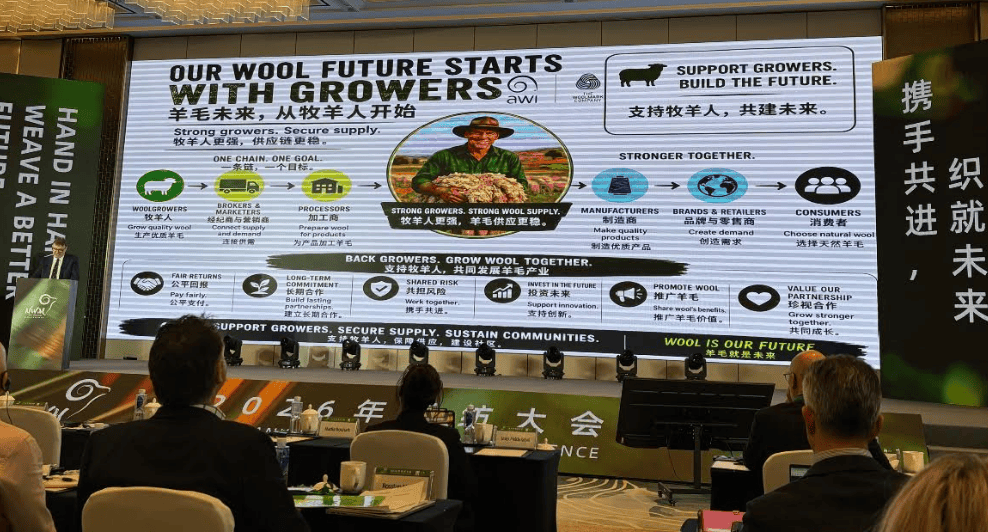
CHINA’S wool processing trade was told farm production costs and other viable land use options meant any Australian fibre production increase would be incremental at current prices, at the Nanjing Wool Market Conference this month.
Western New South Wales grower, Dermot Murray at ‘Newfoundland’ near Louth, told the conference that Australian Merino growers needed a wool price of 2200c/kg.
Dermot was part of a Macwool tour group led by broker Don Macdonald who said the Chinese trade was told if growers could not get that type of money for their wool – which they are getting now because 19 micron is at 2200 cents – there are goats and obviously cattle.
“And benchmarkers will tell you that the only thing that beats a Merino enterprise is a goat enterprise, because there are no costs.”
Dermot also shared some numbers from his family’s operation.
 “To the buyers I say were are not in the game to try to get rich out of it, we’re just trying to maintain what we’re doing and keep doing better.
“What we heard from the Chinese mills is they want consistent clean product, but one of our challenges is labour and we need to do better with fewer people and the infrastructure to do that costs a lot of money,” he said.
He said maintaining the 800km of fencing across his operation’s 300,000 acres cost $7 a kilometre annually. Murray said the annual shearing cost is A$13/sheep or in Chinese currency 62RMB, crutching cost A$3/head or 14.3RMB, a four wheel drive work vehicle cost A$100,000 or 480,000RMB, “and we have 10 of those.” Diesel is A$2.90/litre or 14RMB/litre, he said.
Newfoundland has had up to 28,000 sheep, but is currently running about 15,000 sheep after offload sheep due to the dry conditions last year.
Dermot said the Chinese are confident and would keep buying Australia wool, but for Australian growers to keep improving the quantity and quality of production they would need to keep “tipping money into us” to get the clean and consistent product they want.
“The market’s OK at the minute, it isn’t anything to write home about, but none of us saying this because we want to get rich out of this game, but we want to be able to do it easier and do it better.”
Dermot said one example of necessary infrastructure for efficient handling of large number of sheep is expensive bulk handlers, but with eight yards across their operation, the equipment and skilled labour input costs are significant.
Conference panel heard growers’ comments
Mr Macdonald spoke on a panel at the conference, answering questions about measures to improve wool quality, challenges facing Merino wool growers and expectations of a production increase.
He shared panel with representatives from South Africa and China, and based his comments on the “aggregated opinions” of growers on a ‘decision-makers’ tour he was leading around the China wool industry. Mr Macdonald said the group of 27 young wool growers included four whose grandfather started doing business with the Macdonald broking group. They toured mills, scourers, top makers and garment makers, as well as attending the conference.
Mr Macdonald said the Chinese processors and buyers wanted to know if there would be more production now that prices have improved.
“We told them no, it will be incremental – pretty everyone there said that increased production will only come from those who are already in the industry, we’re not going to attract other people back to the industry (at current price levels) … because other competing land uses are just as good and have been better for longer.
“We told them that to build confidence in the industry we need more than one good year in five (in respect to prices), that was the first message.”
Mr Macdonald related that the growers are happy with the current prices, but Australia has some of the highest minimum wage structures in the world.
Mr Macdonald said the Chinese were also told the industry had lost a lot of its skilled workforce.
“We’ve got to compete for labour against the mining industry, which is a very big issue in rural areas.”
He said the wool industry had to compete with mine workers being paid $60-$80 an hour in western New South Wales. Many of the young growers are also university educated or trained in another profession and know what they could be earning “if they were on the tools”, Mr Macdonald said.
“So they are better at coming to terms with what they have to pay to get good help.
“They know that if they want good help, they are going to have to pay $400-$500 a day.”0
“The problem is the breeding ground for skilled labour in animal husbandry side of Merinos is just not there, because the jackaroo system is pretty well gone.”
The tour group growers estimated their shearing costs as equal to 20pc of their gross income.
“That was one the first points I made was that 20pc of our gross income is straight off the top just to get the wool in the bale
“And we are paying about four times as much as South Africa and South America (for shearing).”
Lack of confidence in sustained prices is a constraint
Mr Macdonald told the conference that constraints to increased production include a lack of confidence in sustained prices, meat values provide the majority of income and are too attractive to hold sheep and a shortage of skilled labour including in shearing.
He told them the young growers could not see production increasing substantially as the industry wasn’t attracting farmers back who have left, but small growth would come from within.
“The shearing and the quality of the harvesting workforce is a major constraint and corporate agriculture is disappearing from the Merino industry so we are losing a training ground for sheep husbandry skills.
“New entrants to largescale grazing almost always choose cattle, even though benchmarking data shows Merino sheep are more profitable.”
One grower told him that since the year 2000, the national lamb indicator has risen 500pc, the Eastern Market Cattle Indicator has risen 300pc and the Eastern Market Wool Indicator for wool has risen 200pc.
Challenge on robotic shearing
Mr Macdonald told the conference that working with live animals offers a wider challenge for innovation and progress, although there are no examples of robotic use with animals on farms.
“I then through down the challenge to them — with their advancements in robotics (manufacturing), which are truly impressive in China — to automate shearing and help us solve those issues, which I think was taken well.”
Mr Macdonald said the Chine trade is also getting “pushback” from the other end of the supply chain, with no change in economic conditions in consumer markets.
“The only thing that has pushed the price up is lack of wool and really that was the main message that we wanted to say is, ‘if you are worried about lack of wool now, don’t let this market fall, because if this market goes back to 1400-1500c/kg (clean) again you’re going to lose a heap more’.”
Chinese top makers ‘caught in a wedge’
Mr Macdonald said China’s top makers are “caught in a wedge” being no longer able to blend higher priced wool with cheap stock on hand.
“Now that’s all gone, they’ve got no cheap stock, everything they’re buying is costing them … they’re apparently not able to sell tops for no more than what they are paying for the wool, in other words they are processing it for nothing.”
To counter this there is a trend toward blending wool with other technical fibres, including for next-to-skin wear.
“So we are now getting 40-50 percent of wool into a sector where we had nothing, so that’s all positive.
“Europe is looking a bit better, but basically consumption at the other end is probably stagnant and if we hold production where it is at, we’ll certainly I think keep the market somewhere in the ballpark of where we are,” he said.
“The question I asked everywhere we went, when they asked about increasing production, is ‘If we add 10-15pc to the wool clip that puts up over 300 million kilograms, will the price stay where it is?’… and they couldn’t answer it.
“They didn’t give me confidence they they could handle 340 million kgs at a viable price, where we were 10 years ago,” he said.
No wool in the pipeline
Mr Macdonald said there is no wool in the global pipeline.
“You can see for yourself that the mills are not running at capacity and they’ve got no stock.”
But he said the spinners are saying that their trade is better than it was 12 months ago.
“So there is a little bit of confidence there and I think that once we get the peak spring season shearing behind us and they see that we fall back to 25,000 bales a week (in auctions) as far out as you can see, they will have to step up to the plate, but it is not because they’re making sales at profitable levels to the spinners, it’s because they want to keep their machinery running.”
Mr Macdonald said one thing that put “a spring in his step” was the calibre of the young wool growers that are better tuned in than their predecessors at the same age.
There is as much interest from Australian wool growers to see how committed the Chinese industry is as there is from the China trade in assessing the level of commitment from Australia, he said.
Mr Macdonald said the wool industry is really exposed to the generational switch to new enterprises.
“We are exposed to a new cohort of young producers coming on that are taking their parents’ debt and buying new country, and if the numbers don’t stack up and they can’t get the work done, they will do something else as quick as that.”
Positive tone at conference – Lamb
Australian Council of Wool Exporters and Processors president Josh Lamb said the general tone of the conference was positive, with a lot of discussion about current wool prices and the ability of the trade to pass it on down the pipeline.
“The general consensus is that only 60-70 percent of the rise of the last 12 months is being passed on by early stage processors.
“The take away from that is a large part of it is being consumed and given how quickly the market rose, that’s encouraging,” he said.
“It can take 18 months or more for any significant market move to be accepted all the way to the retailer or end user, so to see almost three quarters of the rise being accepted bodes well medium term for the market here.”
Mr Lamb said having almost 80-100 wool growers present gave the conference a different feel this year.
“There was a real sense of collaboration from the Chinese and Australian sides for a more sustainable price and industry.
“Quite a few Chinese clients made mention to me of how young the grower attendees were, not just the Australian Wool Innovation future leaders group, but all three Broker lead tours also,” he said.
“The global industry thought this was very noteworthy as well.
“With several wool growers speaking at the conference, China now has a better understanding of the challenges Australian growers face daily,” Mr Lamb said.
“The most important of which is they don’t have to grow Merino wool. It’s a choice not a given.”
Mr Lamb said the Chinese industry is narrowing, but as it does the investment is increasing.
“Growers saw this first hand and took confidence in that intent for Chinese processors investing in the future of our great industry. It’s here to stay.”
Excellent outcomes for future confidence.
And how much time did growers spend listening to what the customers required? What were the customer’s requests? And what are we going to do to satisfy the customer’s requirements?
Did any grower hear the words non-mulesed? Better processing wools? Wool free of contaminants, both physical and chemical?
Every seller wants more money, but every buyer will only pay one bid more than the last bidder.