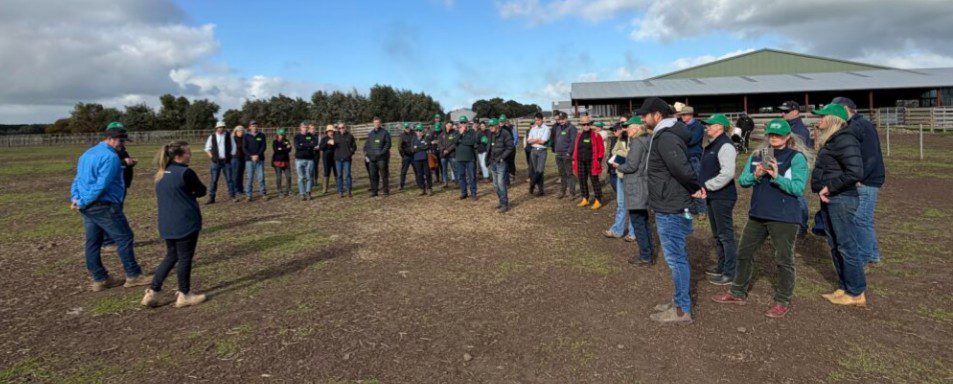
Green Sheep Project launch participants get an insight into Midfield management at Quamby East. Image – GHCMA.
SHEEP Producers Australia’s Green Sheep Project was launched on-farm in Victoria this week, leaving participants keen to see more detail about how it will deliver on its aims with $3 million in funding over three years to 2028.
More than 70 farmers attended the project launch at the Midfield Meat Group’s property Quamby East near Woolsthorpe.
Sheep Producers Australia chief executive officer Bonnie Skinner said the Green Sheep Project is an investment in the long-term success of the sheep industry.
“Producers are increasingly being asked to provide evidence around sustainability and natural capital outcomes, and this project is about making sure the sheep industry is prepared and producers are supported,” Ms Skinner said.
“What makes this project powerful is the whole-of-industry approach; from producers to processors, natural resource management organisations and supply chain partners, all working together to build the capability the industry needs to measure, communicate and respond to changing expectations.”
Finding the right tools for market access
Glenelg Hopkins Catchment Management Authority land health manager Bernadette Northeast said the project is about working out how farmers can maintain market access and get an economic return on the good stewardship of their land, water and biodiversity in the markets they supply.
“Finding the right tools to measure that, understand what farmers know now and what they need to know, and what it all looks like in the paddock and for farm businesses is what the project will deliver over the next three years.”
The Green Sheep Project is being delivered around Australia by the Glenelg Hopkins CMA and other natural resource management organisations – NRM South (Tasmania), Wheatbelt NRM (Western Australia) and Holbrook Landcare Network (NSW) – together with and supply-chain bodies and industry groups.
In Victoria, the GHCMA said the project will be delivered through demonstration farms and practical workshops showcasing how producers can implement the tools, measure, record, and understand the natural capital on their farms and how it can benefit their business economically.
Winslow fine wool grower Susan Finnigan and Green Sheep demonstration farm applicant said she needed to see more detail about the project.
“If they could endorse some tools that are accessible to everybody and that would be acceptable for the Responsible Wool Standard, Livestock Production Assurance, Authentico and Reda, and all the other people that we often have to report to, that would be good.
“There is potential there if they could get all those stakeholders in a room and actually agree on tools that everyone is happy with,” she said.
“I think there is a lot to be worked out.”
She said many organisations had sustainability goals, including the European Union and the United Nations – and with wool, a lot of brands had their own goals. Ms Finnigan said sheep producers are also keen to get their carbon accounting baselines and it would be helpful if accounting tools could be made available to everybody.
“We need verifiable metrics and it would be nice if they could endorse a part set of tools that is accessible for all farmers to use across biodiversity, animal welfare, flock management ….”
Demonstrations on farms needed to be back by evidence
Soil research scientist Roger Armstrong said the project has a good aim to promote the marketability of Australian produce to domestic and overseas consumers by encouraging adoption of management practices tat contributed to environmental service, while maintaining and hopefully improving on-farm profitability. He believed most farmers would like to see more detail before fully engaging.
“As a scientist, I like to have confidence before fully commiting to a particular management approach.
“Having documented guidelines provides an opportunity to fully consider the pros and cons of particular approaches, especially if it involves additional costs or labour in the short-term.”
Dr Armstrong said it was important that on-farm practices being promoted were backed by evidence; especially what environments and enterprises they worked best in, while recognising there could be some situations in which they were problematic. He is a strong advocate of evidence-based policy.
He said using demonstration farms to validate practices underwritten by prior research is a good strategy to encourage local adoption.
“You can’t use demonstration sites alone however, as evidence that something will always work.”
The Green Sheep Project is led nationally by Sheep Producers Australia with funding through the Australian Government’s Climate-Smart Agriculture Program under the Natural Heritage Trust and delivered in Victoria by Glenelg Hopkins CMA. The GHCMA said it is a national initiative designed to build capability and confidence across the sheep industry by equipping farmers with user-friendly tools to demonstrate their environmental credentials, support improved grazing and pasture management, document natural capital and make data-driven decisions.
The GHCMA said the Victorian launch included producer talks and paddock walks with agfluencer Tara Bellerose from Tara Farms highlighting the importance of the farmers being seen for what they do and how her Youtube videos reach 100 million people a year. There were discussions around the current levels of industry understanding of natural capital, how The Midfield Group is implementing environmental sustainability lessons learned from dairying operations into lamb and beef production enterprises, and what the market is beginning to expect from producers around their environmental stewardship.
The national project was officially launched by the Minister for Agriculture, Fisheries and Forestry Julie Collins at AgFest in Tasmania earlier this month.
For more information on The Green Sheep Project, visit www.ghcma.vic.gov.au/greensheep
HAVE YOUR SAY