
AUSTRALIA’S goat producers are being asked to fund a greater emphasis on marketing and market access in a proposal to more than double the transaction levy from 37.7 cents to 90 cents per head.
A webinar earlier this month kicked off the goat transaction levy review producer consultation process, to be followed by a Goat Industry Council of Australia Roadshow.
The levy consultation process will culminate in a producer vote on 24 November coinciding with the Meat & Livestock Australia annual general meeting.
The levy proposal put to producers includes a tripling of the marketing component from 10.5 cents to 31.5 cents and from 16.7 cents to 27 cents for research and development, plus a doubling of the biosecurity activity component from 4.5 cents to 9 cents and more than tripling the National Residue Survey allocation from 6 cents to 22.5 cents.
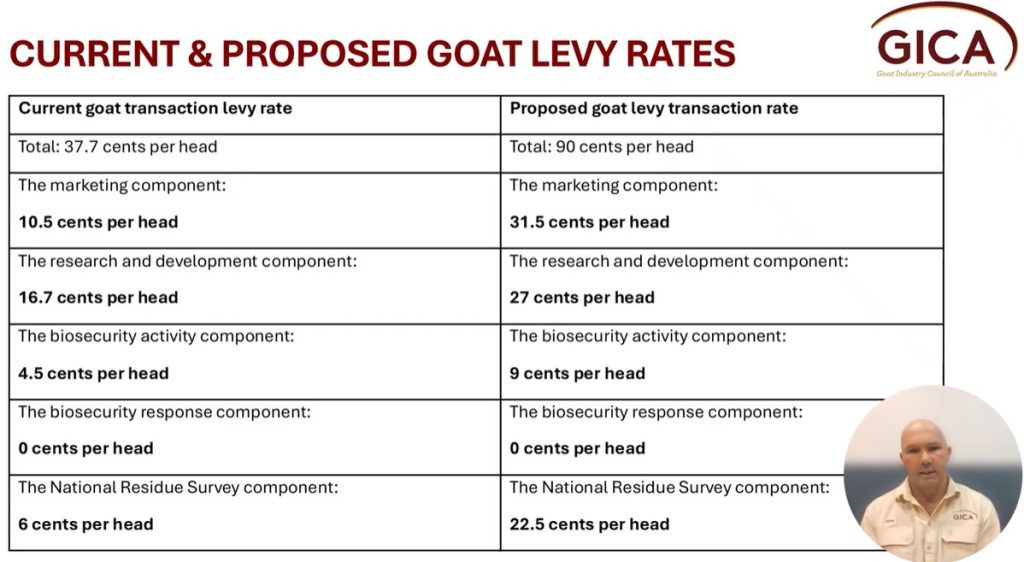
GICA will need to get the approval of more than half the voting producers for any levy proposal to proceed to a formal recommendation for government approval. The council is launching a series of face-to-face meetings across the country from 2 July to consult on the proposal to increase the goat livestock transaction levy and equivalent goat owner export levy.
GICA president John Falkenhagen said the levy increase is necessary, for research and development, marketing, market access and biosecurity.
“We’re doing big (R&D) projects, but spreading them out over years, so that we can actually afford them.
“On NRS, with the volumes we are putting through, we must invest more – it’s not a ‘we would like to’, it’s a must if we want to maintain market access,” he said.
“And we are hearing from producers they want to invest more into marketing – and if you want to invest more into marketing, we need to come up with some more money for that.
“And biosecurity is a no-brainer in agriculture; we’ve got to continue to be prepared in that space.”
Mr Falkenhagen said previous suggestions to increase the levy had ranged from 15 cents to $2.50.
“We are going to have a myriad of opinions on all of this, on ‘it’s too high, it’s too low, it needs to be this or that’.
“We’ve come up with what we think is fair and equitable for everybody to sustain the industry into the future.”
Mr Falkenhagen said producers need to have their say and “they asked us to do it.”
Although GICA consulted with MLA, Animal Health Australia DAFF and the National Residue Survey to get data on programs, the service provider bodies are not allowed to ask for any money from GICA, he said.
Good initial support for levy proposal
He conceded that GICA had not consulted widely with every producer to form the levy proposal “but that’s what the next part’s about” – the GICA Roadshow.
“Let’s have the conversations and then ultimately let’s have that vote, which is mandatory.”
On the risk that producers might reject the 90 cent proposal, Mr Falkenhagen said the resolution did not have to finalised until later in the year.
“If there is an overwhelming response that it (the 90 cent proposal) is not right we will have to reconsider, but I think what we’ve put up is pretty fair.”
He said GICA is encouraging all goat producers to vote on the 90 cent proposal because of the need for more than 50pc approval.
“Ultimately we could go through this process and the producers could say ‘no, we like what we’ve got’, but it is a producer levy for them.
“We have good initial support – the feedback has been really good.
“Ultimately there is significant pressure on where the goat levy sits; we need to do something,” Mr Falkenhagen said.
“So if they say ‘no’, we are going to have to find some other way of doing some things.”
Levy has not changed since 1997
Mr Falkenhagen said the levy was set in 1997 and the dollar value of the levy has not changed since, leading to a decision that the time is right to review the levy to ensure it is fit for purpose and able to support the growth of the industry.
“A lot has changed since 1997, but the levy paid by goat producers hasn’t changed and clearly with costs increasing and service delivery models changing, we needed to review the levy amount and distribution.”
GICA engaged with service providers Meat & Livestock Australia, NRS, Animal Health Australia and the Department of Agriculture, Fisheries and Forestry, and reviewed the relevant data that informed council deliberations.
“From that, we developed a proposal which we launched with a special online event attended by producers and other stakeholders.
“We believe that the proposal is in the best long-term interests of the entire goat sector. We need to invest in all areas to keep up with the maturity of our industry and market access requirements for both the export and domestic sectors,” Mr Falkenhagen said.
GICA said Australian goat meat production reached new highs in 2025 with Australian Bureau of Statistics data highlighting that it was the industry’s strongest on record since 2024.
Total goat meat production surpassed 60,000 tonnes for the first time – reaching 63,672 tonnes. This represented an increase of about 9250 tonnes (or 17pc) on 2024 levels.
Mr Falkenhagen urged producers to engage with the events being held around the country to consult on the levy proposal.
“The goat industry is a great industry, and it is continuing to grow because producers see a future. We now need to see the investment to match that to achieve even greater success into the future.”
Mr Falkenhagen said GICA is not allowed to allocate any levy funds for its administration. He said it is important to producers that GICA is producer-based and led.
“I support that, but we still need to find some funding at some point to make sure that we can spend the time to do all this stuff.”
The roadshow dates and locations include in South Australia at Gawler on 2 July and Quorn on 2 July; in Victoria at Shepparton on 6 July; in New South Wales at Ivanhoe on 8 July, Orange on 10 July and Bourke on 13 July; in Queensland at Barcaldine on 15 July, Toowoomba on 17 July; in Tasmania on 4 August; and in Western Australia on 29 July. A final webinar outlining the roadshow’s findings will be held on 20 August. GICA will advise of the actual roadshow venues through various communication channels.
HAVE YOUR SAY