KEY animal welfare data in the 2026 Australian Sheep Sustainability Framework released this month and launched in Canberra today is either unavailable or out of date by up to two years.
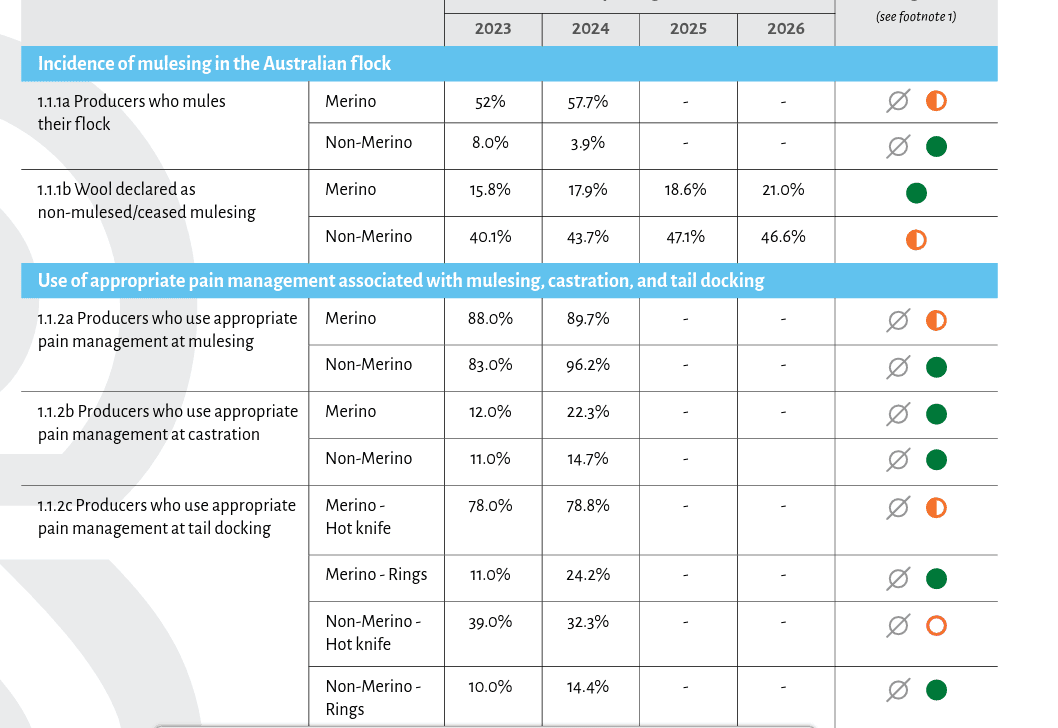
The Sheep Sustainability Framework’s 2026 report released this month did not include data on the percentage of Merino and non-Merino sheep producers who mules their sheep since 2024.
However, the report did include up-to-date data on the percentage of wool declared as non-mulesed/ceased mulesing, with a 2.4 percent increase to 21pc in 2026 in the Merino category and a 0.5pc decrease to 46.6pc for non-Merino wool.
This data reflects continued movement towards non-mulesed wool and responsiveness to animal welfare and market expectations, the report said.
 The report also did not have 2025 and 2026 data for the use of appropriate pain management at mulesing, castration and tail docking.
The report said that some data relating to mulesing and pain management is collected via the National Sheep Producer Survey which is conducted every three years. The next update is in 2027. AWI and MLA are investigating complimentary data sources which could provide more regular updates on mulesing and pain management and these sources will be presented to SSF governance groups for consideration, the report said.
The report also did not have any data for the past three years on sheep transported in line with animal welfare standards (fit to load). The report said there had been delays in sourcing the data for this indicator. Data in this area has recently become more important with two major sheep saleyards having had animal welfare complaints levelled at them – Bendigo and Forbes — however, Sheep Producers Australia has been unable to give a reason for the delay in the week since the report was released on 17 November.
The report said progress has been made in 2026, through the Federal Sustainability Reporting Uplift Grant and through continual work with the Australian Livestock and Rural Transporters Association, to source data relating to animal movement and performance by animal welfare accredited transport operators. Reporting on this indicator will commence when data becomes available, the report said.
Non-mulesing progress too slow
Animal welfare program manager for Humane World for Animals – Australia, Georgie Dolphin said the wool industry cannot claim to be responsive to animal welfare concerns when the rate of increase in non-mulesed or ceased mulesing Merino wool is so painfully slow.
“If the latest annual rate of increase were maintained, it would take more than three decades for the Australian wool industry to cease mulesing of Merinos.
“The slow pace of change shows it is time for governments to step in on mulesing, to legislate a clear and practical phase-out timeframe and to support producers to complete the transition,” she said.
“Many wool producers have already demonstrated that transitioning away from mulesing is both possible and commercially viable.
“This year, the Australian Veterinary Association supported an industry-wide phase-out of mulesing,” Ms Dolphin said.
“The Sustainability Framework is a welcome initiative, but it clearly has a way to go.
“There are substantial gaps in the data needed to properly assess overall animal welfare measures,” she said.
“More than half of the framework’s metrics have no new data this year, the latest producer-level data on mulesing and pain management relates to practices undertaken in 2023, and there is still no national result for whether sheep are being transported in accordance with fit-to-load requirements.”
Joint release praises ‘transparent’ and ‘full picture’ report
A joint media release from the framework, Sheep Producers Australia and WoolProducers Australia said the report revealed strong sheep meat values and continued progress in animal welfare and biosecurity alongside persistent pressure on productivity, operating returns and wool supply.
The 2026 report draws together industry-level data across animal care, environment and climate, people and communities, and financial resilience, the release said.
Independent chair of the SSF board, Angus Gidley-Baird, said the report showed an industry making progress in some areas while confronting structural challenges in others.
“The value of the report is that it puts the full picture on the table,” Mr Gidley-Baird said.
“It shows where the industry is moving forward, but it is equally clear about the areas that need continued attention.”
The joint release lauded the 2.4pc increase in Merino wool declared as non-mulesed or ceased mulesing among the report’s “positive results”, as well as Australia maintaining its freedom from 12 major sheep diseases, supporting animal health, market access and confidence in Australian sheep meat and wool.
The report also showed the gross value of Australian sheep meat production reached $5.617 billion in 2024–25, up 37.5 per cent on the previous year.
However, a good market alone doesn’t make an industry resilient, Sheep Producers Australia chief executive officer Bonnie Skinner said.
“Strong prices are welcome and give producers an important incentive to invest, but tight supply is a double-edged sword,” she said.
“Competition for fewer sheep has driven livestock prices to record high.
“That’s good news for producers, but every part of the supply chain relies on a steady flow of stock for industry sustainability,” she said.
“Our long-term sustainability rests on continual improvement, responding to change and keeping enough sheep to serve our customers,” she said.
WoolProducers Australia CEO Jo Hall said the report was increasingly important to businesses and organisations seeking reliable information about the sustainability of Australian wool and sheep meat.
“The report identifies declining productivity, workforce pressures and falling wool supply as ongoing areas of concern,” Ms Hall said.
“Sheep production competes with every other use of land, labour and capital.
“Securing its future means creating the conditions for sustained investment, higher productivity and the capacity to adapt, so sheep and wool remain a viable choice,” Ms Hall said.
“The value of the SSF is that it does not gloss over the numbers.
“Being clear about where returns and productivity are falling short gives industry a stronger basis for action,” she said.
Mr Gidley-Baird said the framework’s role was not to set policy or prescribe how individual businesses should operate.
“Its role is to report the evidence clearly and consistently, so industry, government and markets can make informed decisions from a shared understanding of the facts.
“Customers, governments, brands and supply chain businesses are asking more detailed questions about sustainability, traceability, animal welfare and resilience,” he said.
“The SSF gives them a consistent, transparent view of what is happening across the industry, based on data rather than assertion,” he said.
The Sheep Sustainability Framework is led by Sheep Producers Australia and WoolProducers Australia, with support from Meat & Livestock Australia and Australian Wool Innovation. The 2026 Sheep Sustainability Framework Annual Report is available at: www.sheepsustainabilityframework.com.au/resources/reports/
HAVE YOUR SAY