
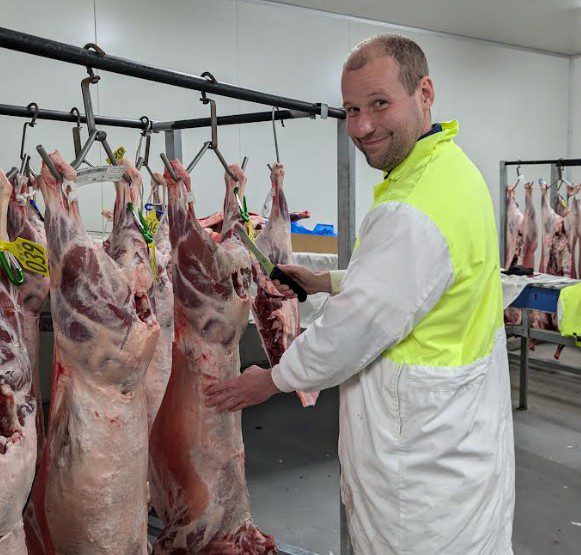
Assoc. Prof. Holman examines some goat carcases.
AN Australian science team has developed the first benchmarking specifications for rangeland goat meat — a classification grid that could see more consistent cuts and better eating quality for popular export commodity.
While quality baselines have been established for muscles in beef and sheep carcases, they are unavailable for rangeland goats, the main source of animals for goat meat processing in Australia. Animals are being processed as whole carcasses or as frozen six-way cuts into meat known as chevon.
To develop the ARG carcase specifications, New South Wales researchers established a quality baseline for eight muscles taken from 25 entire male goats, comparing elements such as cooking loss, shear force – the meat’s resistance to dark cutting or ultimate acidity/alkalinity measured as pH.
Lead researcher, Charles Sturt University’s Assoc. Prof. Benjamin Holman said chevon is a popular lean red meat, but in Western markets, consumers will often consider it as inferior to other red meats.
“This could be the result of chevon being less tender and juicy than beef and sheep meat, a quality difference that is likely due to its unique physicochemical properties, such as a lean carcass composition and the distribution of connective tissue.
“It is important we don’t transfer our understanding of lamb and other small ruminant meat quality traits to ARG without first validating it,” he said.
“The leanness of ARG seems to affect the muscle-to-meat conversion, resulting in some interesting differences between the cuts in terms of tenderness.
“Chevon often fails to achieve the high degree of tenderness achieved by other red meats, partly because goats lack to subcutaneous fat coverage necessary to protect carcasses from cold shortening during the chilling process,” Assoc. Prof Holman said.
“Chevon also had significant muscle‑specific variation in quality,” he added.
“The study determined superior tenderness of muscles around the rump, tenderloin and eye fillet regions, and the lesser water‑holding capacity of the backstrap, along with consistently high ultimate pH.”
His study revealed that the ultimate pH of muscle tissue has the biggest influence on the variation of meat quality, followed by cooking loss and tenderness-related traits.
“Goats are widely considered as temperamental animals, and highly susceptible to pre‑slaughter stress.
“This leads to the rapid depletion of muscle glycogen, resulting in the high pH values,” Assoc. Prof. Holman said.
“The high ultimate pH would likely have impacted on the water‑holding capacity of chevon, a characteristic often associated with dark, firm and dry meat which has poor shelf life and low consumer appeal.
“This biochemical state could also explain the high cooking loss.”
The study found that that several chevon muscles failed to achieve the high degree of tenderness achieved by other red meats, specifically the backstrap. Some cuts could be also subject to cold-shortening during the chilling process due to a lack of subcutaneous fat coverage, Dr Holman said.
Assoc. Prof. Holman said the results from the study identified less-tender muscle groups more suitable for value-added processing or slow-cooking applications. The work also highlighted the importance of pre-slaughter management and glycogen preservation in rangeland goats.
The scientist is based at CSU’s Gulbali Institute and shared his findings recently at the 72nd International Congress of Meat Science and Technology in Korea.
“This data can help link specific muscles to optimal cooking methods or processing interventions, such as electrical stimulation or ageing, to meet consumer expectations and maximise carcass value,” he said.
“I think it’s a good first step to understanding the potential for ARG meat and developing specific cuts/products for domestic table services as well as those better suited for processing or value-adding.”
HAVE YOUR SAY