
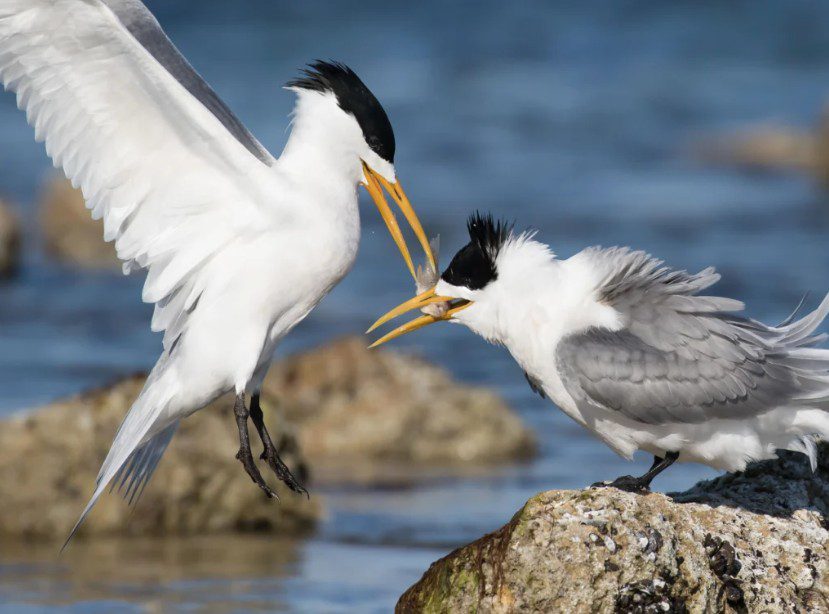
Greater Crested Terns. Photo by Rebecca Harrison, BirdLife Australia.
FARMERS are being urged to update their biosecurity plans after local transmission of H5N1 bird flu was detected in South Australia and Victoria, with the expectation there will be further spread into wildlife.
Victoria has also recorded its first H5N1 in a Greater Crested Tern at Portland leading to the state implementing its Emergency Animal Disease Response Plan.
Minister for Agriculture, Fisheries and Forestry Julie Collins and chief veterinary officer, Dr Beth Cookson, yesterday confirmed 11 further greater crested terns from South Australia have returned suspect positives for the H5N1 virus and sent to the CSIRO lab for confirmatory testing.
 “This follows 27 confirmed detections of H5 bird flu in Australia to date.
“There is 10 currently in Western Australia, 14 in South Australia, two in New South Wales, and one in Queensland,” Ms Collins said.
“I can advise that today the Consultative Committee on Emergency Animal Diseases, met and has agreed, based on testing and sequencing by the CSIRO lab, that some local transmission has occurred between a number of greater crested terns that are resident in South Australia.
“While there remains no evidence of any mass mortalities at this point in time, we do expect with this local transmission that there will be further detections in Australian wildlife,” Ms Collins said.
Ms Collins reiterated that there has been no detections in any poultry or agricultural industries in Australia and that the risk to human health remains low, but asked people to not touch any dead birds found, and go to birdflu.gov.au to report them or for updates.
The total of presumed positive H5 bird flu cases in Australia was later updated today to 29.
Dr Cookson said based on overseas experience that once the virus becomes more widespread in wild bird populations, it will not be possible to avoid losses in susceptible wildlife in the natural environment.
“Our focus will continue to be on surveillance to confirm where the virus is circulating and to take further action to reduce the impacts where possible.
“This small shift in the situation will be very disappointing to many, but it’s certainly not an unexpected development.”
NFF urges review of farm biosecurity plans
The National Farmers’ Federation has urged farmers to urgently review their biosecurity plans, as the H5N1 strain of avian influenza spreads.
NFF chief executive officer Mike Guerin said the news is unwelcome, but not unexpected.
“Unfortunately, this is a turning point in the spread of this disease.
“We take comfort in the fact there’s been no mass mortality events, and there have been no detections in agriculture,” he said.
“But while this outbreak is currently a concern for wildlife, now is the time for all farmers to review their biosecurity plans.
“Bird flu poses a serious threat to poultry, as well as a much smaller cross-species risk across livestock industries,” Mr Guerin said.
“It’s imperative that farmers record accurate people and animal movements in their biosecurity plans and look for ways to reduce risks.”
Mr Guerin said the spread of the disease reinforced the importance of strong biosecurity.
“We continue to advocate for the strengthening of Australia’s biosecurity systems,” Mr Guerin said.
“We’ll keep working closely with Government and our members to monitor the situation and support a coordinated national response.
“Industry and Government have both invested heavily for years to prepare for this, and have learned lessons from outbreaks of other strains, including H7.”
Farmers are encouraged to report any sick birds or animals to the Emergency Animal Disease Hotline on 1800 675 888.
Dr Cookson said there has been more than 10,000 calls to the national hotline since 20 June and Ms Collins said hundreds of tests have been done on birds and some mammals.
Detection is concerning – VFF
Victorian Farmers Federation president, Ryan Milgate, also urged farmers to review their biosecurity plans and keep an eager lookout for any unusual illness or unexplained bird deaths and report them immediately to the Emergency Animal Disease Hotline on 1800 675 888.
“While this detection is concerning, it’s not unexpected and the wider agriculture industry has been undertaking an enormous amount of preparation over the past few months for this very moment.
“Importantly, this detection is in a wild bird,” he said.
“There has been no spread to commercial poultry flocks or any agricultural environment at this stage, and the risk to human health remains very low.
“We are continuing to work closely with government and industry as the response continues.”
Mr Milgate said good biosecurity remains our best defence against the spread of disease.
“We strongly encourage all livestock producers, not just poultry farmers to review their biosecurity plans, ensure they reflect current risks, and remain alert for any sick or dead birds or unusual signs of disease on or near their property.”
Agriculture Victoria confirmed the H5 detection at Portland, but said there are currently no movement restrictions in place for poultry or bird movement in Victoria.
Overseas, this strain has caused severe disease and high death rates in poultry, wild birds and other wildlife. Human cases are rare and the virus does not spread easily between people, Agriculture Victoria said.
Victoria’s chief veterinary officer Dr Graeme Cooke said following weeks of enhanced readiness, Agriculture Victoria has enacted Victoria’s State Emergency Animal Disease Response Plan.
“Based on international experience, this H5 variant differs from previous strains and has been known to cause large numbers of deaths in wild birds and some mammals,” he said.
“Our plans aim to limit impacts where possible particularly on our most threatened species, while also supporting our farmers and reducing risk to domestic and commercial poultry.
“We need Victorians to avoid contact with sick or dead wildlife, record what they see and report it. Early reporting gives us the best chance to reduce the impacts of the disease,” Dr Cooke said.
BirdLife Australia seeks $200m nature resilience package
BirdLife Australia said the announcement of new suspected cases of H5N1 bird flu in resident Greater Crested Terns in South Australia means the threat to Australia is growing day by day. All seven birds were found on South Australia’s Limestone Coast, with five of the birds found at the same location in Southend. The other two birds were found at Cape Jaffa and Port Macdonnell.
These new cases show us that the virus is now spreading among resident Australian birds.
BirdLife Australia CEO Kate Millar said the significant development needs to spur actions to help wild bird populations wherever possible.
“We can now see that the virus isn’t just arriving on birds that have caught it offshore, it’s on the move here on the Australian continent.
“Sick seabirds arriving from the Southern Ocean were like embers from a forest fire,” she said.
“Now there’s smoke.
“With federal and state departments at various stages of stepping up surveillance and preparing for incident management, we’re asking that real action to protect wildlife is undertaken with appropriate urgency.”
Dr Cookson has said there is limited feasible and practical actions to control or contain H5N1’s spread in wildlife, but the government’s significant investment in preparedness has allowed early detection and well-enhanced surveillance activities, especially in high-priority conservation species. She said there will be a continued focus on protecting captive breeding populations.
However, BirdLife Australia has urged a scaling up of actions actions to support the resilience of birds and wildlife in Australia through a $200 million urgent nature resilience package.
“More needs to be done to target surveillance efforts, mitigate threats and bolster populations of the bird populations at risk.
“Targeted surveillance needs to be backed up with actions that are going to immediately support the resilience of wildlife populations and the species at greatest risk,” she said.
“It’s not too late, but we can no longer afford to wait.”
Ms Millar said Australia should be controlling pests at critical breeding sites where even a small number of foxes can have an enormous impact. Funding for nest protection in the Coorong, which is due to run out right at the peak of the next tern breeding season, can be extended, she said.
“Reinstating funding that has run out for weed removal and feral bird control on the Fleurieu islands can help seabirds there.
“These are known solutions that can be rolled out relatively quickly.”
Greater Crested Terns nest in colonies and roost in large flocks, making them particularly vulnerable to H5 bird flu. They also interact with other coastal and wetland species, so these should not be thought of as isolated cases, BirdLife Australia said.
HAVE YOUR SAY