
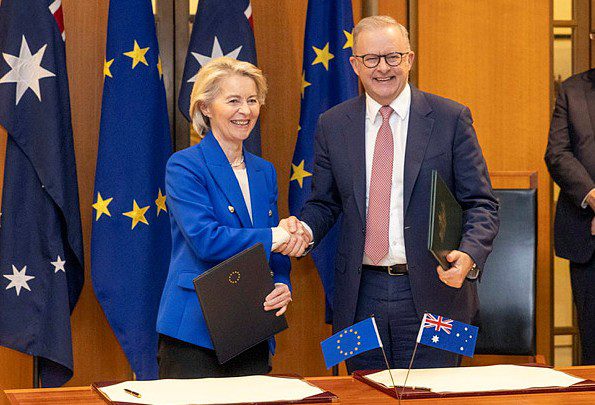
Prime Minister Anthony Albanese and European Commission prsident Ursula von der Leyen also signed the Australia‑European Union Security and Defence Partnership in Canberra today. Image – Supplied.
SHEEP and goat meat access into the European Union has been increased, but well below industry expectations, in what is being described as the worst ever free trade agreement for Australia’s red meat sector.
Chair of the Australia–EU Red Meat Market Access Taskforce, Andrew McDonald, said the sector has been profoundly let down by the outcome, described by the industry group as the “worst ever free trade agreement for Australian red meat industry to date.”
“The Australian red meat industry has been crystal clear that the FTA negotiations were the ideal mechanism to finally address the EU’s punitive and highly discriminatory import regime.
“Yet the agreement delivers just 30,600 tonnes carcase weight (cwt) of beef access over the next 10 years, when a minimum of 50,000 tonnes (cwt) was required simply to be in line with what the EU has offered our competitors,” he said.
 “On sheep meat and goat meat, the result is equally disappointing: 25,000 tonnes (cwt) over seven years, despite Australian industry requesting a minimum of 67,000 tonnes cwt.
“This stands in stark contrast to New Zealand’s access of 163,769 tonnes, which is an outrageous discrepancy,” Mr McDonald said.
“To land a deal so far below what other suppliers have secured is genuinely bewildering.
“The agreement is a long way from anything resembling ‘free and fair trade’, particularly given Australia already provides the EU with quota‑and tariff‑free access for meat products like pork, while the A‑EU FTA locks in perpetual volume constraints on Australian red meat entering the EU.”
The taskforce said the Federal Government has badly let the sector down, signing an extremely disappointing free trade deal with the European Union that falls far short of what Australia needed and expected.
Australia’s red meat industry is devastated that the Federal Government signed an FTA that falls well short of delivering a significant increase in market access, despite repeatedly indicating it would not sign a bad deal, a taskforce statement said.
The taskforce said while the incremental increase in quota access has been noted, the outcome is well below the Australian Government’s own objectives, let alone stakeholder expectations.
Mr McDonald last month said Australia’s current country specific beef quota sits at just 3389 tonnes shipped weight (swt). This compares starkly with:
49,500 tonnes cwt secured by Brazil (assuming 50 percent of Mercosur’s 99,000 tonne outcome); and
50,000 tonnes cwt secured via the EU-Canada agreement
He said New Zealand enjoys 125,769 tonnes of WTO access plus 38,000 tonnes under its FTA. By contrast, Australia is limited to just 5851 tonnes.
“A genuinely trade enhancing FTA must go a long way toward addressing this imbalance by securing at least a minimum of 67,000 tonnes.”
Disproportionately low EU quotas to continue
The taskforce today said unfortunately, the deal announced this morning by Australian Prime Minister Anthony Albanese and EU Commission president Ursula von der Leyen will see the continuation of disproportionately low quotas for red meat, placing Australia at an ongoing competitive disadvantage in the highly valued EU market.
“This outcome also sits uneasily beside the EU’s rhetoric of providing ‘a level playing field for all’ and its claims that Australia is a ‘like‑minded’ partner. In practice, this agreement delivers neither fairness nor reciprocity.
“This is unquestionably a missed opportunity for Australia’s red meat producers, processors and exporters,” Mr McDonald said.
“It will limit our sector’s ability to diversify into a market of 27 countries with strong and ongoing demand for imported meat. It will also deprive most of the EU’s 450 million consumers of the chance to choose high‑quality, sustainable Australian red meat products.
“The EU’s inability to reform its deeply protectionist trade regime ultimately prevented the delivery of a good deal.”
Australian farmers extremely disappointed – NFF
National Farmers Federation president Hamish McIntyre said Australian farmers are extremely disappointed that negotiations for a free trade deal with the European Union have concluded without commercially meaningful agricultural market access gains since Australia last walked away from negotiations.
“What the Australian Government has accepted today appears to offer no material change for key agricultural commodities as what the government rightly rejected in October 2023.
“For decades, our sector has been guided by a clear principle of wanting more two-way trade with the EU, not less,” he said.
“The NFF has long championed free and fair trade, recognising its role in global economic growth and stability. Australian agriculture is unwavering in its commitment to this.
“A deal with a market of this size offered an opportunity to help ease the pressure on farmers who are grappling with the impacts from the conflict in the Middle East, China’s beef tariffs, and United States trade volatility, which are creating global trade headwinds,” Mr McIntyre said.
“The NFF acknowledges the efforts made by Australian negotiating officials against a tough counterparty.
“While we acknowledge some progress on issues such as geographical indicators, preserving the use of names like prosecco and parmesan, farmers will rightly be concerned this deal hasn’t delivered commercially meaningful access for Australian agricultural exports,” he said.
“They will now pay the price for this subpar EU deal for decades to come.
“Questions will be asked as to how we can now advocate for others to liberalise trade, having accepted a deal ourselves that does not reflect the core tenet that free-flowing agricultural trade drives positive economic and sustainability outcomes,” the NFF leader said.
Mr McIntyre said market access is the lifeblood of Australian farmers who do not rely on government subsidies.
“We are concerned the EU has offered subpar access for Australian producers while potentially needing to deploy billion-dollar subsidies to get their producers to accept the deal.
“This is exactly what happened when the EU signed a deal with the Mercosur nations, fast-tracking nearly $80 billion in farm subsidies, sending a clear signal protectionism is alive and well,” he said.
“A strong industry and government partnership has been a tenet of Australian trade policy for many decades.
“The government must now demonstrate how it will rebuild this trust,” Mr McIntyre said.
“While the government cannot control other nations’ trade policies, it can control its own, so a good first step would be to pause its plan to increase export costs on industry through full cost recovery until global conditions stabilise.
“The EU’s inability to reform its deeply protectionist trade regime ultimately prevented the delivery of a good deal.”
PM Albanese proud to deliver the deal
A statement from Prime Minister Anthony Albanese said the trade agreement will result in 98 percent of the current value of Australia’s exports entering the European Union duty-free.
The statement said Australian farmers and producers will benefit from the elimination of almost all European Union tariffs on agricultural products, including wine, nuts, fruit and vegetables, honey, olive oil, most dairy products, wheat and barley, and seafood. Australian wine producers and exporters will benefit to the tune of around $37 million annually with the removal of EU import tariffs.
The statement said “the agreement delivers commercially meaningful access through new or expanded tariff rate quota volumes, including for beef, sheep meat, sugar, rice, wheat gluten, skimmed milk powder and natural butter.”
“The removal of most Australian tariffs on imports from the EU will make things like European wine, spirits, biscuits, chocolates and pasta cheaper at Aussie checkouts. Farmers and businesses will also benefit from cheaper motor vehicles and machinery.”
Mr Albanese’s release said the government has protected the rights of Australians to continue using well known terms such as parmesan, and kransky, and preserved the right for Australian winemakers to keep making and selling Prosecco domestically. Grandfathering and lengthy phase-out periods have been secured for a limited number of terms such as Feta, Romano and Gruyere.
The elimination of European Union tariffs on Australian critical minerals and hydrogen will support Australia’s ambition to become a renewable energy superpower and help stabilise supply chains, the government said.
The government said the agreement will also give Australian companies better access to bid for lucrative European government contracts, service providers will have greater market access to the EU, including in financial services, education, tourism and communications. Australian professionals will be able to travel to the European Union more easily and will benefit from streamlined recognition of their Australian qualifications, the release said.
The government said the agreement will enter into force when both Australia and the European Union have completed their domestic processes.
Mr Albanese said he was proud the government has been able to secure the deal, which will deliver benefits for both Australia and the European Union for generations to come.
“This deal creates major new opportunities for Australian exporters in the European Union’s massive $30 trillion economy, and will reduce costs for Australian consumers.”
Minister for Trade and Tourism Don Farrell said the hard-fought deal delivers real commercial gains for Australian exporters, farmers and producers into a market that has been difficult to enter or effectively closed for decades.
“The removal of EU tariffs on most of Australia’s exports gives Australian exporters the opportunity to diversify trade with 27 European countries and 450 million consumers.
“This is a strategically important and economically valuable agreement at a time when Australian exporters are navigating choppy trade waters,” he said.
“More trade, with more trading partners means more supply chain security, more well-paying jobs, cheaper prices, and more national income to build things like urgent care clinics and improve government services.”
HAVE YOUR SAY