
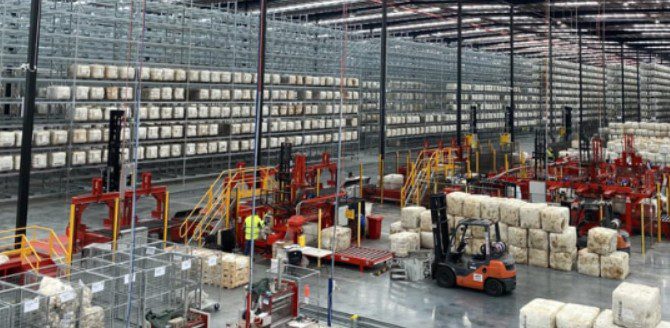
Elders state-of-the-art Ravenhall wool handling facility.
A DECISION by Elders to discontinue selling Western Australian clients’ wool in the state from July next year has been blamed on the Albanese Government’s phaseout of live sheep exports by sea.
An email to WA producers from Elders western region general manager Matthew Ericsson yesterday said Elders has decided that from July 2027, all WA wool handled by the company will be received, processed and sold through its Melbourne operations.
“This decision reflects the impacts of a sustained decline in WA wool production volumes, close to 40 per cent in recent years, and our sense of responsibility to ensure long-term support for our clients.”
He wrote that the decision was reached “after careful consideration and engagement with industry stakeholders.”
“Our priority throughout this process has been to identify a solution that delivers the greatest benefit to growers, including strong access to buying competition, efficient speed to market and long-term industry viability,” he said.
Elders move underscores ‘deeply flawed’ live sheep decision – WoolProducers
While noting that Elders had made a commercial decision with “the long-term sustainability of the western industry in mind,” peak grower body WoolProducers Australia said the fact that the Federal Government’s decision to ban live sheep export had led to the immediate and severe reduction of sheep numbers in Western Australia cannot be ignored.
The statement from WPA chief executive officer Jo Hall and president Steve Harrison said WoolProducers had warned that any move to ban live sheep exports by sea would have a severely detrimental impact on the Western Australian wool industry.
“This announcement by Elders has proved that the paltry (transition) compensation package that has been offered by the Federal Government has done nothing to keep western growers in the wool industry.
“It further underscores the deeply flawed ideological decision made by the Federal Government to shut down an industry,” WPA said.
“Government funding for roadmaps or strategies counts for nothing when it is commercial realities that dictate the viability of industries.”
PGA livestock committee president Chris Patmore said he blamed Elders decision on the low sheep numbers in the state and the live sheep phaseout “has a fair bit to do with it, although possibly not entirely to blame.”
He said when he started farming 30 years ago there were close to 40 million sheep in the state and now the flock was down to8-10 million.
He and his family had sold wool through Elders for the past 70 years and he was not overly concerned about the decision.
“I haven’t seen the figures that they are using to justify their decision, so I won’t criticise it without seeing those numbers.
“I’m happy enough to take their word for it on face value, but I would be interested to see the figures at some stage as to how it is going to affect us as producers,” Mr Patmore said.
“It all comes down to economics, if it works out better to sell wool in the east, we’ll do it that way.”
However, he said the decision was a shame given that in 2023, Elders opened a new $25 million wool handling hub near the Port of Fremantle, integrating storage, handling, and sale facilities.
PJ Morris Wool managing director Peter Morris said he did not expect the Elders decision to affect the viability of wool sales continuing at Fremantle which is very economical to run.
He said the live export phaseout decision and meat market uncertainty had led to many wool grower had selling sheep. But with the current high sheep meat prices and higher wool prices, and reasonable seasonal conditions, sheep numbers could increase 15-20pc in the next three years.
Mr Morris said it was important that WA maintain its wool industry knowledge and capital, but agreed that the Albanese Government “has just crucified and destroyed another industry” with its live sheep trade phaseout.
“They didn’t think anything through, crucified the sheep meat and wool sector, and we’re just working through the rubble now.”
Decision reflect production volumes, not reduced commitment
Mr Ericsson said WA client wool will be handled through Elders’ Ravenhall facility in Melbourne and assured growers that:
- Selling costs will remain the same.
- Freight costs will be covered by Elders and buyers.
- In many cases, wool may reach sale as quickly or faster due to increased processing capacity.
- A dedicated WA section will be established on the Ravenhall show floor so that WA wool is clearly identified and showcased to buyers.
“We want to be clear that this change does not mean Elders is stepping away from the WA wool industry.
“On the converse, Elders remains fully committed to WA agriculture and to supporting our growers, communities and clients across the state,” he wrote.
“This decision reflects changing production volumes, not a reduction in our commitment to you or to the wider wool industry.”
WA wool decline risked long-term viability
An Elders statement today said WA wool production has declined by close to 40 percent in recent years, raising concerns about the long-term viability of maintaining local handling operations at current volumes.
The company said it has carefully assessed how best to continue delivering strong outcomes for growers, with a focus on access to buyer competition, speed to market and long-term industry sustainability.
The statement said Melbourne is the largest weekly wool selling centre in the world, hosting around 27 active buyers and accounting for more than half of Australia’s total wool sales each week. The depth and diversity of the Melbourne market provides greater competition and demand across all wool types, from superfine fleece to cardings, Elders said. Sheep Central has been told Elders handled 15-20pc of the WA wool clip.
Elders’ general manager operations Dave Adamson said the decision reflects a proactive and grower-first approach.
“Our priority is, and always has been, to act in the best interests of our clients,” Mr Adamson said.
“Transitioning WA wool handling and selling to Melbourne ensures growers continue to benefit from strong buying competition, efficient processing and consistent weekly auction access, despite the significant decline in local production volumes.”
WA wool will be handled through Elders’ Ravenhall facility in Melbourne, a worldclass, 24hour processing operation opened in 2024 following a $25 million investment – the largest single investment in wool infrastructure this century. The facility has the capacity to handle all WA wool, with no additional selling costs to growers. Freight costs associated with the transition will be covered by Elders and buyers.
A designated WA section will be established on the Ravenhall show floor to ensure WA clips are clearly presented and easily identified by buyers. Elders’ District Wool Managers will continue to work closely with growers throughout the process, providing local support and guidance.
Mr Adamson said Elders remains fully committed to Western Australian agriculture and the Australian wool industry.
“We are moving away from our WA handling facility due to declining production volumes felt across the industry, not walking away from growers.
“We will continue to operate our branch network across WA, support local communities and invest in long-term, sustainable solutions for our clients.”
Who will pay?
Elders said Elders’ Ravenhall facility in Melbourne was “a world-class, 24-hour processing operation opened in 2024 following a $25 million investment – the largest single investment in wool infrastructure this century.”
The company said the Melbourne facility has the capacity to handle all WA wool, “with no additional selling costs to growers.”
“Freight costs associated with the transition will be covered by Elders and buyers,” Elders said.
However, wool trade sources indicated it was counter-intuitive to bundle up and send bales of wool across Australia for sale, when companies were being forced to look at their carbon footprints.
“If that becomes an issue in the next couple of years, all those growers who send wool bales from one side of the country to the other are at a disadvantage,” one buyer said.
Sources also questioned the argument that the buyers will pay for the delivery of the wool from one centre to another “because the grower actually pays for it.”
Wool buyers bidding at auctions nationally automatically deduct the differing post-sale charges on wool lots levied by brokers in deciding their bids. Elders itself already adjusts post-sale charges on interstate wool sold through Ravenhall based on the freight costs incurred.
“So there will be an added cost to the grower … we adjust what we will bid on a bale of wool according to the cost structure … the grower pays for it,” a buyer said.
Congratulations to Elders for centralizing WA wool sales in Melbourne. If our industry had rational leadership there would only be one selling centre in Australia and New Zealand and that would be Melbourne, which would include, of course, one modern AWTA testing facility.
It is essential to slash both buyers’ and growers’ costs. Rationalization of selling and testing is imperative. Well done Elders; buyers and growers can only hope your leadership is promptly followed.
Peter, I understand the intent around efficiency and cost reduction, and on the surface a single selling centre might seem logical. But I’m not sure it’s been fully thought through from all sides of the industry.
For a start, our Western Australian counterparts — the people actually producing the wool — would be the ones carrying a significant portion of the burden. Additional freight, handling, interest, and delays to market don’t disappear in a centralized system; they simply shift. Realistically, that could mean an extra $60–$70 per bale, which ultimately comes back to the grower.
There’s also the growing importance of carbon accountability. Longer supply chains and double handling increase emissions per bale. With global brands placing more emphasis on sustainability, decisions like this could have unintended consequences, potentially leading to penalties or reduced demand for wool that carries a higher footprint.
Biosecurity is another factor worth considering. If we’ve learned anything from recent years — whether it’s COVID or the ongoing concern around Foot and Mouth Disease — it’s that centralizing systems can increase risk. A disruption in one location could take months to unwind and may severely impact access to overseas markets.
Finally, the broader trajectory of the Merino industry has been toward more sustainable pricing and supply chain resilience. Maintaining regional capability and flexibility has arguably supported that progress, rather than hindered it.
So while the idea of rationalisation has merit in theory, the practical implications — particularly for growers and long-term industry positioning — deserve a more balanced consideration.
Wonderful, you have some brains.