
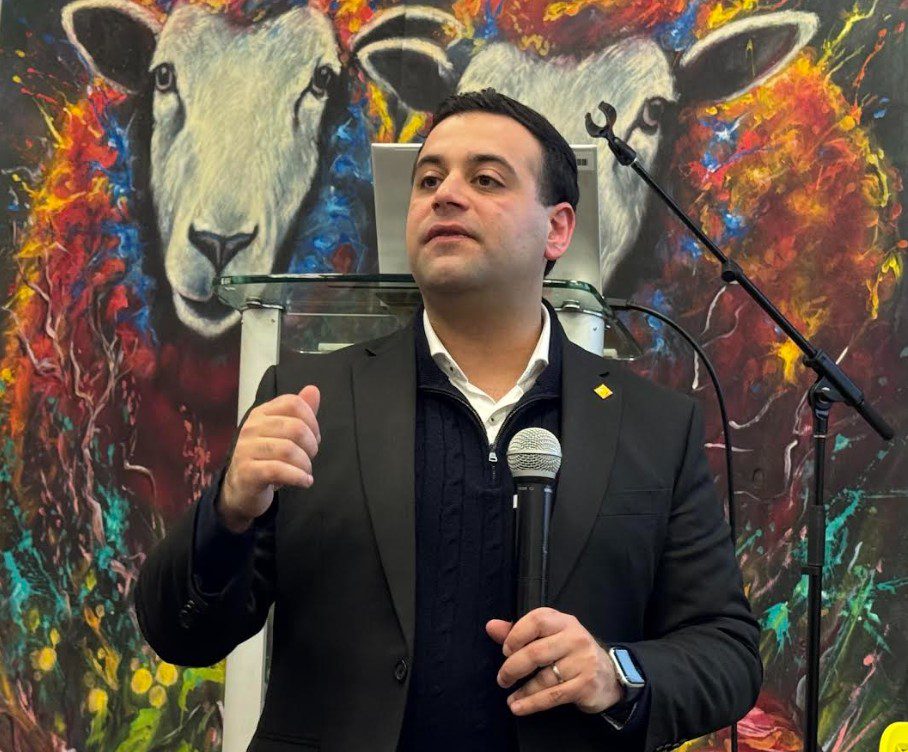
CBA director of fixed income and interest rate strategy, Dr Hamid Yahyaei.
THE importance of interest rate changes and market directions were highlighted in the Commonwealth Bank’s agribusiness panel discussion at the Hamilton’s Sheepvention Rural Expo this week.
CBA agribusiness executive at Hamilton Kate Crozier introduced a panel of industry speakers, including the bank’s director of fixed income and interest rate strategy, Dr Hamid Yahyaei, who outlined the CBA’s expectation that rates would be dropping by mid-2027.
In his first trip to south-west Victoria and the rural expo, in his ‘A brave new world’ presentation he said it was safe to say the world has “absolutely changed” since COVID.
“And perhaps the most damning of changes comes from the geopolitical dimension; the election of certain individuals across the world and so too the re-election of certain individuals across the world has caused an upheaval and has caused a series of changes around the globe and we have accept that reality and understand what it means for our economy and markets.”
Dr Hamid has had a series of ‘”rolling supply shocks” since the pandemic sparked by the invasion of Ukraine by Russia and more recently the Middle East conflict, had raised a lot of questions about energy security and impacted commodity prices in ways that are still playing out – especially in fuel and fertilizer prices — slowing the Australian economy. He said there remained considerable uncertainty over the near-term trajectory of the conflict, with domestic growth slowing and inflation below expectations and an easing labour market.
“And that’s what gives us confidence that by this time next year we’ll be back to cutting rates and the RBA will be taking the foot off the accelerator a little bit.
“So we expect them (interest rates) to remain on hold and you’ve got to remember the weaker housing market – the impact from the rate hikes thus far as well – 75 basis points or a 0.75 percent increase in interest rates, as well as the fact we’ve got this uncertainty, allows the RBA to sit back and just wait and see how the economy goes.”
He said the bank was convinced the economy was slowing from the recent rate hikes and the “consumption drag” from commodity prices due to the ME crisis “because people do change their behavior as well.”
“So that gives a little bit of conviction that this time next year we will start to see inflation return to a more normal pace.
“The risk is obviously if tomorrow oil prices spike to $120(/barrel), $130, $150, we’re almost back to where we started and we are starting to think about inflation again.”
Dr Hamid said because the Australian economy is so exposed to imports that come into the economy it is really hard to understand where price is going to be, particularly geopolitically.
Dr Hamid said the CBA expected the RBA to remain on hold on interest rates for the rest of 2026, before cutting rates in 2027. He said the ongoing ME conflict, weaker housing market and the impact of the past three rate hikes would allow the RBA to wait and see how the economy evolves.
The economist also outlined what financial markets meant for borrowers of credit in the Australian economy, home and car loans, “everything that we have to pay interest on.”
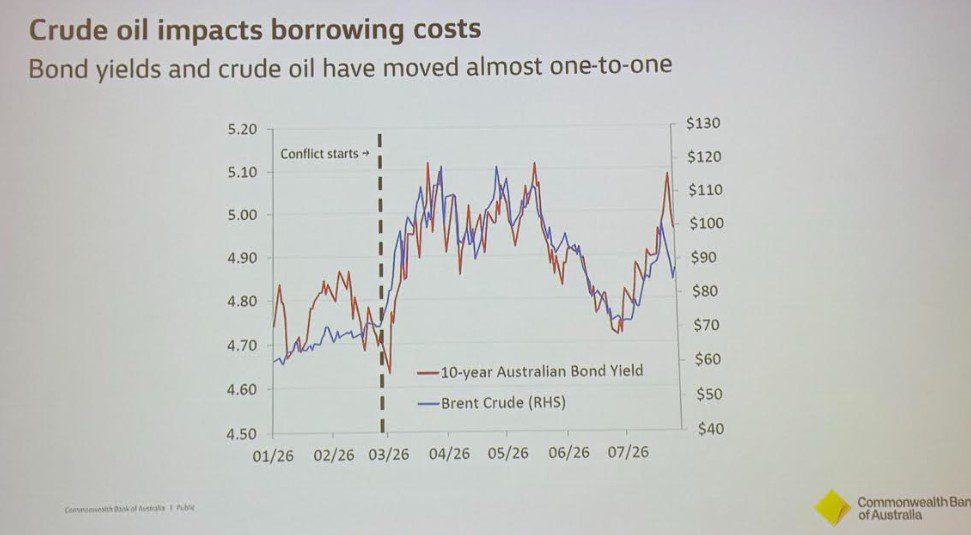
“The fact that we have this surge in crude oil (prices) leads to a rising inflation expectations and concerns that the RBA will have to hike.
“You get this almost one-to-one relationship with the cost of funding (and oil prices) and this is quite important, because every time crude oil surges you have this increase in bond yields as well, 10-year bond yield is effectively the benchmark for lending in Australia.
“So every time crude oil has peaked, bond yields go up and that starts with a lag going to the price of funding and credit for everyone else in the economy.”
Keep a watch on interest rates
When asked by panel moderator Episode 3 analyst Matt Dalgleish which economic indicator farmers should be watching over the next year that would influence agriculture, Dr Hamid said everyone is looking at the price of groceries and fuel.
“So I think the inflation story becomes central to effectively everything that we do.
“So the RBA is obviously very closely focused on that, that’s their mandate.”
Dr Hamid said there are a lot of questions around how good the RBA has been able to control that mandate in the five years after the COVID pandemic, when inflation got out of control.
“To give them a little bit of credit, on the other side of the mandate, of course, is the labour market.
“You push too hard and you are going to cause people to lose their jobs and being unemployed is not a good thing,” he said.
“So I think for us as economists we need to be just look at the data and keep thinking about what will cause that general increase in the price level to be volatile, or to go up, because it hurts everyone.”
He said everyone – farmers or city workers – “faces that same consumer basket to some extent; so that for us is key.”
Understanding market drivers is important – Crozier

CBA agribusiness executive Kate Crozier.
Ms Crozier outlined her personal experience purchasing a property with her partner and running Angus steers with the long-term aim of building a self-replacing breeding herd.
She said the experience had reinforced to her that farming is a business built on patience and that there isn’t a silver bullet.
“You won’t get every decision right, but if you constantly make good decisions, manage your risk, and keep your focus on the long-term, you give yourself the best chance of building a sustainable and profitable enterprise.”
Using the example of a western Victorian sheep enterprise with about $10 million in debt and turning off 5000 lambs annually, Ms Crozier said if interest rates were to rise by 0.25 percent, the additional cost would be roughly equivalent to $5 a head on a 24kg carcase or around 20 cents/kg cwt.
“Now compare that with the day-to-day movements in the lamb market; a 20 cent/kg shift in commodity prices can happen in a single week, sometimes in a day.
“It highlights that while interest rates matter, understanding what’s driving commodity markets can have an even greater impact on your bottomline,” she said.
“The businesses that constantly perform well aren’t just reacting to change, they are anticipating it.
“Understanding where the economy, consumer demand and global markets are heading helps you position your business, and make informed decision and capitalize on opportunities before they flow through to your bottomline – that’s exactly why we are here today.”
Very interesting Sheepvention report on interest rates. Whilst speculation on forward Interest rates by bank economists should be noted, all of us can keep informed by watching the market, particularly yields on US Treasury bonds. Yields on long-term US debt of over 5 percent is a red flag. What is particularly worrying is the US Treasurer’s latest maneuvers to manipulate rates; a maneuver that can only be highly inflationary in anyone’s book.
Hi Peter,
Very wise words you commented here, many countries have increasing bond yield and as you mentioned are now over 5 percent. Inflation moves in cycles as the wise know, small cycles then larger cycles, study history and you can see the pattern with US 30 year bonds now over 5 percent.
There have been periods when inflation rose above 15 percent and even back in history where it approached over 1000 percent. In 1907, US overnight interest rates averaged 20 percent and in October 1907 they reached 100 percent. Imagine if that happened in today’s world? It would be blood running in rivers, not on the streets, as the pun says.
Great comment and glad you’re over it.
Good points Neil. You mention the 1907 financial crisis; it was of course this crisis that precipitated the creation of the US central bank — the US Federal Reserve or ‘The Fed’ — in 1913. Most people foolishly think central banks like the Fed and the Reserve Bank of Australia control interest rates. Central Banks only control short-term rates. It is the market that decides and when risk increases lenders demand higher rates. And when the lenders lose confidence then the currency itself can collapse and become worthless. We are in very dangerous times and caution is prudent.