
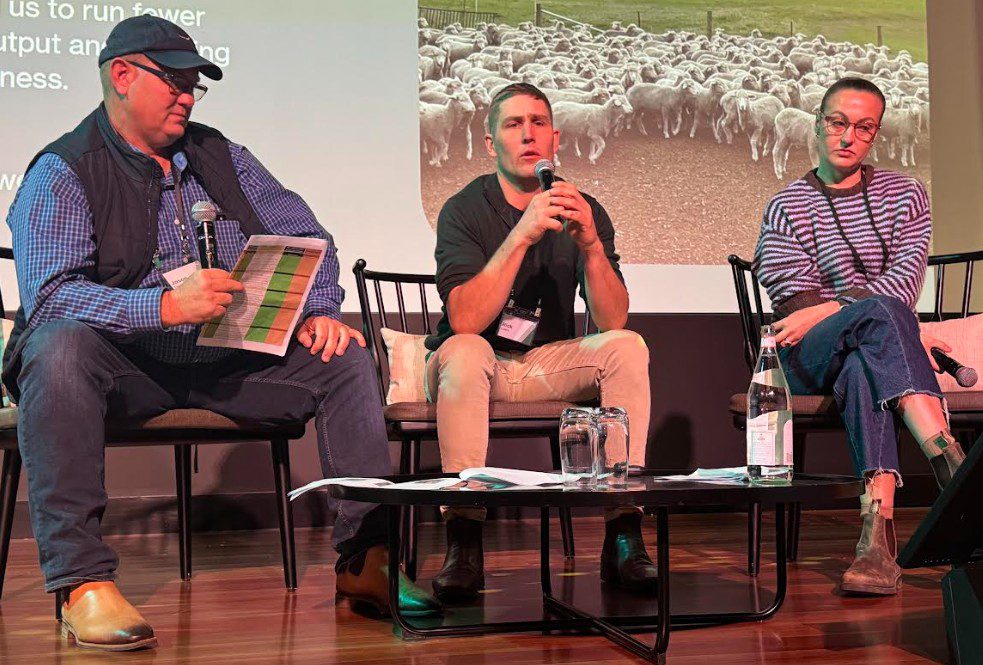
The Luhrs session at the BestWool BestLamb Conference, from left, Jason Trompf, Rick Luhrs and Marni Luhrs.
THE importance of not getting “wool-blind” with the recent lift in auction prices was highlighted by Western District modern Merino breeders and prime lamb producers Rick and Marni Luhrs at the BestWool BestLamb Conference in Ballarat yesterday.
In a session celebrating the role of previous BestWool BestLamb and other industry programs on the Luhrs operation, moderator Jason Trompf led the couple through their operation’s performance using categories in a farming flexibility tool.
The tool has the aim of giving balance in an enterprise to allow farmers “to move from your safety position to where the good oil lies,” Mr Trompf said.
On the aspect of sheep genotype and its ability to adapt to varying seasonal conditions, the Luhrs outlined the development of the original wool-focussed flock to a more modern Merino supplying wool and meat markets.
Rick said he is passionate about the Merino and the stud he runs with his wife Marni and parents Russell and Davina. For Rick, the stud is “a hobby and an obsession” and the benefits of this filter down to the commercial flock.
He said he saw what was possible with Merinos from his visits to the Boufflers’ Triggervale stud and elsewhere and the family wanted to keep the Merino on their flock through their succession plan.
“So we’ve basically built a modern Merino that is robust to take our environment and to create opportunities in all markets.”
He said the Luhrs flock went non-mulesed in 2018 and their wool is now marketed undera 10-year contract with the New Zealand-owned Zentera under their ZQ program. They also recently won accolades for the carcase and eating qualities of their Merino lambs by winning the first AMPC LambEx Feedlot Carcase Competition overall top performing lamb producer category in 2024.
“We won Lambex,” Marni said, and “with a Merino wether mind you,” Rick added.
“I like winning,” Marni said.
Rick said developing the genotype of their sheep involved a focus on higher early growth rates – using post weaning weight and yearling weight breeding values — and early maturity, strong carcase, eye muscle, fat depth and balanced fleece weight with wool quality.
“I can’t stress that balance enough – it’s bloody amazing to see wool prices where they are at the moment and it is where it needs to head to keep the Merino as the bread and butter of the Australian sheep industry.
“But I stress my concern of people going back to getting wool-blind and overcompensating with that on a sheep.
“If you get that balance right in an animal (carcase and wool) it is enough definitely to be a good profitable sheep.”
He said the Merino could get back to a “scary spot” if wool prices return to historical levels.
“So for us it was a Merino with the right amount of carcase and fat to carry their fleece weight through those tough times.”
He said working consultant Darren Gordon on sheep in containment they now feed a 15pc-less paddock ration to maintain condition score through joining.
“So now to get our ME surplus we just feed them the lifetime ewe maintenance ration and we gain condition score on our ewes through joining and get good conceptions.”
He said being able to feed 15pc less supplement for four months, gain condition score and shear a fleece with good tensile strength made breeding a balanced Merino very attractive. Going too hard on one trait meant missing opportunities, Rick said.
Hoof structure was very important in high rainfall, he said.
“A car’s no good on three wheels and a sheep is not either – so we’ve got to keep those feet sound.”
The balance philosophy is also applied to the Luhrs operation taking over Tim Leeming’s project of using Merinos to put finer wool into broader wool flocks, to produce a mid-micron fleece on a composite sheep. This has led to a flock of 300 fine flock maternals producing a 23-24 micron fleece.
“It’s pretty exciting to see what you can do with that sort of animal.”
The Luhrs run a 6000 commercial and stud flock operation on 1200 hectares north of Hamilton. The flock consists of 4500-5000 mature ewes, joined for a June-July lambing, and 700 ewes lambs that lamb in August-September. Sixty percent of the commercial ewes are joined to Poll Dorset sires and 35pc are mated to Merino rams. About 80 rams are sold from both the Mooralla dual purpose Merino and the 24 micron maternal studs.
It goes to show how versatile the Merino is; the potential is unlimited and so exciting.
The genetics are available, all it needs is a change of mindset to reap the rewards.
The Luhrs recognised the potential many years ago, then worked on finetuning the process.
By using the best advice and doing things properly they are achieving great results.
Should others follow their approach they would be able to stay in Merino sheep and run very successful and profitable farms.