
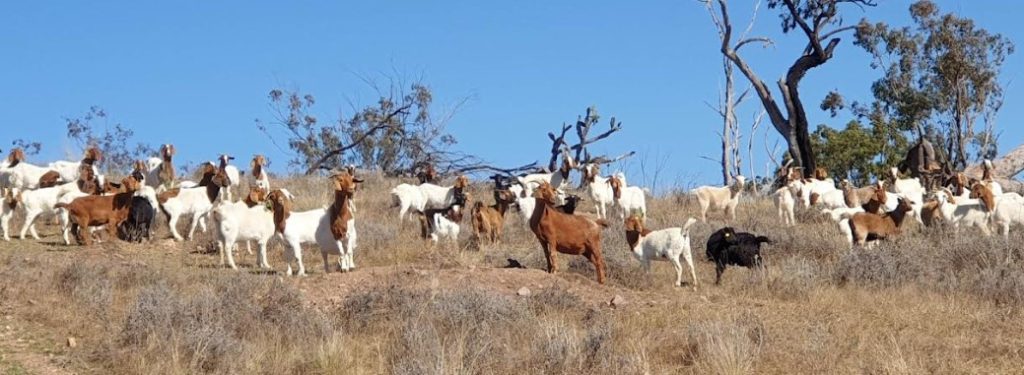
Boer goat carcases delivered the best yield results in a recent University of Queensland study.
BOER goats delivered the greatest meat yield in a three-way breed comparison led by Queensland scientists.
Boers outclassed F1 crosses and rangeland goats in a study of young bucks led by the University of Queensland’s Prof Louw Hoffman.
The scientific team studied 24 bucks from three genetic groups: purebred Boer, rangeland goats and F1 crossbreds (Boer bucks x rangeland does). After rearing in the same Goondiwindi-area paddock with no additional feed they were slaughtered at around 270 days.
Liveweight and chilled weight measurements taken at the University of Queensland’s meat laboratory at Gatton were divided into standard retail portions of shoulder, shank, neck, loin, rack, chump, back-leg, and flap. Additionally, each retail cut was further dissected to separate the lean meat, fat and bone. Both liveweight and chilled delivered a dressing percentage of 38 percent.

UQ study leader Professor Hoffman.
The Boers had the larger overall carcass weights, averaging 8.36kg, compared with 7.27kg for the rangelands and 7.06kg for F1. Specifically, Boers were heavier in the chump, back leg and flap. The neck, loin and rack weights were not significantly different between Boers and rangelands but the F1 goats were lighter in all. Carcase and cut weights indicated that the Boer breed had heaviest cuts.
Prof Hoffman said it was expected that the meatier Boer goat would yield more of the more valuable commercial cuts – the loin, rack, chump, and back leg. He added that studying older goats would possibly increase the meat yield difference.
High meat pH levels across all three breeds suggest goats’ susceptibility to stress before slaughter, Prof Hoffman said.
“The reasons behind goats’ susceptibility to pre-slaughter stress are not entirely understood.”
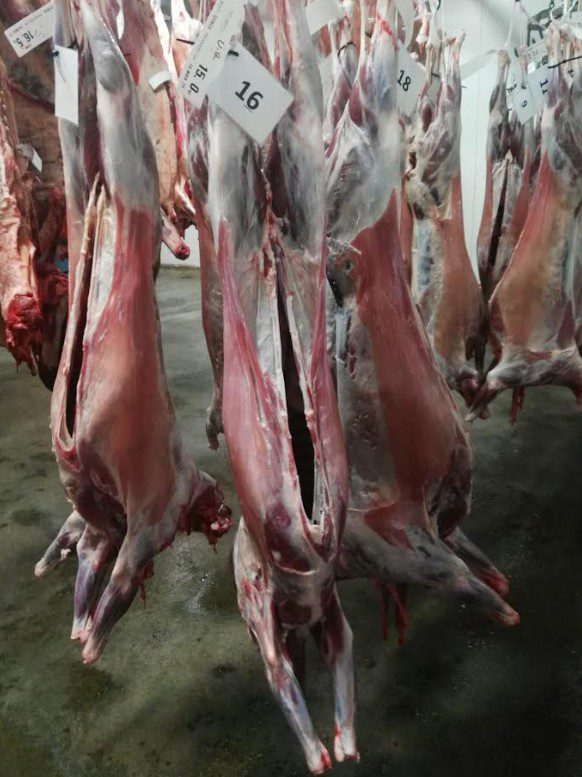
Goat carcases in the Queensland study.
Goat breed did not influence the protein proportion in the selected muscles, and the Boers recorded a marginally higher fat content in two muscles.
“However, the low fat content (<4pc) across all six muscles makes goats an ideal low-fat meat source,” Prof Hoffman said.
“The Boer goat stands out for its high meat production, outperforming other breeds in terms of liveweight and carcass weight at a similar young age when reared under the same conditions,” he said.
“With a high proportion of lean meat and minimal bone, it provides an optimal choice for meat producers.
“Conversely, the F1 breed falls short, as evidenced by its low lean-to-bone ratio in the loin and chump areas, making it less desirable for efficient meat production.”
The researchers noted that the goats were slaughtered at a young, low liveweight. Future research should incorporate heavier, more mature animals, they suggested.
Reporting in the May edition of Animal Production Science, the researchers noted that most of Australia’s goats, roughly 95%, are found in southern rangeland regions, predominantly as feral (harvested rangeland goats) animals, with a growing proportion under semi-domesticated management.
Generally, under rangeland conditions, a muster of the goats is done once a year, and all males above a minimal weight (21kg liveweight) are slaughtered. Most females are returned; the argument is that sufficient bucks miss being mustered and remain in the area to ensure a satisfactory all-year-round mating, they reported.
The study team included researchers from the University of Jeddah in Saudi Arabia and Czech University of Life Sciences. Other scientists involved in the research were Faris Almutiri, Daniel Cozzolino, Jacobus Charl Hoffman and Daniel Bureš.
HAVE YOUR SAY