
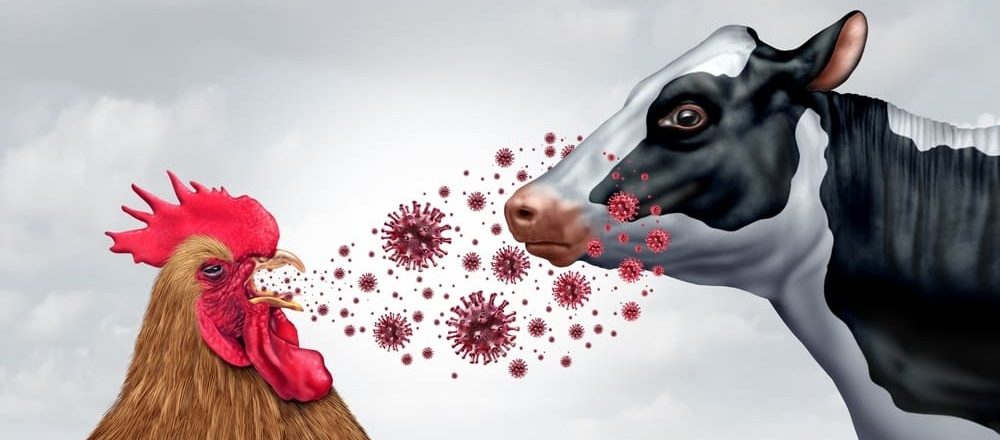
Livestock producers have been reminded to avoid co-mingling poultry with livestock to minimise bird flu risk.
A RAPID assessment of the risks posed by high pathogenicity avian influenza to Australia’s sheep and goat industries has recommended avoiding co-mingling of poultry with small ruminants.
The rapid risk assessment by Dr Isabel MacPhillamy and Dr Robyn N. Hall has concluded that current spillovers of clade 2.3.4.4b HPAI into small ruminants have most likely been via infected poultry or direct contact with large numbers of sick and dead wild birds.
They have recommended that where possible, prevent (or limit) access of wild birds, poultry and peri-domestic wildlife to small ruminant feed, pasture, feed storage, water sources, bedding materials and facilities.
 The latest assessments for other livestock species were done alongside a risk assessment of H5 bird flu in Australian dairy cattle, and found the risk of H5 bird flu to be negligible for beef cattle, sheep and goats, and low for pigs should it become established in Australian wild birds.
The comprehensive study, commissioned in partnership with Dairy Australia, also found that H5 bird flu would pose a low risk to Australia’s dairy industry if it became established in wild birds across Australia.
However, the latest rapid assessment assessment found that small ruminant infections have also been reported overseas, including in goats, sheep and alpacas.
One infection (based on detection of viral RNA) has been reported from a sheep in the UK and five infections were reported in newborn goat kids in the US. However, the assessment authors said, critically, limited surveillance is being done for HPAI infection in small ruminants.
“Therefore, infection rates may be underestimated.”
One of 85 sheep grazing pastures in Norway where sick and dead wild birds were present was found to have antibodies against clade 2.3.4.4b HPAI (Tønnessen and Paulson 2025), while all sheep remained healthy.
The assessment authors said the recent outbreak of clade 2.3.4.4b HPAI in dairy cows in the US, along with the detections in both goats in the US and a ewe in the UK, has heightened concerns about the potential risk to Australia’s small ruminant industries.
They have recommended that farmers avoid sharing (unclean) equipment or vehicles with poultry (and dairy cattle) farms.
Other recommendations to reduce the likelihood of transmission between small ruminant premises included:
- Minimise unnecessary animal movements and keep detailed movement records, particularly if moving animals between small ruminant dairy premises.
- Maintain good farm biosecurity (e.g. pro-actively manage movement of people, equipment and vehicles).
- Enhance general surveillance (e.g. monitor for sick livestock, wild birds or wildlife; consider HPAI as a differential diagnosis for unexplained illness or mastitis in small ruminants).
- Jurisdictions and the Commonwealth should establish testing protocols for non-avian species for HPAI, to facilitate testing of suspect cases.
- Consideration should be given as to whether an evidence-based active surveillance strategy is required following detection of a clade 2.3.4.4b HPAI spillover event in small ruminants. This would need to be assessed within the specific context of an incursion.
To reduce impacts, the report authors recommended:
- Response strategies in non-avian species should be considered now (i.e. in peacetime) and clearly communicated so that industry can better understand the likely impacts of potential control measures.
- Consider the use of personal protective equipment (such as gloves, apron, respiratory protection and eye protection) in certain circumstances (e.g. during milking in small ruminant dairies or when in close contact with secretions from sick animals like during drenching) to reduce the risk of human infection.
- Do not consume raw milk, colostrum or raw milk products from small ruminants.
While the assessments were conducted based on information available up to 3 June 2025, as of October 2025, Australia remains free of clade 2.3.4.4b HPAI. However, the recent outbreak of clade 2.3.4.4b HPAI in dairy cows in the US, along with the detections in both goats in the US and a ewe in the UK, has heightened concerns about the potential risk to Australia’s small ruminant industries.
A statement from the office of Minister for Agriculture Fisheries and Forestry Julie Collins said while these findings provide reassurance to Australia’s agriculture industry, the government remains focused on preparing for a potential outbreak of H5 bird flu.
Ms Collins said having spent time on-farm with dairy farmers throughout the year, she knows there has been concern about the potential impacts of H5 bird flu on their industry, following significant outbreaks in US dairy cattle early last year.
“Australia remains the only continent free from this highly pathogenic strain of H5 bird flu, but ensuring we’re prepared for a potential outbreak is critical,” she said.
“That’s why our government is investing over $100 million towards H5 bird flu preparedness and response capability – with this research part of our work to be better prepared and to respond effectively.
“Our government will continue strengthening surveillance, preparedness and response capability to mitigate the impacts of a potential H5 bird flu outbreak.”
The study was funded as part of the Albanese Labor Government’s $100 million investment to strengthen bird flu preparedness and enhance national response capability.
Producers should report unusual signs of disease in cattle or other animals to the Emergency Animal Disease Hotline on 1800 675 888.
For a copy of the report please visit: https://agriculture.gov.au/bird-flu-in-livestock
HAVE YOUR SAY