
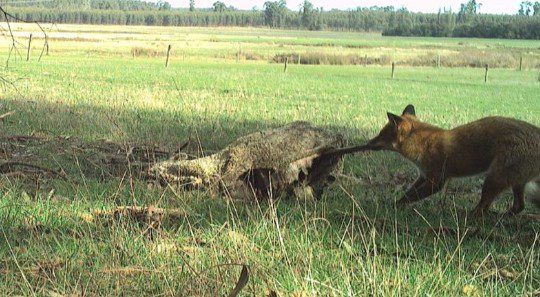
A fox on a sheep carcase. Photo – Lisette Mill.
AUSTRALIAN sheep producers need not be alarmed at the first confirmation of H5 bird flu in a fox, but precautions should be taken, according to Bendigo Sheep Vets principal Dr Tristan Jubb.
Last Friday, Australian Chief Veterinary Officer, Dr Beth Cookson reported that testing at CSIRO’s Australian Centre for Disease Preparedness confirmed H5 high pathogenicity avian influenza (bird flu) in a red fox, found at Osborne in metropolitan Adelaide.
“This marks the third detection of H5 bird flu in a mammal species in Australia, and the first in a land mammal.
“There is currently no evidence of mammal-to-mammal transmission associated with H5 bird flu in Australia,” Dr Cookson said.
“On other continents, infection has been documented in a wide range of terrestrial carnivores, particularly species that scavenge carcasses (including red foxes).
“In wild terrestrial carnivores these detections are believed to be isolated spill-over events from birds,” she said.
“Although this is a concerning development, it is not unexpected given that H5 bird flu has been detected in other wildlife in areas where there are high levels of infection in wild birds.
“This detection in a fox is a good reminder that people and their pets should avoid sick or dead wildlife,” Dr Cookson said.
“There remain no detections in poultry or in our agricultural production system.
“The risk to human health remains low.”
Sheep appear to be at low risk for bird flu
Dr Jubb has been fielding questions from farmers after the fox bird flu confirmation.
On whether Australian producers be worried, he said H5 bird flu is now present in Australian wildlife and has crossed into several mammal species.
“Sheep appear to be at low risk, but the world’s first naturally acquired infection in a ewe shows that infection is possible.”
H5N1 bird flu was confirmed in a sheep for the first time globally in March 2025, in Yorkshire flock in England.
Dr Jubb said as at 28 August 2026, Australia had recorded 413 positive H5 bird flu events across six states, including Victoria.
“Most involved wild birds, but infection has also been confirmed in a long-nosed fur seal found at Beachport in South Australia and a red fox found at Osborne in metropolitan Adelaide.
“Importantly, there have been no detections in Australian poultry, sheep or the wider agricultural production system,” he said.
“The Australian Government continues to describe the risk to human health as low.”
Bird flu can infect a range of mammals
Dr Jubb said H5N1 is principally a virus of birds, but overseas experience shows that it is capable of infecting a surprisingly wide range of mammals. Many infections have occurred in scavengers and predators after they ate infected birds or encountered heavily contaminated environments.
“The major exception has been the extensive outbreak in dairy cattle in the United States. Affected cows can shed very large amounts of virus in their milk.
“Cats on dairy farms have died after drinking infected raw milk, demonstrating another way the virus can cross between species.”
Dr Jubb said the only reported naturally acquired H5N1 infection in a sheep on a Yorkshire property in the United Kingdom where H5N1 had been confirmed in captive birds.
“The ewe developed mastitis and H5N1 was repeatedly detected in the milk.
“Blood testing demonstrated antibodies, but testing did not find widespread virus throughout the organs and tissues,” he said.
“No infection was detected in the other sheep on the property.
“This case demonstrates that sheep can become infected, but it does not suggest that sheep are an important host or that H5N1 spreads readily between them,” Dr Jubb said.
“There has been no reported flock outbreak and no evidence of sustained sheep-to-sheep transmission.
“For Australian sheep producers, the present risk therefore appears low,” he said.
“The more immediate concern remains transmission among wild birds and the possibility of the virus entering poultry.”
Sensible precautions for sheep properties
Dr Jubb said sheep producers do not need to be alarmed, but some straightforward precautions are warranted:
- Do not touch sick or dead wild birds with bare hands.
- Keep sheep, working dogs and farm cats away from bird carcasses.
- Prevent dead birds from contaminating stock feed and water where practicable.
- Do not take sick or dead wildlife home for disposal.
- Seek veterinary advice about unusual illness or deaths in livestock, particularly following exposure to affected wildlife.
- Report groups of sick or dead wild birds to the Emergency Animal Disease Hotline on 1800 675 888.
Dr Jubb said the infected Australian fox is a timely reminder that dogs and other scavenging mammals should not be allowed to investigate or eat dead birds.
“The practical message for sheep producers is to remain aware without becoming alarmed.
“H5 bird flu is now present in Australian wildlife, so sensible biosecurity, keeping domestic animals away from bird carcasses and promptly reporting unusual wildlife deaths are worthwhile precautions,” he said.
Is there a strategy on bird flu spread via pest species?
When asked if there was a strategy to mitigate the potential spread of bird flu into farming areas by foxes, a Department of Agriculture Fisheries and Forestry spokesperson said there has been no detections of H5 bird flu in Australia’s agriculture industry or in poultry.
“Australia has been preparing for the possible arrival of H5 bird flu for more than two years.
“Since 2024 the Australian Government has committed more than $113 million to strengthen surveillance, preparedness and response capability for a potential incursion, which has positioned us well,” the spokesperson said.
“There is also an additional funding of $24 million from the Australian and State and Territory Governments allocated to support early response activities.
“Our national response aims to minimise risks to human and animal health and wherever possible, minimise impacts to Australia’s native bird and mammal species and on communities,” the spokesperson said.
“An additional $20 million has been allocated to support urgent biodiversity and resilience actions managed by the Department of Climate Change, Energy, Environment, and Water.”
This includes:
emergency response activities, including urgent interventions for priority species and places on Commonwealth parks
threat mitigation and resilience activities to boost and extend on ground action for key species and locations
support for citizen science and community engagement to improve what we know about our native species and support local biodiversity.
The DAFF spokesperson said the Australian Government is keeping industry informed through regular briefings on the H5 bid flu situation.
“We will keep working across government and with state and territory governments, sector partners, communities and businesses to manage impacts to the rural communities from the potential spread of H5 bird flu.”
The Department of Agriculture Fisheries and Forestry told Sheep Central that based on international experience, wild birds have most often been associated with spill-over events of H5 bird flu from wildlife into agricultural production systems.
Wild foxes, pigs and other mammalian pest species have not been considered to be epidemiologically important in the long-distance spread of H5 bird flu, the department said.
DAFF said on other continents infection has been documented in a wide range of terrestrial carnivores, particularly species that scavenge carcasses (including red foxes). In wild terrestrial carnivores these detections are believed to be isolated spill-over events from birds, and ongoing transmission or spread has not been observed.
Sheep Central was told DAFF and Dairy Australia commissioned an independent risk assessment on H5 HPAI (bird flu) in Australian dairy cattle and other livestock, completed in September 2025. The assessment found that if the virus establishes itself in wild birds, the risk to the Australian dairy and pork industries is estimated low and negligible for beef cattle and small ruminants (sheep and goats).
From 12 August 2026, the Federal Government changed how it reported on H5 bird flu detections. Reporting will be based on events, rather than individual detections. See birdflu.gov.au for the latest information.
Other sources
- Australian Government H5 bird flu event data
- Australian Government H5 bird flu updates
- UK Government report of H5N1 in a sheep
USDA information on H5N1 in livestock
Read a previous Sheep Central article on foxes and bird/mammal interaction in farming areas here.
HAVE YOUR SAY