
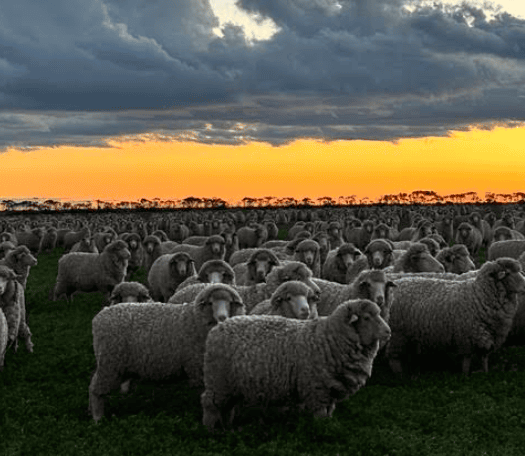
WA Wattle Dale Merino hogget ewes. Image – Craig Wilson.
A NATIONAL comparison of Merino genetics production is a step closer with the start of the inaugural Western Australian Lamb Trial.
Australian Merino Production Trial convenor Craig Wilson said 36 teams of 20 wether lambs — representing over 250,000 ewes on the entrants’ properties – have entered the WA trial.
Mr Wilson said the WA trial will have a national connection.
“Through linkages with the Australian Merino Production Trial in New South Wales, the results from this first WA intake will help build a broader picture of commercial Merino performance across Australia.
“We are aiming to have 100 teams from across Australia to benchmark,” he said.
Mr Wilson said the first WALT lambs are scheduled to arrive at Fletcher International Exports’ Ronneby Feedlot at Beaufort River, on Friday 4 and Saturday 5 December, 2026, when they will shorn and weighed.
The lambs will all backgrounded on grass for six weeks, and then the trial will start officially on 18 January in the feedlot, he said. The lambs will be on a commercial ration in the feedlot for three months and then shorn again in late April-May before processing
Mr Wilson said the trials will replicate what happens with lambs in WA with the lot feeding of lambs on farms.
“This will allow other farmers benchmark their own performance against the WALT lambs, as well as a between-flock comparison of the trial lambs.”
Mr Wilson said the WA lambs would be weighed every three weeks and growers will be given regular progress reports.
“Between now and the end of May next year they are going to have a really good snapshot of where they sit.”
WALT trial entrants to get a Merino flock profile
A Merino flock profile would also be done on all the teams, to give a flock-level genetic benchmark, by genotyping the lambs and comparing their average breeding values to the industry. The profiles will estimate each flock’s genetic merit across key trait groups; including wool quality and quantity, growth, carcase, health and welfare, and reproduction.
Mr Wilson said the initial WALT trial is part of a larger plan to run a longer-term trial over the next five years. He said the most interesting part of the trial is the number of sheep the entrants represent – 250,000 sheep.
Mr Wilson said he believed the sheep producers who have stayed in Merinos in Western Australia are the committed professionals “and that’s who we have in this trial.” He said the trail would give these growers direction in their breeding programs and the information to make changes if they choose to.
“What’s driving me is that looking at the variation (between bloodlines) that we’ve seen in the east, and what that offers people.
“I feel it’s my obligation to take that to the other side of the country and show people the same thing, because it can absolutely change people’s businesses,” he said.
“The frustrating part of it is that if everyone knew what the capacity of their genetics was, we wouldn’t need to run these trials.
“When we run these trials we see a 100 percent difference (between the low and high performing sheep).”
WA needs to know how good its Merinos are
South-east WA producer Dave Vandenberghe said he had been participating in wether trials for about 30 years, including the Australian Merino Production Trial several years ago.
He expected the trial would give an indication of where his sheep’s performance ranked against other sheep. The trial was important to give direction to the WA Merino industry, Mr Vandenberghe said.
“There have been massive changes here as far as people going out of livestock all together and also switching to shedding sheep breeds and others.
“And a lot of that has been done without any economic modelling or comparison; it has just been ‘well, that’s what I’m going to do because it sounds like it’s a good idea,’” he said.
“It will be good to get some facts and figures about the range of productivity and profitability within our Merino industry here.”
Mr Vandenberghe said the gross margins on Merino flock were “miles ahead” of shedding sheep and more profitable than cropping, “if you’ve got good sheep.”
He believed the WA industry had already “gone off on a tangent” by focussing more on carcase traits and disregarding the importance of wool.
“I think it will come back to bite them.
“Nothing gets cheaper, so you can’t afford to grow less wool, so you sell or kill something once, but you can shear it every year,” he said.
“So we just have to get back to a bit of balance on where our money is coming from, rather than focus on the one cheque you get selling your lambs.”
The Vandenberghes this year will run about 12,000 Merinos, with beef cattle and cropping on 11,000 hectares north-west of Esperance. They also run the Wattle Dale Fine Merino Stud.
Mr Wilson said the WA trial is being privately funded after an application for a live sheep export transition grant was unsuccessful.
“This is being driven by industry and by people who are committed to the industry.”
He said it hoped to get 64 teams in the next Australian Merino Production Trial in the eastern states.
HAVE YOUR SAY