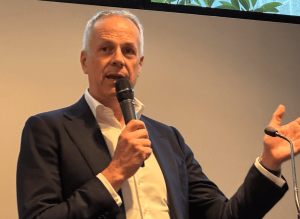
AWI CEO Bryan Fry
REVENUE improvement will provide an opportunity for Australian Wool Innovation to invest more in demand creation and on-farm research in 2026-27, according to AWI chief executive officer Bryan Fry.
However, AWI has admitted that most of the revenue gains in 2025-26 were allocated to increasing the company’s reserves, from $77.26m to $92.84m as at 30 June 2026.
AWI’s 2026 annual report released this week showed that that wool levy income lifted from $31.167 million in FY 2025 to $39.652m in FY 2026.
“The improvement in revenue for 26–27 will provide us opportunity to increase our investment in demand creation and on-farm research supporting long term productivity gains and demand for Australian wool,” Mr Fry said in his report.
An AWI spokesman said income from the wool levy is the main revenue component every year, but would not disclose 2026-27 revenue expectations.
“Other areas include licensing, interest earned and government grants.”
The spokesman said given market and seasonal conditions, revenue is constantly monitored and the AWI board is updated at every meeting.
The AWI spokesman said under the current three-year strategic plan AWI has two priorities: firstly, grow demand and fibre advocacy and secondly, sustainable and profitable wool growing.
“Those priorities will continue (and) individual projects will be assessed on their merits both on and off farm.
“We are well aware that productivity and profitability at farm level is central to compete with other land uses.”
In his annual report, AWI chairman George Millington said most of AWI’s revenue is tied to the price and volume of wool sales, so AWI has been reducing team numbers and projects to manage the fiscal reality.
“We did that in a strategic way so structural improvements could be locked in.
“The improvement in revenue over the last nine months was used both to bolster reserves and roll out targeted projects that were not originally budgeted for,” he said.
The AWI spokesman said a high proportion of the increase of revenues (ahead of budget) was due to increased market pricing that eventuated in Q4.
“We maintained fiscal operating discipline in an uncertain market, and most of the improvement in revenue in 25-26 was allocated to reserves.
“A smaller amount went to new or upgraded projects across the business.”
The spokesman would not detail which new or upgraded projects were funded.
AWI demand creation yield positive results
Mr Fry said AWI’s demand creation produced positive results in priority markets.
“Campaigns increased Merino wool awareness by 11 percentage points in China and consideration of Merino apparel by 17 percentage points in the United States.
“Owned social channels achieved 16pc follower growth despite a substantially reduced budget,” he said.
“Retail education reached 54 global brands and 2292 retail staff, while 40 international trade engagement initiatives strengthened relationships throughout the global supply chain.”
He said AWI also delivered 51 processing innovation and product development projects, supporting new wool applications across performance, fashion, casual, workwear and automotive markets. Emerging-market activity established 32 new supply chain partnerships across Portugal, Bangladesh, Thailand, Vietnam and Sri Lanka.
Mr Fry said research investment strengthened sustainable and profitable sheep production through the provision of data and extension programs in Merino genetics, methane mitigation, natural capital, animal health and precision livestock technologies.
New breeding technologies progressed for resilience, methane emissions, flystrike resistance and productivity, while 14 research, development and extension projects supported strategic priorities.
“Wool harvesting research also advanced, with trials progressing and new follicle culture systems developed to accelerate screening, improve research efficiency and support strong animal welfare outcomes.”
Mr Fry said wool grower engagement maintained its position as a critical piece of AWI’s business model. AWI’s six extension networks grew to 15,553 members, and workshops achieved an average satisfaction rating of 8.81 out of 10. Wool harvesting initiatives retained 65pc of trained participants after 12 months, including 94pc of improvers, while 1418 people progressed through improver and in-shed training programs, he said.
HAVE YOUR SAY