
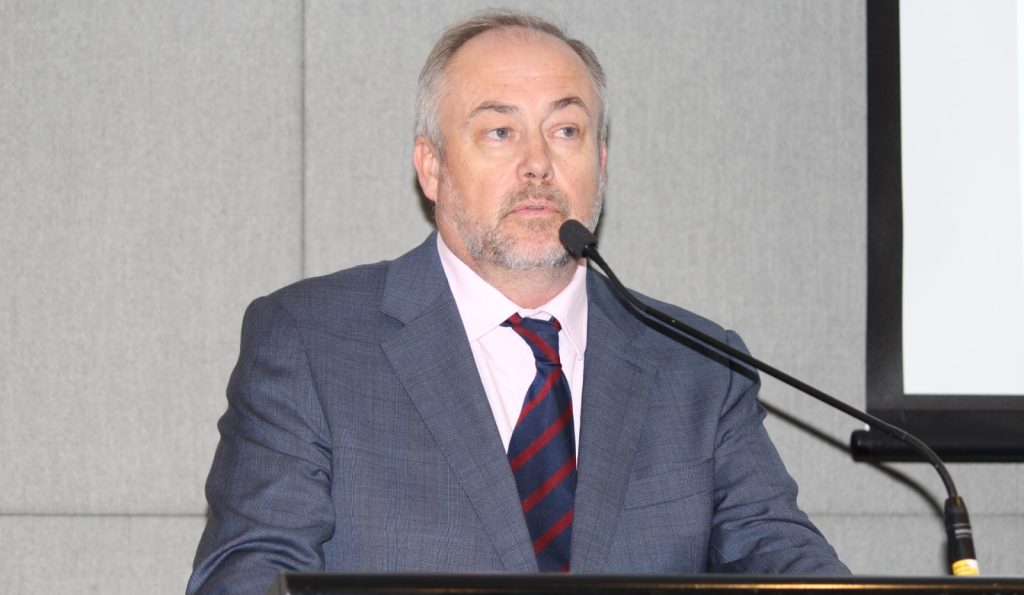
AWI CEO John Roberts — downsized the business by more than 20 staff in the past 18 months.
AUSTRALIAN Wool Innovation chief executive officer John Roberts gave insights into the current financial and staffing situation of the downsized company during the Wool Industries Australia Wool Week forum in Melbourne yesterday.
Mr Roberts outlined some of the AWI program cuts — including to shearer training and bioharvesting research – and the work continuing in wild dogs, capacity building and marketing.
He said the company was budgeting on receiving about $54 million in revenue this year due to the decline in wool production, prices and levy rate.
“Reserves are sitting somewhere in the vicinity of $74 million and the board likes to maintain about a $50 million minimum to make sure we cover any of our liabilities should the company be folded up.”
“So that puts us in a much tighter environment,” he said.
“We have downsized the business in the last 18 months by more than 20 staff.
“I’d like to say that’s completed, but it’s not and it’s been a very challenging time for everybody,” Mr Roberts said.
“The staff of this company have been amazing; they have maintained their focus, they have maintained their vigilance, they’ve maintained their focus on serving wool growers.
“So I’m very proud to work with them and continue to work with them for the next few months.”
Highly consultative process opts for ‘demand creation’
In outlining the pillars in AWI’s recent strategic plan, Mr Roberts said it was completed after a “highly consultative process” and growers had a dislike for the word ‘marketing’ prompting the use of the phrase ‘demand creation’.
“It’s not being tricky, it’s just when we had a discussion around the room at the Wool Industry Consultative Panel (and the Wool Consultative Group), we talked about marketing and product innovation and emerging markets.
“They’re all demand creation, so we really tried to put a broader terms around that,” he said.
He said AWI would continue its fibre advocacy work, including around the EU Product Environmental Footprint and eco-credentials of wool.
The other strategic plan pillar of ‘sustainable and profitable wool growing’ focusing on research and productivity was of equal importance.
“I think when you look at our biggest challenges as a fibre, our biggest challenges are competing land use and competing fibre consumption.
“Our consumers have choices in what sort of fibres they put on their bodies and our farmers have choices in what they do with their land.”
Increased focus on improver shearer training
Mr Roberts in the on-farm space, AWI’s funding of shearer training has been successful in the last 12 months.
“We hear it consistently now that there is less pressure for wool growers to find shearers and access to shearers is a lot better.
“I’m really proud of the work we’ve been able to do there and we are going to continue to do that.”
Mr Roberts said AWI would continue to support the National Wool Harvesting Training Group.
“Our wool harvesting budget, like most of our other budgets, is down about 44 percent, or that vicinity, so we have to be really laser-like on what we are going to focus on there.
“Certainly we did a lot of novice training before, but the consensus was we needed to focus a bit more on improver courses.”
He said the animal welfare training for shearers and wool handlers would continue.
Bioharvesting wool collection research paused
Mr Roberts said the bioharvesting research would continue and was working on getting the (corn-derived) zein protein into an injectable form “which is progressing quite well.”
”It is a long process, we said that at the outset, at least five years.
“We’re still waiting for APVMA approval to make sure there is no residues in the meat or any issues with pregnant ewes, these sorts of things, so there is still a long way to go,” he said.
Mr Roberts said AWI had put a pause on research into the harvesting of wool from treated animals because “we’re not ready yet; we haven’t got that injectable right so we’re just going to pause that.”
“But that work that we did with some of the universities is still, it’s in the bank and ready to go when we need to use it.”
The AWI CEO said AWI would continue its wild dog work. He introduced several AWI staff members to the industry forum and said “capacity building” work with wether competitions to get more youth involved would continue.
Mr Roberts said about 15 engineering companies are now producing the AWI Catch and Drag modules that have been rolled out around the country, allowing older and smaller shearers to start and keep shearing.
He said the sterile fly program with Meat & Livestock Australia on Kangaroo Island is “showing promising signs.”
“Like all research it’s high risk, it takes time, but it’s going well.”
‘Non-mulesed operation’ workshops are available
Mr Roberts said the nanotechnology/tea tree compound work, which is potentially a natural repellent for flies, is also work that is showing a lot of promise “and we’re quite excited about that”.
“The flystrike workshops, we continue to do those, whether it be Stratefly … there are so many different fly workshops we do and they’re really tailored for different growers in different areas and diofferent stages of their production,” he said.
“And also our ‘moving to non-mulesed operation’ workshops, which is something we make available.
“We are looking to make that more cost-effective by doing it online and we’ll obviously make those available as and when required,” Mr Roberts said.
Mr Roberts said AWI would continue to work on methane mitigation programs in New South Wales, South Australia and Western Australia.
“We’re also trialing this anti-methogenic feed additive – the good news is they seem to be showing some promise.
“The good news it is not just growers’ money, it’s also government money, because they do believe in this space.”
He said the carbon storage on farm project with the Australian Meat Processors Corporation to develop a novel data stream to enhance Life Cycle Assessment capabilities with MLA co-funding would complement biogenic work.
He said AWI work on PEF had deferred its introduction in the EU and allowed the inclusion of current LCA data which has significantly improved the outcome for wool’s footprint.
Mr Roberts said the Woolmark+ insetting project — that aims to connect fashion and textile brands with wool growers to achieve greenhouse emission reductions – has 40 growers, 10 brands and a number of supply chain partners participating.
He said AWI is pleased about the Australian Wool Traceability Hub’s progress and the support for the Australian Wool Sustainability Scheme.
“And I think with the right comms to the global market we can make that work.”
AWI to continue to defend its core market
Mr Roberts said AWI is trying to combine marketing and product innovation because they were both about demand creating.
He said the three pillars to AWI’s marketing work are to defend the core market of suiting and coats – “even though no-one is wearing them.”
“We look after that core market, we defend that, woe look after that volume, because it is still our lifeblood.
“It’s shrinking through ‘casualisation’, but it’s still there,” he said.
“The other pillar is ‘accelerate expansion’ including all the stuff we are doing in sports and active, wellness and functionality – whether that be in military, an outer shell, whether that be in whole garment knitting.
“All those sort of things where we actually change people’s perceptions about the fibre, think about it as a technical fibre of the future,” he said.
“Not the traditional old fibre that we often hear in the ‘itchy scratchy grandma’s jumper’ type of story … we all know that’s rubbish, the world is starting to realise that and we’ve been pushing hard on that message for the last 10 years, people get it now.
“People are coming to Woolmark now and they view us as a technical fibre, a sustainability partner and a fibre for the future.” He said.
“The brands are now coming to us, we’re not knocking on their door because they see us as a solution to meet performance challenges they’re doing or sustainability challenges.”
Mr Roberts thanked Wool Industries Australia chairman David Michell for his leadership and the support of National Council of Wool Brokers of Australia immediate past president Rowan Woods and Australian Council of Wool Exporters and Processor president Josh Lamb in succeeding in getting harmony in the industry.
In what was appreciated as a tongue-in-cheek comment, Mr Roberts started his presentation with: “it is actually nice to finally contribute something to the industry and deliver an 80-cent (price) increase….”
“It’s finally nice to give something back,” he said to a background of laughter.
The drop in AWI revenue has been outlined.
The real issue here is the drop in wool production with wool sheep numbers at a low level.
An investigation into why producers have exited Merino sheep would be a good starting point for the new AWI board. The reasons are fairly straightforward but obviously have been missed by past and present administrations.
I find it interesting that those commercial producers that have moved to a modern Merino, plain bodied, fly-proof type are moving ahead and are sticking with the Merino. More lambs, faster growing lambs and easier shearing are a few of the benefits.
Time will tell if the direction of AWI changes or continues on its downward spiral.
A sincere loyal man, what else could John Roberts say?
But I do hope that John shares with wool growers some of his insights into AWI following a discrete period after his retirement.
But perhaps it is time for a full-blown inquiry into AWI, so that a light can be shone onto the shenanigans of our institution.
Where to start on AWI’s hopeless performance…???
Try this beauty…
‘AWI’s marketing work are to defend the core market of suiting and coats – “even though no-one is wearing them.”’
I had to read it twice. Speechless.
Join the club. We have been tightening our belts for years as farmers,