
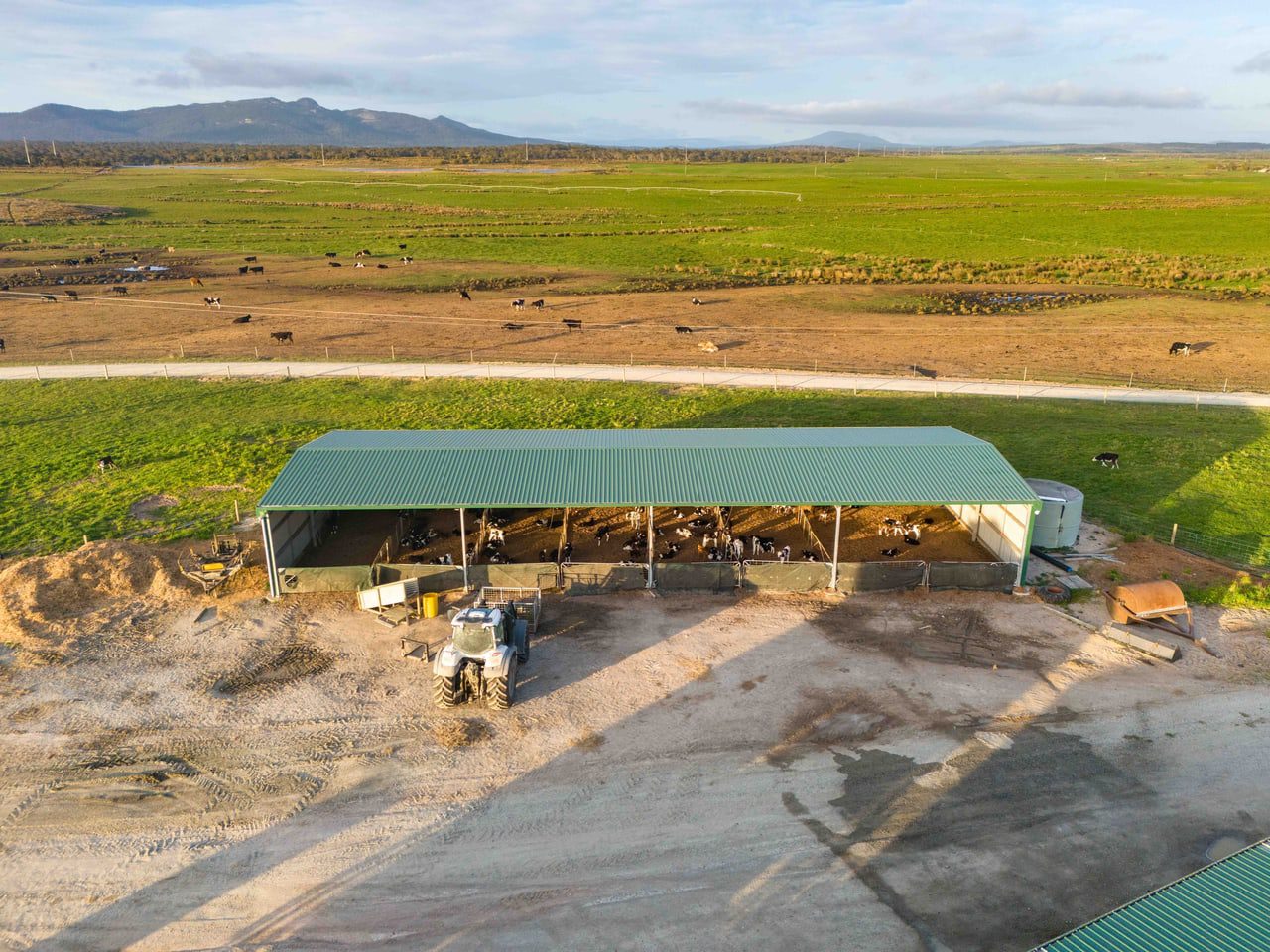
Rushy Lagoon has sold to UK investor Gresham House. Photo: LAWD
NOTE: This article has been updated to include a statement and background from Federal Treasurer Jim Chalmers.
AFTER months of speculation, today’s approval of the sale of Rushy Lagoon, Tasmania’s largest farm, to UK investor Gresham House has sparked mixed responses.
The sale will see land use at Rushy Lagoon in the state’s north-east transition from beef and dairy production and cropping into forestry over much of its 21,745ha.
In a statement, TasFarmers president Nathan Cox said the decision was a betrayal of Tasmanian agriculture and a breaking of the social contract between government and the Australian people.
“This is a disgraceful outcome for Tasmania and for Australian food security,” Mr Cox said.
Not surprisingly, the Australian Forest Products Association has welcomed the Foreign Investment Review Board’s approval of the sale.
“We welcome this important strategic investment to help support and grow Australia’s sovereign capability for sustainable timber production and supply,” AFPA acting deputy chief executive Dominic Lane said.
“During the building boom in COVID, we couldn’t rely on imports to meet our housing needs in Australia, so new opportunities to strengthen our sovereign capability and investment are critical.
“We also know various forms of agriculture can co-exist in Australia to provide long-term and sustainable benefits to regional communities, local jobs, the national economy and wider population.”
Tasmanian Senator Richard Colbeck was scathing of the approval in a post today on his Facebook page.
In May, he used Senate Estimates to question Department of Agriculture, Fisheries and Foresty deputy secretary Matt Lowe about the potential impact of a change in Rushy Lagoon’s land use from agriculture to forestry.
“The Albanese Government has used the cover of the winter parliamentary recess to approve the sale of Rushy Lagoon after months of delay, stonewalling and a complete refusal to be transparent with the Australian public,” Mr Colbeck’s post today said.
“The approval of the sale of Rushy Lagoon is a disappointing decision that flies in the face of the concerns raised by local farmers, agricultural businesses and regional communities throughout this process.”
Green light from Treasurer
Prior to the approval of the sale to Gresham House, the Clean Energy Finance Corporation and DAFF committed to support the new owner’s plans for Rushy Lagoon because it would deliver sustainable forestry plantations in Tasmania with positive flow-on effects.
The Federal Government has advised that FIRB’s decision incorporated views from DAFF, the Department of Climate Change, Energy, the Environment and Water, and the Tasmanian Government.
It said Rushy Lagoon’s land parcels are generally classified by the Tasmanian Government as Class 5 and 6 out of seven classes and are not prime agriculture land.
“I have accepted the clear advice from the Foreign Investment Review Board to not object to the Tasmanian Natural Asset Trust’s proposal to acquire agricultural land in Rushy Lagoon, Tasmania,” Federal Treasurer Jim Chalmers said in a statement.
“The proposal is expected to create over 190 jobs over the life of the project and create economic benefits for the region.
“This was a very difficult, on-balance call and it follows a rigorous process and extensive consultation that took account of all relevant considerations including economic, environmental and other national interest issues.
“My decision is entirely consistent with the advice of the Foreign Investment Review Board that the proposal is not contrary to the national interest.”
“The advice was clear that Rushy Lagoon is already decommissioning its dairy farming business, the sale of the property was advertised through an extensive sale process, and the Tasmanian Government classifies the land as marginal agricultural land.”
TNAT launched
Alongside Gresham House, CEFC and Aviva Investors are contributors to what a CEFC statement has described as “a groundbreaking $142 million project”, with Rushy Lagoon the cornerstone.
The statement said that alongside the forestry angle, the investment will generate high-integrity Australian Carbon Credits Units, and protect an important Ramsar wetland with diverse habitats.
As the Tasmania Natural Asset Trust (TNAT) afforestation and natural capital platform, it will be managed by Gresham House Asset Management.
“This critical investment converts degraded farmland into a production model that will boost the Australia’s forestry industry, create local jobs, support sustainable timber production, introduce sustainable grazing and protect the unique environment.
CEFC head of natural capital Heechung Sung said the project will alleviate some of Tasmania’s wood supply pressures and help divert harvesting away from native forests.
“The Radiata Pine trees produced by the project are expected to be processed locally by Tasmanian-based sawmills and supplied into the Australian market,” Ms Sung said.
“It is expected to stimulate the local economy, creating jobs for contractors, sawmill operators, field surveyors and planting crews.
“In addition, sustainable agricultural activities will continue in designated areas across the property.”
Timber is to be grown under Forestry Stewardship Council certification or Programme for the Endorsement of Forest Certification and be processed by Tasmanian sawmills to help offset a critical shortage of construction timber in the Australian housing market.
Tasmanian Government concerned
The Tasmanian Government has expressed deep concern following the Federal Government’s decision to approve the sale of Rushy Lagoon.
Acting Premier Bridget Archer said there are serious questions to be answered about the Federal Government’s decision to approve the sale and commit taxpayer money to a potential buyer.
“Tasmanians are asking why the Federal Government committed support and investment into this project before the Foreign Investment Review Board’s decision,” Ms Archer said.
“Backing a project, and then going through a process to decide if it’s fair or not, does not pass the pub test.
“We recognise the value of investment in regional Tasmania, but we hold serious concerns about the way this process has played out.
“Rushy Lagoon is one of Tasmania’s most significant farming assets and has made a major contribution to our dairy, beef and cropping sectors for decades.
“This decision will have a significant impact on Tasmanian farmers, the North East community, and Tasmania’s agricultural capacity.”
Source: TasFarmers, AFPA, CEFC, Tasmanian Government
HAVE YOUR SAY