
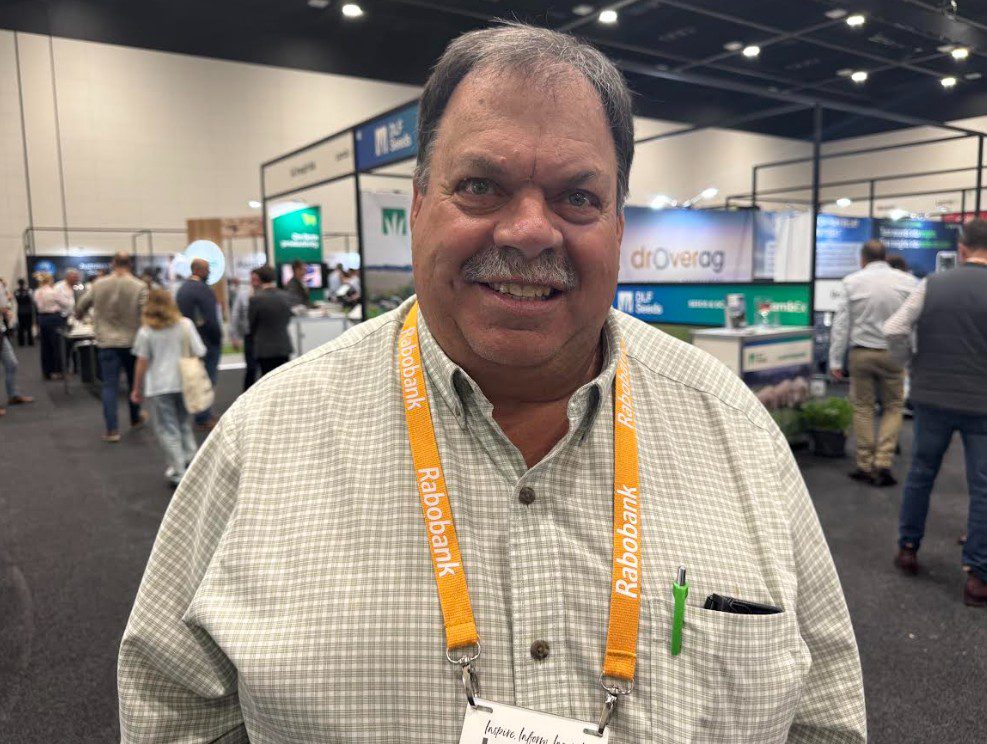
American Sheep Industry Association vice-president Joe Pozzi at LambEx26.
AMERICA’S lamb industry wants at least four years of improved profit margins without high import volumes to help increase the US flock and boost production.
US lamb industry leaders at LambEx last week refused to talk about efforts to impose tariffs on imported lamb; however, Australian producers at LambEx were told of Australian and NZ companies undercutting American producers’ efforts to direct market their lambs.
American Sheep Industry Association vice president Joe Pozzi said the industry recognized that increasing production could help domestic producers compete with imported lamb.
“Of course any time we increase production and have more animals on the ground it is helpful.
“The challenge sometimes are the cost comparisons and being able to get them out there at an affordable price and a price that the consumers will purchase them at, versus other lambs in the country.”
According to the ASI website, Mr Pozzi is a fourth-generation Californian rancher who in an effort to turn a profit with the sheep, started Sonoma Wool Company to direct market wool products and moved to selling grass-fed lamb into local markets in northern California. Instead of shipping lambs once a year, he works with other area sheep producers to supply a truckload of lambs each week throughout the year, his short biography said.
Mr Pozzi said the industry is working on improving the sheep genetics to improve weight gains on pasture and in feedlots.
“We’re doing a lot with predator management with different projects, mostly non-lethal to manage predator issues.
“We’re working with guard dog programs and enhancing fencing.”
He said ASI was also working on finding new markets for American lamb, including developing the strong ethnic market for smaller lambs.
“There’s been a big increase in the ewe flock for the smaller carcase lamb.”
Mr Pozzi said the industry was getting new sheep producers into the industry through non-traditional ways, including running sheep under solar farms.
“We have a lot of new solar farms being implemented in the United States; some of them are 10,000-15,000 acres of solar field and they all need to have sheep under them to graze.
“So it has given new opportunities for younger individuals, people who may not have the traditional flock already established to come in and have ground ready to be grazed,” he said.
“On that ground they are also being paid to graze those properties.
“So not only do they get the gain of those lambs and the wool that they are getting of those sheep, they get the gain of the service they are providing.”
Mr Pozzi said many US municipalities have also undertaken grazing programs to lower the fire risk around city and town boundaries.
“So every town has set aside properties or parks and they are bring sheep and goats into those properties to graze that down in the spring, so that through the dry summer season if a fire starts, there is short 1-2 inch grass versus a 4-5 foot grass.”
Mr Pozzi admitted he had been urged by Australian producers at LambEx to support greater co-operation with Australia and New Zealand on lamb marketing and promotion in the US, and he was familiar with the former discontinued Tri-Lamb agreement of the three countries.
He said the current Next Gen program through the Global Sheep Producers Forum was very similar to Tri-Lamb and was doing a good job to sponsor collaboration
“We are a global industry and getting together as we are here at LambEx … I’ve talked to so many different individuals from all different countries, mostly Australia and New Zealand, and the leadership in those countries.
He said he had discussed the state of the industry in the US and where each country stands, including the import issue, and challenge that imports represent “because of the numbers of lamb that come in.”
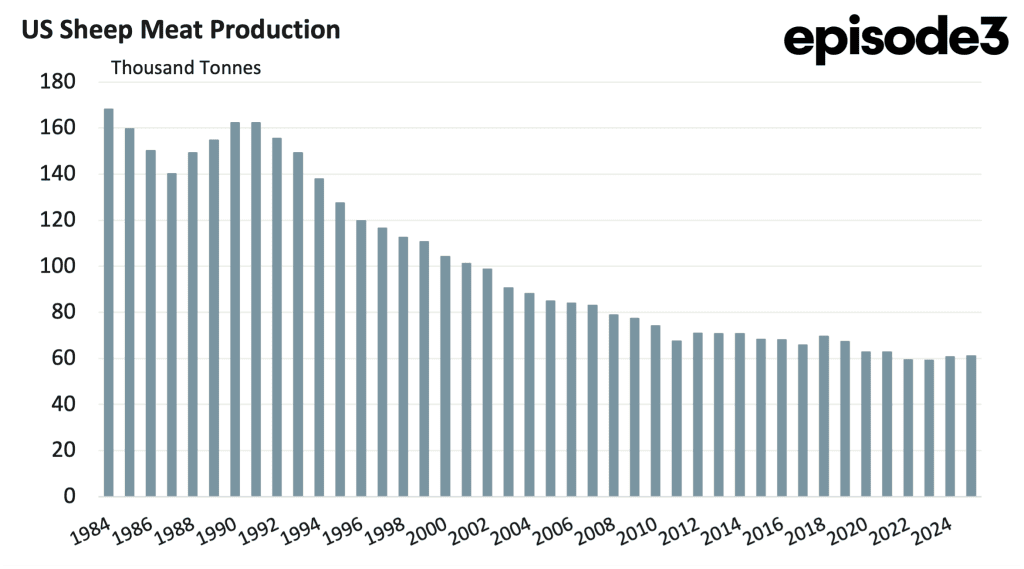
He said there was also the challenge of America’s declining sheep numbers and how that can be stabilized.
However, Mr Pozzi said he could not see that there would be a role for joint country marketing of lamb in the US.
“I don’t know if that’s the case; it is really important for us as United States producers to have our own identify in our own country, but I think having conversations with all the nations is so important to talk about all the different possibilities, also the challenges we have.”
America will only promote American lamb

American Lamb Board treasurer Mike Duff at LambEx26.
When asked whether there were any positives or negatives with having Australian and NZ lamb available in the US, American Lamb Board Mike Duff said the board’s demographic studies on US consumers showed they preferred milder grain-fed lamb.
“They like the quality of American lamb.”
He said demand for lamb in the US had been historically low, but has rapidly increased recently.
“We’re selling every ounce of lamb we can produce at good prices, and so imports fill that gap between what we’re producing and what the consumers want.
“The question from us is, in the future whose going to fill that next tranche of demand,” he said.
“Is it going to be with increased domestic production, which is what we’re hoping for and we’re trying to stimulate production because we don’t have enough sheep, and so that is why the lamb board has put a lot of money and resources into teaching people how to get bigger in the sheep business, or to get into it.”
Mr Duff said there is an increase in sheep numbers in states that have had historically low numbers.
“A lot of that is in the east and the southern states; we’re seeing big gains in sheep numbers in Kentucky, Pennsylvania and the Carolinas, places that didn’t have big sheep flocks before.”
He said there is also some conversion from wool sheep into hair sheep in southern states like Texas.
Mr Duff said the flock increase can be partially attributed to people wanting to move to livestock, but cattle are too expensive to get into.
“You can get into sheep cheaper and there is a separation between traditional lamb markets and the ethnic lamb markets.
“So new producers in the south and the east can supply the ethnic market without having to have 150lb lambs hanging around and having to wrestle them to the ground – they can handle these smaller grades of (hair) sheep.”
Mr Duff said there had been some losses in wool sheep flocks in the west that have supplied the traditional heavier lamb market, with people converting to cattle or just getting out of farming.
“It’s very difficult, and given the number of major processors that we have and some them have been practicing ‘captive supply’, so that when the independent lambs come off the ranges in the west, they are not really fair or active in buying those lambs.
“So it depresses the prices and that makes it hard for us to get those people to expand because the margins are small.”
In the US, ‘captive supply’ refers to livestock procured or committed to packers through forward contracts, marketing agreements, or packer-owned feedlots, rather than at saleyards, and potentially obscuring true market price discovery.
Mr Duff said US lamb promotion and marketing is funded by a carcase check-off of 0.007 cents/lb. He said there are no plans to increase the check-off.
“What we have done is improve enforcement of the collection; we found that there was a big segment of the industry that wasn’t collecting those.”
Mr Duff said since he had been on the board, its budget had almost quadrupled and the ALB had “sort of divided the baby” on check-off expenditure between marketing and increasing production.
“We’re putting a lot into education and research; teaching producers about things that will allow them to grow and tell them about incentives.”
This included sponsoring Next Gen producers to attend LambEx and “learn things they didn’t know they didn’t know.”
He said the ALB just initiated a $5 million program with the United States Department of Agriculture to improve knowledge and understanding of best management practices related to regenerative agriculture.
When asked if there was a possibility of the American industry working together with Australia and New Zealand to promote lamb in the US, Mr Duff said he believed the sharing of information would continue on an informal basis, driven by individual relationships. Mr Duff has hosted Sheep Producers Australia chair Bindi Murray and chief executive officer Bonnie Skinner at his Idaho farm.
“I guess it’s predictable that when you have a global market things inside that market are going to homogenise some, but from an American Lamb Board standpoint our mandate and the regulations that govern our activity mandate that we promote American lamb.”
But he said this precluded the ALB from attacking other lamb or promoting imported lamb.
“Right now most sheep producers I know are worried about surviving and it’s not very easy to work cooperatively when you are worried about being there the next day, but I think communication is going to continue, there is going to be a sharing of things.”
As a seedstock producer selling 250 Suffolk rams annually for crossbred lamb producers running Rambouillet ewes, Mr Duff said he valued being able to learn from Australian producers. But he said profit margins for US producers needed to increase.
“We have high input costs, predator losses take a big chunk out.
“We’ve got to increase the profit margins and the international marketing of lamb between Australia and New Zealand in the US is a big factor in that,” he said.
“We’ve got to see at least four years of reasonable profit levels to allow producers then to capitalise the reinvestment in themselves and their operations to grow to help meet demand.”
“We’re out there actively talking to cattle men, dairy men who have resources who have resources where they could run sheep but don’t, and we’ve had a huge surge in solar grazing.”
He said one of the Global Sheep Producers Forum Next Generation leaders at LambEx, Brittany ‘Cole’ Bush, gets paid to run sheep around Los Angeles.
“That’s a new wrinkle, to get paid to run sheep.
“That’s a unique niche and a growing one.”
HAVE YOUR SAY