
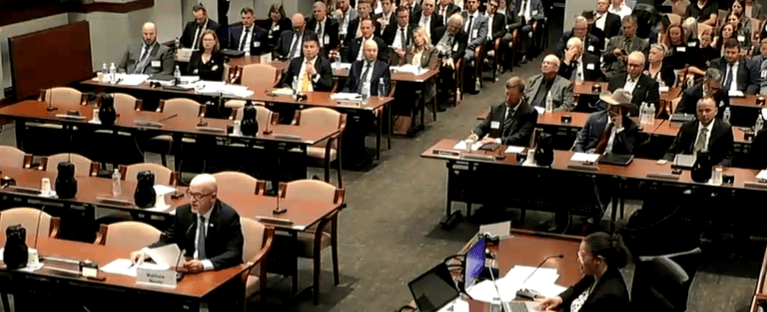
The USITC hearing into lamb imports last month.
UNITED States international trade commissioners are equally divided on whether lamb imports are a substantial cause or threat of serious injury to the American industry, with President Trump now set to decide on potential further action.
The US International Trade Commission today said that three of its commissioners voted in the affirmative – that serious injury has been caused – and three voted in the negative, as part of a global safeguard investigation into lamb imports.
The commission has been conducting the global safeguard investigation into whether lamb meat is being imported into the United States in such increased quantities as to be a substantial cause of serious injury to the domestic industry producing products like or directly competitive with the imported product.
The split decision follows a public hearing last month in which Australian, New Zealand and US industry representatives put their positions before the commissioners. US lamb producers and processors are seeking tariff relief above the current 12.5 percent tariff or restrictions on imports, claiming imported lambs is underselling domestic product, whereas some US supply chain businesses, and the Australian New Zealand industry, have argued imports have satisfied unmet demand for lamb in the US unable to be supplied by American sheep producers.
The USITC said its commission chairman Brett W. Doyle and Commissioners Jason E. Kearns and Bart Thanhauser voted in the affirmative. Commissioners Peter-Anthony Pappas, David Foley Jr., and Samuel T. Negatu voted in the negative.
As a result of today’s vote, the USITC said it will proceed to the remedy phase of the investigation. The USITC will hold a public hearing on remedy on December 1, 2026, and will submit its report containing its determinations, remedy recommendations, certain additional findings, and the basis for them to US president Donald Trump by January 11, 2027.
Split decision welcomed by US and Australian industry
A joint statement from the Australian Meat Industry Council and Sheep Producers Australia said the Australian industry is encouraged by today’s vote.
The bodies said as the investigation continues to the next phase, the industry will keep advocating strongly, to advance the argument that Australian lamb complements US domestic production and is neither a cause nor a threat of serious injury to the US lamb meat industry.
The statement said an evenly divided outcome does not in itself result in any trade restrictions on imported lamb to the US. Current trade arrangements for Australian lamb will remain unchanged until the end of March 2027, while the remaining phases of the investigation process are underway.
AMIC chief executive officer Tim Ryan said Australian lamb has played a vital role in strengthening the lamb category and growing demand among US consumers in a competitive protein market.
“Australian lamb is entirely complementary to US domestic production.
“A strong US lamb industry requires ongoing demand from US retailers, food service businesses and consumers, and imports play a clear role in supporting this through reliable, year-round supply,” he said.
“Imports fill seasonal gaps in domestic supply and help maintain the critical mass the category needs to remain viable.
“By keeping lamb on menus and in stores year-round, Australian lamb ensures US producers have a strong market to sell into – and that market is essential to their confidence to invest,” Mr Ryan said.
“The success of the US lamb category has been built on the contribution of both domestic and imported product, and by working collaboratively we can continue to grow the lamb category in the US.”
Sheep Producers Australia CEO Bonnie Skinner emphasised that the process was not yet concluded.
“Australian sheep producers value the longstanding trade relationship with the US and the important role our lamb plays in supporting the US market.
“We presented a comprehensive, evidence-based case throughout this investigation and will continue to represent the interests of Australian sheep producers as reliable trading partners as the process moves to its next stage,” she said.
“It’s important to be clear, this outcome, alone does not impose any new trade restrictions.
“While the remedy phase of the investigation progresses, Australian lamb continues to enter the US on the same terms as before,” Ms Skinner said.
AMIC and SPA said alongside Meat and Livestock Australia and the Australian Meat Processor Corporation, they will continue working closely with the Australian Government, industry stakeholders and US end users to ensure Australia’s interests are strongly represented as the process moves to its next stage.
The American Sheep Industry Association said President Trump has 60 days to accept the findings and recommendations or adopt a remedy of his choosing. If the president decides to grant relief, the measures will take effect about 15 days after the president proclaims the action, the ASI said.
ASI president Ben Lehfeldt said while the ASI would have preferred a clear affirmative decision, “a tie still results in an important step forward for American sheep producers and reflects the collective efforts of our industry to bring this issue before federal decision-makers.”
“ASI has worked tirelessly alongside our members to ensure their concerns are heard and supported by the economic evidence we’ve gathered. We are encouraged by this determination, but our work is not finished.
“We will continue advocating for meaningful relief that gives American sheep producers a fair opportunity to compete and supports the long-term future of our industry,” Mr Lehfeldt said.
Over to President Trump
The USITC said when its commissioners are equally divided in a injury determination in a global safeguard investigation, it is required to submit the views and findings of both groups to the president and make certain additional findings under the statutes implementing certain free trade agreements (FTAs).
The ITC said that pursuant to these statutes, the commissioners voting affirmative found that imports from Australia, individually, are a substantial cause of serious injury or threat thereof.
The commissioners found that imports of lamb meat from neither Canada nor Mexico account for a substantial share of total imports or contribute importantly to the serious injury caused by imports. They also find that imports of lamb meat from CAFTA-DR (Costa Rica, El Salvador, Guatemala, Honduras Nicaragua, and the Dominican Republic), Colombia, Jordan, Korea, Panama, Peru, and Singapore, individually, are not a substantial cause of serious injury or threat thereof.
The findings of both groups of commissioners will be forwarded to the president as part of the USITC’s report.
President Trump will make the final decision concerning whether to provide relief to the U.S. industry and the kind of relief to provide, including with respect to imports from FTA countries, the USITC said in a statement.
The commissioners’ determinations were following investigation initiated on July 13, 2026, under section 202 of the Trade Act of 1974 (19 U.S.C. § 2252), following a request filed by the U.S. Trade Representative on July 13, 2026. Information about this investigation and global safeguard investigations in general is available in the USITC fact sheet.
A public report concerning this investigation will be available on the USITC website after the USITC submits its findings and recommendations to the President.
Status of proceedings, links to relevant documents, and more information for this investigation can be found at the Commission’s Investigations Database System (IDS).
HAVE YOUR SAY