
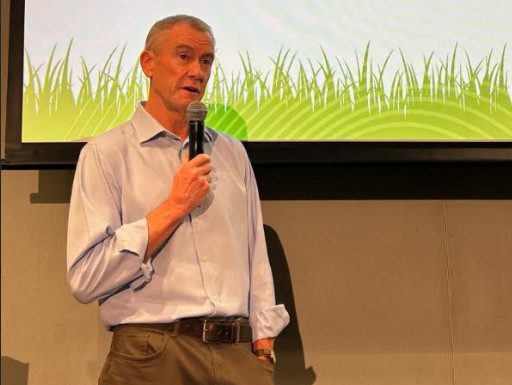
ANZ head of agribusiness Mark Bennett at LambEx.
ROCKETING land values are driving Australia’s agricultural debt into record levels and rewriting farm-level risk, a banking leader has warned.
While ANZ’s head of agribusiness Mark Bennett is bullish about the future for Australian agriculture, he warned that the gap between farm values/debt over gross production/earnings has never been greater.
“Farming’s never been stronger, from a financial health perspective, on the balance sheet.
“Land prices are the big driver of this,” Mr Bennett said at the recent LambEx conference in Adelaide.
“If land prices are your avenue for future growth or survival, because you can borrow against it all the time, I think that’s a very high-risk strategy.”
He continued: “I think it’s cautious time in some respects. But it’s an opportunity to use your balance sheet well, if you’re in a position to go,” he said.
 “But if you’re a bit leveraged and that golden opportunity is coming up right now, with everything at the top right now, you want to be pretty sure you’re very resilient to a flat period.
“If you rely on your bank to give you money all the time for all your needs because of your land values, one day the bank might not be able to assist. And where does that leave you?”
Mr Bennett said many of Australia’s farm acquisitions are debt-driven and total debt is around $145bn.
“That’s $145bn owed by farmers where 85pc of that debt is owed by 20pc of the farming population who produce way more than 50pc of the total output.
“So, the relevance of volume and supply chain and future is very strongly embedded in a handful of farmers that command all the debt,” he said.
Mr Bennett said has been charting Australian farm financial performance over the past 30 years.
“Over this long period, the average earnings in farming per annum has been around $8bn and so one of those trends we see is that, by and large, costs follow income.”
However, the concentration of Australia’s agricultural sector has doubled that figure, even annualised as high as $20bn, as the averaged total earnings were spread among a declining pool of farmers.
“Over this period of time we haven’t lost half the number of farmers, but close to it. So, if you said that we make $8bn a year as a constant, profitability as a farm seems constant – but it isn’t – it’s actually doubled over that time if you call that half the farmers have disappeared,” he said.
“There’s more money being made per business.
“In the last four or five years we’ve seen four of the most-profitable years in farming,” he said.
Profit at closer to $20bn than $8bn. So this is a very profitable period.
“Not everybody is making that profit on a shared basis, of course,” Mr Bennett said.
“If land values are pre-running where earnings and profitability are going, it will be okay. But if we do have that default to type and we’re back making $6-8bn all over again instead of $20bn then it does look like a big gap.”
Mr Bennett described what he called ‘the golden run of agriculture’ and asked ‘will it ever be this golden again?’
“Hopefully, yes. I’m extremely bullish about the positive opportunity for agribusiness in Australia well into the future. Absolutely,” he said.
“There’s heaps of reasons why; strong underlying demand from countries that have all the population and don’t have the means to feed themselves in the way that they would like to.
“They are resource-poor, demand-heavy with a growing import need from places like Australia, and we are a very good industry as a supply chain delivering to those markets,” Mr Bennett said.
“I’m more than cautiously optimistic at the farm level; I’m not as completely bullish because the same farmers won’t be in the room here in another 10 or 15 years.
“So, at the business level there’s a bit more going on,” he said.
“You have to navigate to be part of this prosperous future and it’s not easy – and not necessarily for everyone.”
Mr Bennett spoke of sector ‘dislocation’ from gross and net earnings in farming.
“Debt and land values have never been further from the line.
“This is the pressure we talk about – how do we justify the value of land?” he said.
“Land values and high volumes of transactions pull debt along with it.
That’s the biggest part of the debt market in Australia,” he said.
“Now we’ve got this big gap. How will that gap close? Will it be through increased earnings? Will it be through declining land values?
Well, they’re certainly stabilising and in parts falling,” Mr Bennett said.
“It won’t be through debt going down, I suspect,” he said.
Referring to the ABARES outlook he said: “They’re talking about the 2026/27 year being 70pc down on farm profit. That would take us back to $6bn.”
“That’s below the long-run average and back to making the same old $6-8bn, which doesn’t cover things well if the El Nino kicks in.”
Mr Bennett noted the situation facing small producers.
“When you’re a small farm it’s great, it’s nice, it’s neat, it’s manageable.
You can do everything, get it done,” he said.
“But you can only ever make so much money and you will feel the pressure to increase your size and output in order to keep more cash in your business to do all the things that you’ve got to do.
“That’s the problem; because you still have got that cost issue and you can only pass so much on as a local producer.”
Mr Bennett said farmers are getting fewer and their farms larger.
“It’s not just about farmers going broke.
“It’s about farmers not farming any more for a whole range of reasons,” he said.
“Some of it is (due to) being difficult to keep up with all the complexities and volatilities that go with farming today, some of it is capitalising on fantastic prices, some of it is just natural retirement – no generational pressure, sickness, divorce, death.”
HAVE YOUR SAY