
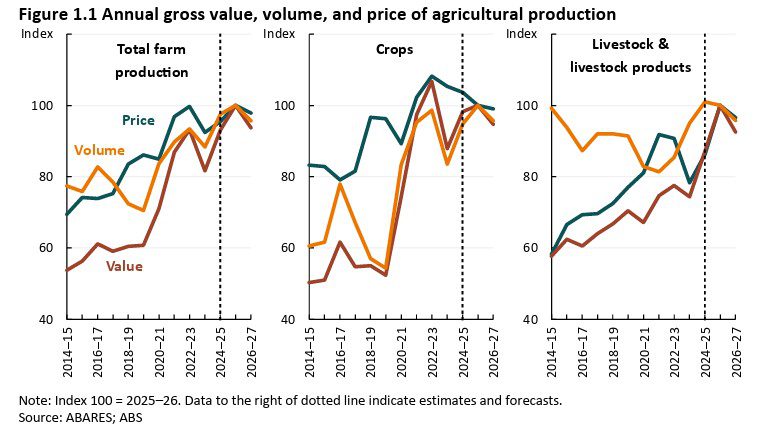
INCREASING beef and winter crop volumes are forecast to drive Australia’s farm gate production value above $100 billion this financial year – four years ahead of the National Farmers Federation’s 2030 target.
The latest forecasts from the Australian Bureau of Agricultural Resources Economics and Sciences released today show Australia’s agricultural production value will hit a record $101.4 billion in 2025-26, and $107.4 billion when combined with fisheries and forestry.
However ABARES also said the gross value of agricultural production is expected to fall by 6 percent to $95 billion in 2026-27, and including fisheries and forestry, combined production value for the sector is forecast to fall from $107.4 billion in 2025-26 to $101.2 billion in 2026-27.
ABARES said in large part, the 2025-26 forecast increase in the gross value of agricultural production, $1.9 billion higher than a December 2025 prediction, reflects strong upwards revisions to beef production volume to service strong export demand as well as upward revisions to winter crop production volumes.
ABARES forecasts show agriculture, fisheries and forestry exports will reach a record high of almost $85 billion in 2025-26, with more demand than ever for Australia’s world-class food and fibre.
In 2018, the National Farmers Federation released its 2030 Roadmap, detailing its vision for agriculture to become Australia’s next $100 billion industry – with agriculture worth around $88 billion when the Albanese Government came to office in 2022.
Since then, the value of Australia’s agricultural production has increased by 15 percent, with agricultural exports now able to reach around 190 markets – the most diversified trade has ever been.
ABARES livestock prices and production forecast not so positive
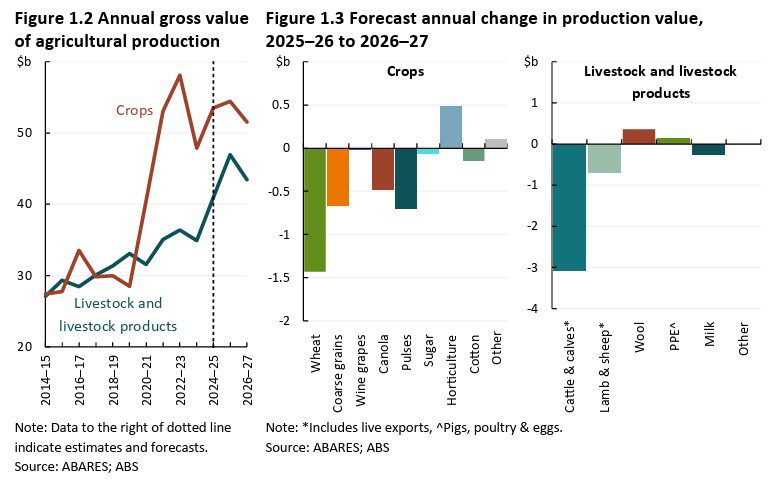
However, the milestone news has been tempered by ABARES forecasts that lower livestock prices and production volumes in 2026-27 will drive value down by $3.5 billion to $43.4 billion.
ABARES said livestock prices are expected to fall from the record highs seen in 2025-26.
Less favourable market access for Australian beef in some key export markets is forecast to lead to softer processor demand and saleyard prices in 2026-27, the agency said.
“Saleyard prices of lamb and mutton are also expected to ease.
“Livestock and livestock product production volumes are expected to fall as elevated turn-off in recent years has reduced livestock available for slaughter,” ABRES said.
By commodity, ABARES said the change in livestock and livestock product value reflects:
- Cattle and calves ($3 billion lower) driven by both lower prices and production volume.
- Lamb and sheep ($0.7 billion lower) driven by a fall in prices combined with expected lower production volumes for both lamb and mutton.
- Milk (down $0.3 billion) driven by lower milk production and a lower farmgate milk price.
- In contrast, Pigs, poultry and eggs value is expected to increase slightly (up $0.1 billion) driven by rising production volumes to meet growing domestic demand.
- Wool value is also expected to increase (up $0.35 billion) driven by higher prices due to robust demand and lack of supply.
Albanese Government works for market access for some
Speaking at the ABARES conference today Minister for Agriculture, Forestry and Fisheries Julie Collins said under the Albanese Government, market access for Australia’s farmers and producers is the most diversified it has ever been.
She said the government has proudly stood for free and fair trade because it knows the benefits it delivers the economy.
“It’s clear the Albanese Labor Government can be trusted to continue delivering market access for our farmers and producers,” she said.
However, remarking on the Albanese Government legislating against market access for live sheep exports by sea, Australian Livestock Exporters Council chief executive officer Mark Harvey-Sutton said ALEC welcomed any announcement in support of agriculture and milestones like this should absolutely be celebrated.
“In celebrating, the government’s ban on live sheep exports should not be forgotten nor the damage that policy has caused to Western Australian farmers and their communities.
“At the end of the day live export contributes much more than valuation figures to agriculture,” he said.
“More often than not it has paved the way for market access of other commodities and assisted in their success.
“There remains tremendous opportunities for growth in the cattle live exports trade, with Indonesia as a focus, and ALEC commits to working with the government to ensure those opportunities are realised, contributing to further growth to the Australian agricultural sector,” Mr Harvey Sutton said.
Time to thank farmers
Ms Collins said the ABARES forecast gives Australians 100 billion reasons to thank Australia’s farmers, whose hard work, resilience and skill is helping power our national economy.
“It shows that the Albanese Labor Government’s work to diversify trade opportunities is helping our farmers and producers to export more of Australia’s world-class agricultural products than ever before.
“Being on track to exceed industry’s $100 billion target by four years is a tremendous result for our farmers and regional communities, and it’s what you can achieve when Government works together with industry to progress their priorities,” she said.
“As we celebrate this significant milestone, we also reaffirm our commitment to supporting our farmers and producers during difficult conditions, because we will always have their back.”
Assistant Minister for Agriculture, Fisheries and Forestry, Senator Anthony Chisholm said Australian farmers operate under difficult and ever-changing conditions yet continue to deliver more for the nation’s economy than ever before.
“This year’s outlook is a remarkable achievement and a testament to the immense resilience and skill of Australia’s agricultural workforce.
“The Albanese Government will always work to ensure Australians can gain the skills they need for good, secure jobs that help keep Australian agriculture strong,” he said
“Agriculture touches every one of us – our government recognises this and remains as committed as ever to growing our agriculture sector and giving Australian farmers every opportunity to thrive.”
National Farmers Federation president Hamish McIntyre said this is a landmark moment for Australian agriculture.
“In 2018, $100 billion was seen as ambitious.
“Today we’re forecast to reach it ahead of schedule,” he said.
“This shows agriculture is an industry worth backing, because when we set a goal, we deliver.
“This milestone wasn’t handed to us, but earned through droughts, fires and floods, through a pandemic and global trade disruption,” Mr McIntyre said.
“It’s important to remember, our target has never been just about chasing a headline number. It is underpinned by a detailed roadmap that places farmer wellbeing, sustainability and natural capital alongside productivity and profitability.
“We could not have achieved this without strong collaboration from our members, governments and the supply chain partners who all backed our vision,” he said.
“But above all, this belongs to Australian farmers.
“It proves Australian agriculture can compete with the best in the world.”
For the full ABARES outlook and reports click here.
HAVE YOUR SAY