
WORLD demand for sheep meat is forecast to remain robust in 2026-27, driven by population growth and rising per capita protein consumption, according to the ABARES September 2026 quarter Agricultural Commodities report.
ABARES said lamb saleyard prices are forecast to moderate by 5 percent to average 1090 cents per kilogram (carcase weight) in 2026-27, down from 1142c/kg in 2025–26.
Mutton saleyard prices are forecast to ease by 8pc to average 704 c/kg in 2026-27, down from 766c/kg in 2025-26
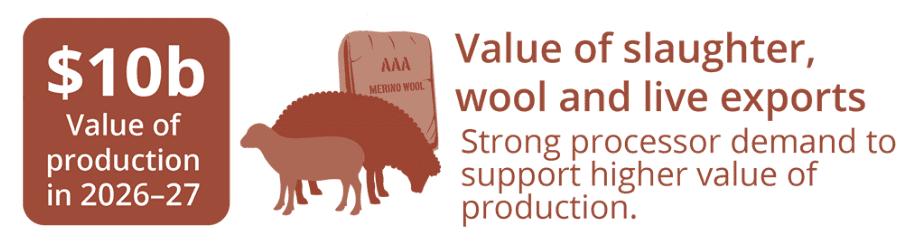
The report released this week said the gross value of sheep slaughtering, wool and live sheep for export is expected to rise 2 percent to $10.3 billion in 2026-27.
Saleyard prices are forecast to moderate as softening sheep meat export prices reduce processor competition, although the value of sheep meat, wool and live sheep exports is forecast to rise by 2pc to $9.4 billion.
ABARES said sheep meat production level is expected to be steady as increased lamb slaughter shields against fall in mutton slaughter.
The benchmark AWEX Eastern Market Indicator for wool is forecast to rise by 15pc to 1840 cents per kilogram clean in 2026-27.
ABARES analyst Fiona Borello said ongoing disruption in the marketplace due to the Middle East conflict and changing trade restrictions are forecast to continue to disrupt product placement, however, high diversification in Australia’s export trade is expected to partially offset the impact on Australian exports.
“United States consumption of sheep meat is forecast to remain relatively robust, albeit falling slightly year on year in 2026-27, reflecting pressure on US household budgets and Australian sheep meat prices remaining elevated.
“The United States imported 19pc of the total volume and 28pc of the total value of lamb exported from Australia in 2025-26 valued at $1.4 billion,” she said.
“In addition, the United States is a relatively high value market for Australian sheep meat paying an average of $16.9 per kilogram (shipped weight) compared to the rest of the world average in 2025-26 of $9.8 per kilogram (shipped weight).”
Ms Borello said lower domestic sheep meat production in the United States is expected to support demand for Australian lamb exports, particularly in the high-value restaurant trade.
“However, uncertainty exists in this market due to the potential for higher tariffs.
“High lamb prices are expected to result in some product substitution amongst different protein sources in the United States.”
Ag production value to fall to $99.4b
ABARES is forecasting the total value of agricultural production to fall by 5pc to $99.4 billion in 2026-27, or $105.6m when fisheries and forestry are included, a reflection of lower crop and livestock production and a decline in livestock prices.
Agricultural export value is also expected to fall 5pc to $76.3 billion, or $80.8 billion including fisheries and forestry.
ABARES acting executive director David Galeano said while the value of agricultural production was down from the record of $104.6 billion in 2025-26, there had been improvements to this year’s outlook over winter.
“Production in 2026-27 is expected to be supported by a wetter than expected winter in south-east Australia, and a smaller than anticipated impact on area planted and yields from high fertiliser prices,” he said.
“While the rainfall outlook for spring 2026 indicates large areas of eastern and southern Australia are expected to be drier than average, the advanced state of winter crops in the south-east and current stored soil moisture mean that crops will be less reliant on spring rainfall this year.”
Total crop production value is forecast to fall by 6pc to $51.9 billion in 2026-27, reflecting an expected fall in winter crop production more than offsetting expected higher prices.
National winter crop production volume is expected to drop 12pc in 2026-27 to 61 million tonnes, still the fourth largest crop on record. Meanwhile, national summer crop production is forecast to fall by 25pc to 3.4 million tonnes in 2026-27, 11pc below the 10-year average.
“Cropping conditions in winter have been very favourable in South Australia, Victoria and southern New South Wales.
“This is expected to be more than offset by a return to longer-term average yields in Western Australia and poor seasonal conditions in northern New South Wales and Queensland.”
Mr Galleano said a lower value of cattle, sheep and pig slaughter is expected to outweigh increases in the value of milk, wool and poultry.
Falling revenue and continued high costs are expected to impact profits. Average broadacre farm business profit is expected to fall by 39pc to $133,000 per farm in 2026-27, which is 6pc above the 10-year average.
The ABARES September 2026 quarter Agricultural Commodities and Australian Crop reports can be viewed here: Agricultural outlook.
HAVE YOUR SAY