
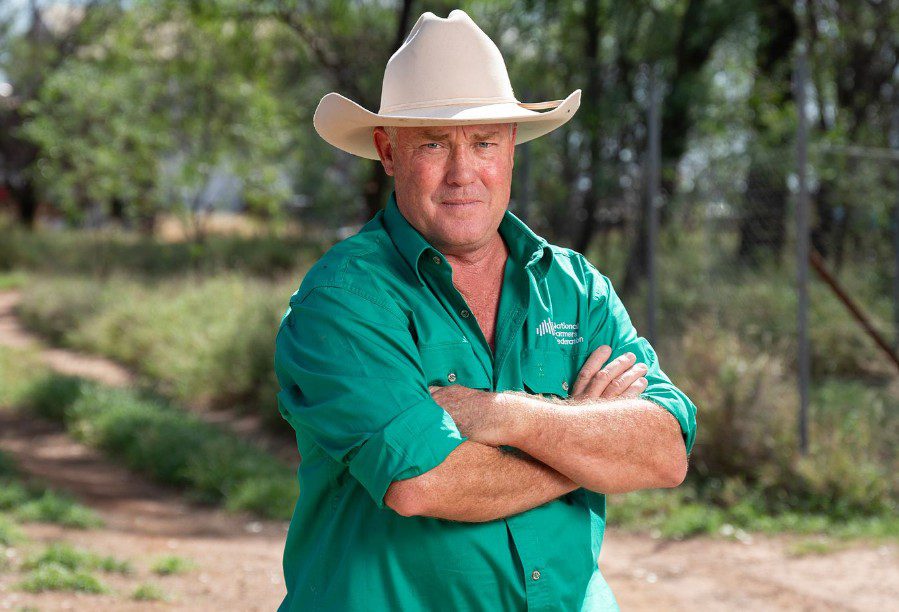
NFF president Hamish McIntyre: will hold trade minister Don Farrell to better EU access offer commitment.
AUSTRALIAN industry messages to the nation’s representatives at Australia-European Union Free Trade Agreement negotiations continued today, with stronger statements by the red meat sector and the National Farmers Federation.
The Australia–EU Red Meat Market Access Taskforce said with the EU only allocating quota increases to its trading partners, rather than genuinely liberalising its import regime, Australian negotiators must remain firm.
Taskforce chair Andrew McDonald said Australia cannot afford to fall further behind other global suppliers.
“A successful deal must correct the disproportionately low quota volumes currently applied to Australian beef, sheep meat and goat meat entering the EU, and secure the maximum possible additional, useable access under an FTA.
“Our competitors have significantly strengthened their position in the EU through bilateral negotiations,” he said.
“With strong support from the Australian Government, we aim to achieve the same.”
Mr McDonald said as a likeminded partner with a strong value proposition, particularly in product quality and sustainability, it is reasonable that Australia secures at least a minimum of 50,000 tonnes carcase weight (cwt) of beef access in line with what the EU has offered our competitors.
Australia’s current country specific beef quota sits at just 3389 tonnes shipped weight (swt). This compares starkly with:
49,500 tonnes cwt secured by Brazil (assuming 50 percent of Mercosur’s 99,000 tonne outcome); and
50,000 tonnes cwt secured via the EU–Canada agreement.
Mr McDonald said the situation for Australian sheep meat and goat meat is similarly inequitable.
“New Zealand enjoys 125,769 tonnes of WTO access plus 38,000 tonnes under its FTA.
“By contrast, Australia is limited to just 5851 tonnes,” he said.
“A genuinely trade enhancing FTA must go a long way toward addressing this imbalance by securing at least a minimum of 67,000 tonnes.
“With Australia’s red meat access to the EU effectively being unchanged for nearly 50 years and then diminishing as a result of Brexit and a redistribution of quotas, this FTA represents the only realistic opportunity to remedy the competitive disadvantage we face, albeit still through restrictive perpetual quota and high tariff arrangements,” Mr McDonald said.
“Settling for a sub optimal outcome at a time of growing global trade uncertainty would weaken Australia’s trade resilience and apply a handbrake to diversification into a market of 27 countries and 450 million consumers.
“Our preference is that the EU genuinely engages in free and fair trade. It is not a good deal for Australia if the Government agrees with the EU to continue punitive restrictions on Australian red meat,” he said.
“We are counting on Trade Minister Don Farrell and the Government to maintain their resolve and secure an outcome our industry can support.
“These necessary access improvements will also help address current skewed trade flows, with the balance of trade, both in its totality and specifically in relation to agricultural goods, firmly in the EU’s favour.”
Mr McDonald said Australia already provides the EU with quota and tariff free access for meat products and hence the EU import regime is a long way from a ‘level playing field.’
“Such a rebalance would clearly be in Australia’s national interest.
“As Prime Minister Albanese has emphasised, “no one held back, no one left behind.” Australia’s red meat sector cannot afford to be held back, or left behind, in these critical negotiations.”
MLA serves as Secretariat to the Australia–EU Red Meat Market Access Taskforce, supporting industry coordination and insights throughout the negotiation process.
NFF to hold Farrell to EU better access commitment
With Australia’s Trade Minister Don Farrell due to hold talks in Europe this week with the EU’s top trade negotiator Maros Šefčovič and agriculture commissioner Christophe Hansen, the National Farmers Federation’s interim chief executive Su McCluskey last week said negotiations are now reaching the “pointy end”, but Australian farmers would not accept a one-sided outcome.
“No deal is better than a bad deal,” Su McCluskey said.
The NFF today welcomed comments by Trade Minister Don Farrell that the deal hinges on securing a better deal for Australian agriculture. Minister Farrell told Parliament last week the deal “would require a better offer by the EU on agricultural market access.”
Mr Farrell told the Senate that the EU is Australia’s largest trading partner without a trade agreement.
“It’s a high income market of 450 million people.
“Concluding a deal will complete the last major piece in Australia’s network of free trade agreements,” he said.
“I look forward to meeting my European counterpart soon to close the gaps on the very few remaining issues, and I’m confident that a deal can be done and will be done, which would require a better offer by the EU on agricultural market access.”
National Farmers’ Federation president Hamish McIntyre said Australian farmers would hold the minister to these comments against a growing fear that Australian agriculture is about to be traded away.
“The government has set a clear bar as we enter the final stages of these negotiations – no deal is better than a bad deal for Australian agriculture,” Mr McIntyre said.
“This deal is clearly at the pointy end, and the Government should not flinch on the standard they have now set.
“A one-sided EU agreement would lock in decades of disadvantage for Australian farmers,” he said.
“At the end of the day, how does the Government explain to Australian farming families that it agreed to a deal that not only harms them against European competitors, but leaves them worse off than other nations doing business with the EU?”
The NFF said recent developments in Europe only heightened concerns for Australian producers.
“As negotiations approach a potential conclusion, we are concerned the EU will continue to offer limited access for Australian producers while relying on billion-dollar, production-distorting subsidies.
“This would be a double blow for Australian farmers,” Mr McIntyre said.
“We saw the EU fast-track nearly $80 billion in farm subsidies to sign an agreement with Mercosur nations.
“The risk for Australia is being offered limited access while our European competitors might receive billions more in subsidises – a double blow for Australian farming families,” he said.
Mr McIntyre said Australian agriculture could not compete on an uneven playing field.
“Australian farmers can compete with anyone in the world, but not against subsidised production unless trade agreements deliver genuine, commercially meaningful access.”
Mr McIntyre said the timing of the negotiations could not be more critical.
“Global trade uncertainty is stacking up as a real threat to farm profitability as we head into 2026. Between China’s beef tariffs, ongoing trade volatility in the United States and rising export costs imposed domestically, now is not the time to accept weak market access.
“Australia can’t control other countries’ trade policy, but we do control the deals we sign,” he said.
“Accepting a bad deal would undermine our commitment to open, liberalised trade and set a damaging precedent for future trade agreements.
“We cannot credibly call on others to liberalise trade while settling for an agreement that fails to recognise the economic and sustainability benefits of open agricultural markets.”
HAVE YOUR SAY