
AUSTRALIA’S trade and lamb indicators surged to new historic peaks above 1200c/kg this week, following extreme competition among exporters for dwindling supplies of old lot-fed domestic and export weight lambs.
After today’s saleyard sales, the heavy lamb indicator closed at 1240c/kg and the trade lamb indicator finished at 1231c/kg.
Global AgriTrends analyst Simon Quilty said the rates are consistent with his expectations and he believes lamb prices could go even higher next year.
The sharp lift in the heavy lamb indicator started late last week with continual increases in the national price record for lot-fed export lines, culminating in two lines selling for $460 at the Griffith saleyards last Friday and a new national record of $477.20 at Dubbo on Monday.
The Elders agent Mark Flagg sold the Daunt Partnership’s 34 second cross lambs at $460 to Thomas Foods International and the other pen of 22 lambs for $460 from Aloisi Farming, equalling the price set at Forbes the previous week.
Meat & Livestock Australia’s National livestock Reporting Service said lamb numbers eased by 950 to 6050 at Griffith and quality was good, with plenty of grain-assisted lambs. Heavy and extra heavy lambs were well supplied and there were good runs of trade weights especially in the Dorper runs.
The NLRS said 2 score processing lambs sold from $155-$205 and averaged 1165c/kg. Trade weights were $6-$10 dearer at $252-$305 or around 1235c/kg. Lambs to 26kg made to $335/head. Heavy lambs to 30kg made $312-$380/head and extra heavy lambs sold from $400-$460 to average 1240c/kg.
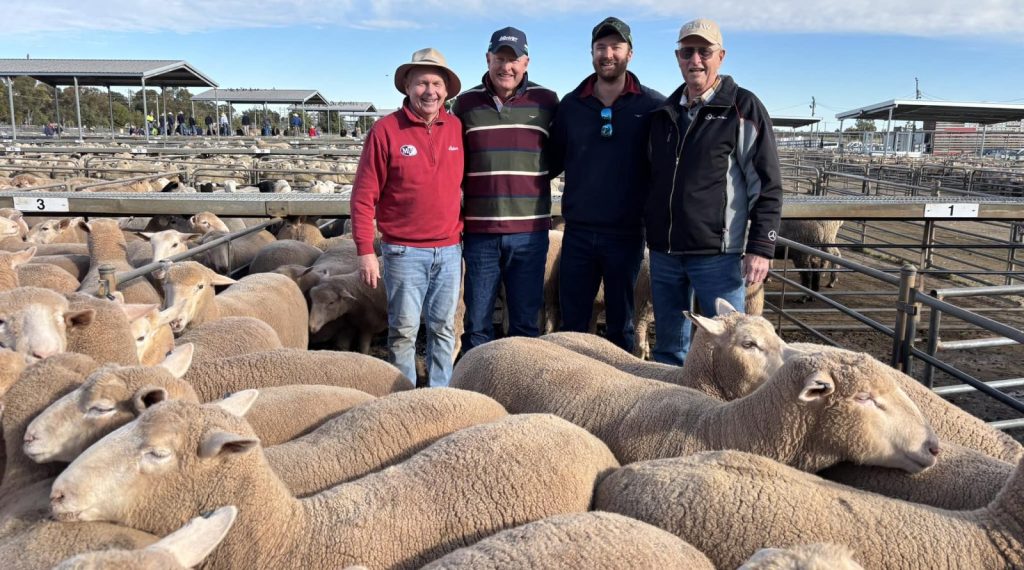
Elders agent Mark Flagg, left, with three generations of the Daunt family — Peter, Luke and John — and their $460 lambs. Image – Elders, Facebook.
Elders agent Mark Flagg said a line of new season lambs also made $300 in the sale, but he said east of Griffith the suckers don’t have enough weight, with the area dry for too long.
“There will very very limited suckers will be sold before September-October, a lot of them will have to be shorn.
“So there won’t be any big runs of suckers and to be honest, from here on, we’ll be out of good quality heavy old lambs as well,” he said.
“There won’t be too many coming at us as agents for a while.”
He said southern processors are struggling to source quality 24-30kg lambs pushing the cents/kg carcase weight value to its highest level.
“And with the very limited amount of really extra heavy lambs, when they do come up , three or four companies all try to secure them.
“I think the competition will be there for quite a while; I can’t see that waning because they just haven’t got the lambs.”
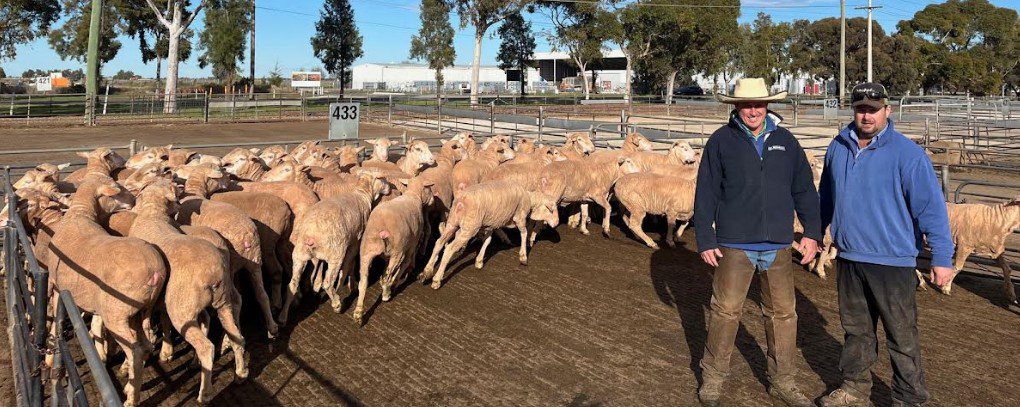
Nutrien agents Justin Buchanan, left, and Matt Taylor with the $370 Merino wethers.
Also at Griffith, 60 Merino wethers from G.A. Hyder of Hillston sold for $370 to Wagstaff, setting what is believed to be a new national record for mutton. Nutrien agent Don Barbaro said the wethers had an estimated carcase weight of 36-37kg.
Dubbo sets new national lamb record
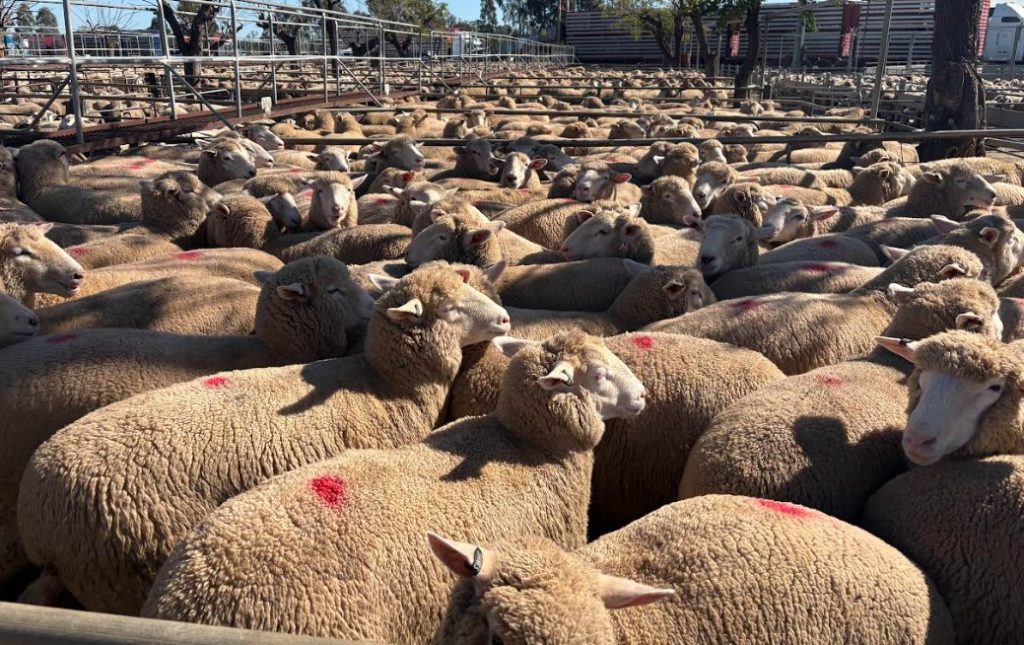
The $477.20 Shanks Farms lambs at Dubbo. Image – Christie and Hood.
Then at the Dubbo saleyards yesterday, the Christie and Hood agency sold 202 Poll Dorset cross lambs for $477.20 from Shanks Farms to set a new national record. The lambs had an estimated carcase weight of 39kgs and they were bought by Fletchers International Exports at Dubbo, with Southern Meats at Goulburn the losing bidder.
The same vendor sent a B-Double of lambs to FIE a few weeks ago that averaged more than $400.
 “It was a good day at the shop buddy,” Christie and Hood agent Tim Wiggins said.
“He’s a very good producer, he does a great job.”
The NLRS said the Dubbo offering of 23,550 lambs, 1350 fewer, had a good selection of trade and heavy weight lamb, plus some well-finished new season lambs a good number of Merinos. Lightweight lambs to the processors finished close to firm, with 12-18kg 2 scores at $144-$203. New season lambs were firm, with trade weights making $218-$268.
Trade weight old lambs were $8-$15 dearer, with the 20-24kg lambs making $221-$325 to average 1145-1240c/kg cwt. Heavy weight lambs were up to $20 dearer, with old lambs over 24kg selling from $281-$477.20. The NLRS said heavy weight lambs averaged 1210-1290c/kg.
New season lambs over 24kg sold from $285-$306. Merino lambs were up to $20 dearer, with trade weights selling from $170-$292 and heavy weights making to $305/head. Young lambs to the restockers made $130-$200 and hoggets sold to $349.
Will producers wait for long-term price signals?
Mr Wiggins said clients were wondering how long the prices would last.
“But our best mutton yesterday made nearly $360 to kill, so they’re now thinking should just kill them all and not worry about breeding anymore, just kill them all while it’s this good, because we don’t want to go back to having it worth $36 again, which could be just around the corner.
“Not many have acted on it, but they’re seriously considering it.”
Mr Wiggins said there had been a lot of sheep killed, that normally wouldn’t have been slaughtered, because of the strength of the market, including joined older ewes and ewe lambs.
“The market is very very strong and hopefully when it settles down, we settle down at somewhere that is profitable for the producers and the processors.”
Is it time for the Quilty contract?
Mr Quilty said the main lamb indicators hitting $12/kg, took him back to the RMA Network conference in 2022 when he predicted that lamb prices would hit that mark within three years and he said a processor representative remarked: “If that happens we’ll call it the Quilty contract.”
Mr Quilty said the price difference between light and trade/heavy lambs in saleyards is a strong incentive to feed lambs.
“I think it is one of the stronger incentives we’ve seen in a good while and as a result those signals are getting through and (after recent rain) conditions look very favourable in southern Australia.
“The prices point to in New South Wales the (lotfeeding) incentive is there for trade lambs and in Victoria the incentive is for heavy lambs.”
However, Mr Quilty said the impact of the dry season on marking rates and future, likely lower, lamb supplies in southern Australia would underpin prices going forward.
“I haven’t moved away from saying strong prices through 2026, 2027, and I think the peak in price will probably be this month in August, and that’s traditional.
“I think it comes a month earlier next year and wherever we land this year on peak of pricing you can add another dollar a kilogram next year to the peak.”
Mr Quilty said it would be challenging for processors to achieve a margin on the current lamb prices.
“I think there is some reliance on markets improving going forward and I’m forecasting that we will probably see the peak in (FAO – UN Food and Agriculture Organisation) global lamb prices next July and that historically happens anywhere between three to six months before the peak in beef prices.
“So my expectation is the peak in global lamb prices is probably July next year, so one of the challenges of processors is trying to get this improvement in pricing on a global level,” he said.
Mr Quilty said another challenge for processors is to maintain throughput to keep their workforces.
“But eventually I think you will find that next year they will start to rationalize to cut back on shifts.
“But normally for the first 12 months when you get to these levels and numbers start to dry up there is 12 months of trying to hold it together,” he said.
“Normally when we go from the high of a market to the low of a market, there can be about a 34 percent reduction in overall slaughter in small stock – mutton and lamb, not goats.”
Value-adding model is holding up
Mr Quilty said lamb and mutton supplies would get tighter after two years of effectively liquidating the flock, which is being reflected in both kills. Another challenge for processors would be servicing their value-added programs, here and overseas.
“But I think one of the benefits of value-adding is that they are getting much closer to a retail price versus a wholesale.
“And in America, in particular, the margins have been very good at retail,” he said
“So I think the model is a good one, it is just in periods like now when supply tightens, that it is challenged, but that’s the meat industry.
“But I think overall it has proven to be the right strategy over the long term, but you are going to have some hiccups.”
Overall, Mr Quilty said although sheep meat supplies would be tighter, prices would be stronger, with a peak in the market this month.
“And whatever we land at in terms of the peak this year add another $1 a kilogram next year.”
He said he was surprised at the slight tightening in supply that led to the recent lamb price hikes and wondered what will happen with even tighter supplies next year.
“It points to very strong prices in market for the next two years.
“I think my $1 a kilogram, may be conservative,” he said.
“This is the start of the flock rebuild, not the end of it, so we’ve got two more years at least of this to occur, and yet here we are at record levels already.”
Mr Quilty expected ewe and cow prices to be cost-prohibitive for some wanting to restock.
“I think that there is a strong parallel between sheep and cattle, sheep are running six months ahead of cattle.”
HAVE YOUR SAY