
Latest listings on our AgJobs Central recruitment page:
- Regional livestock manager (Agrbusiness Recruitment)
- FSQA officer – JBS Riverina (JBS)
- HR officer – JBS Riverina (JBS)
- Stud cattle, Guluguba QLD (ANC Charolais)
- Livestock operations manager – Glen Aplin, Qld (WiseRepro)
- Livestock overseer (sheep & cattle) – Harrow, Vic (DroverAg client)
- Junior farm hand – Merinos & cattle, Western Vic (DroverAg client)
- Livestock manager – Ultrafine wool & Angus (DroverAg client)
- Stud data & agtech coordinator – Cooma, NSW (DroverAg client)
- Assistant manager, Narwietooma Aggregation NT (Hewitt)
- Supply chain analyst, Vic (Rimfire client)
- Leading hand & governess – Oodnadatta SA (DroverAg client)
- Station hand – Angus stud – Adelong, NSW (DroverAg client)
- Overseer – Merino & angus Stud – Cooma, NSW (DroverAg client)
- Senior cropping farm hand – Mixed Farming, Kaniva Vic (DroverAg client)
- Senior station hand cattle – Hernani, NSW (Wright Pastoral)
- Assistant farm manager – Grampians, Vic (DroverAg client)
- Leading hand – commercial Angus, Upper Murray Vic (DroverAg client)
- Station hand – Angus & fine wool, Mudgee NSW (DroverAg client)
- Station Hand / Machinery Operator, SA (Lucas Group client)
- Trade and contract administrator, Vic (Rimfire client)
- Extensions manager (2 roles) – Wagga Wagga, NSW (Rimfire client)
- Grain trader, Vic (Rimfire client)
- Junior trader, Vic (Rimfire client)
- Manager – business development & commercialisation (Rimfire client)
- Manager – partnerships (AgriFutures, via Rimfire)
- Grower relations manager – Wagga Wagga, NSW (Rimfire client)
- Grower relations manager – Toowoomba, Qld (Rimfire client)
- Territory manager – northern NSW and Qld (InterGrain)
- Head stockperson, St George/Roma Qld (McIntyre Agriculture)
Click here to access these and other exciting meat and livestock supply chain jobs currently listed on AgJobs Central.
ADVERTISED base salaries for agribusiness management roles in Australia run from around $80,000-$100,000 for a farm manager to $180,000 and above for a general manager, specialist recruiter, Agricultural Appointments has found.
In its latest annual Agribusiness Salary and Trend Report released last week, Agricultural Appointments sets out the current bands role-by-role, then covers the part that decides most offers: what sits alongside the base.
However, the base figure is the ‘easy bit’, Agricultural Appointments’ Ray Johnson suggests. Housing, vehicle, fuel and the rest are where offers are won and lost.
The 2026 pay bands
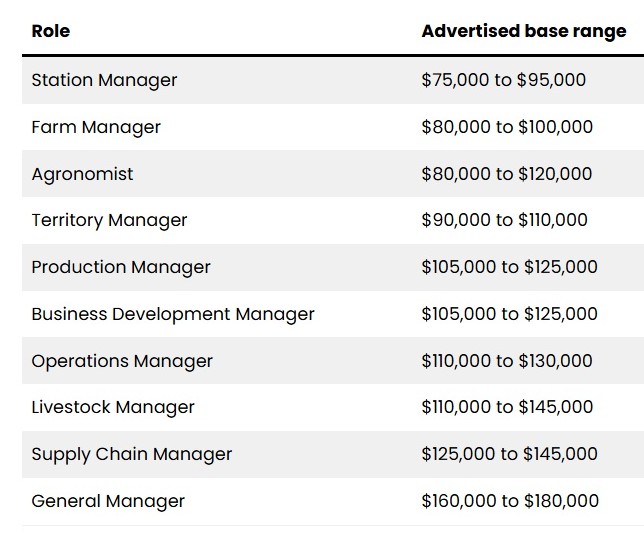
The figures are from advertised full-time salary ranges across Australia, refreshed 1 July this year. They represent base salaries only, with superannuation, bonuses and on-farm benefits sit on top.
Livestock manager base salary sitting above farm manager salary might look wrong, but what’s actually being advertised under those titles explains what’s going on: the livestock manager positions are large feedlots and corporate cattle operations carrying real budget responsibility, not a mixed farm running 400 head.
The operations, production, supply chain and business development bands are drawn from all industries, not agriculture alone, Agricultural Appointments says.
Within farming and conservation specifically, advertised production manager roles average closer to $89,000 and territory manager roles around $94,000. It’s best to treat the wider band as the ceiling, and the ag-specific figure as the floor.
The base salary isn’t the offer
In providing context, Dr Johnson explains that agribusiness has never competed on base salary alone.
A farm manager on $95,000 with a four-bedroom house on the property, a ute with private use, fuel, power, killer beef and a phone is holding something worth $130,000 to $145,000 against an equivalent ‘town’ job, the report suggests.
“If an agribusiness employer’s job ad says $95,000 and stops there, they’re being compared to a $95,000 town job. They’ll lose that comparison every time,” the report suggests.
Price each of these and put the total in the ad, the report suggests:
 Housing, either a maintained house on-property or a rental allowance for town-based roles
- Vehicle with private use, fuel card, and clear family access
- Utilities: power, water, internet and phone
- Meat, and in some operations produce or firewood
- Schooling support, distance education costs, boarding allowance or a contribution to fees
- A bonus tied to something the manager actually controls, like kilograms produced or cost per hectare, rather than group profit
- Relocation, including moving stock, dogs and horses
“Candidates do the maths anyway. Better they do it with your numbers in front of them,” the report suggests.
Moving a band up, or down
Three things move a band up or down, the report suggests.
Scale comes first. A manager running 12,000ha of irrigated cropping with a team of fifteen and a multi-million dollar operating budget is not in the same conversation as a manager on a 900ha dryland block with two casuals. The advertised farm manager band covers both. That’s why it’s so wide, and why quoting the midpoint back to a candidate rarely lands, it said.
Location comes second. The further the property sits from a school, a hospital and a supermarket, the bigger the loading that will be needed. Roles in remote Northern Territory and far west Queensland regularly pay well above the equivalent role two hours from a regional centre, and they still take longer to fill.
Enterprise type comes third. Irrigated cotton and intensive horticulture pay above broadacre. Corporate and institutional owners tend to pay more in cash and less in kind than family operations. Neither model is wrong. They attract different people, and you should know which one you’re running before you write the ad.
What changed this year
Award rates rose 4.75 percent from the first full pay period on or after 1 July 2026, and the national minimum wage lifted 6pc to $1004.90 a week. For those employing under the Pastoral Award, its worth checking current rates through the Fair Work Ombudsman rather than rolling over last season’s figures.
That increase matters further up the chart than what might be expected. When farm hand rates lift, the gap between a senior hand and a leading hand or assistant manager narrows. Leave the supervisory bands where they were and employers end up with good people turning down promotions, because the extra responsibility isn’t worth an extra $6000.
There’s a second change worth planning around. From 1 July 2026, super has to be paid at the same time as wages instead of quarterly, so most operations are now remitting weekly, fortnightly or monthly. The super guarantee rate itself stays at 12pc. It doesn’t change what a role costs over a year, but it does change cash flow, and it takes away the quarterly buffer plenty of seasonal operations were quietly relying on.
The workforce picture hasn’t improved either. Jobs and Skills Australia puts employment across agriculture, forestry and fishing at 285,500, down 13,500 or 4.5pc over the year to November 2025.
Median age in the industry is 51. Median weekly earnings sit at $1358 against $1741 across all industries.
Fewer people, an ageing workforce, and an earnings gap the whole sector is carrying. That’s the market agribusiness employers are recruiting into.
 To read the full summary of the 2026 Agricultural Appointments 2026 Salary & Trend report, click here. The full report can be downloaded from the site.
HAVE YOUR SAY