
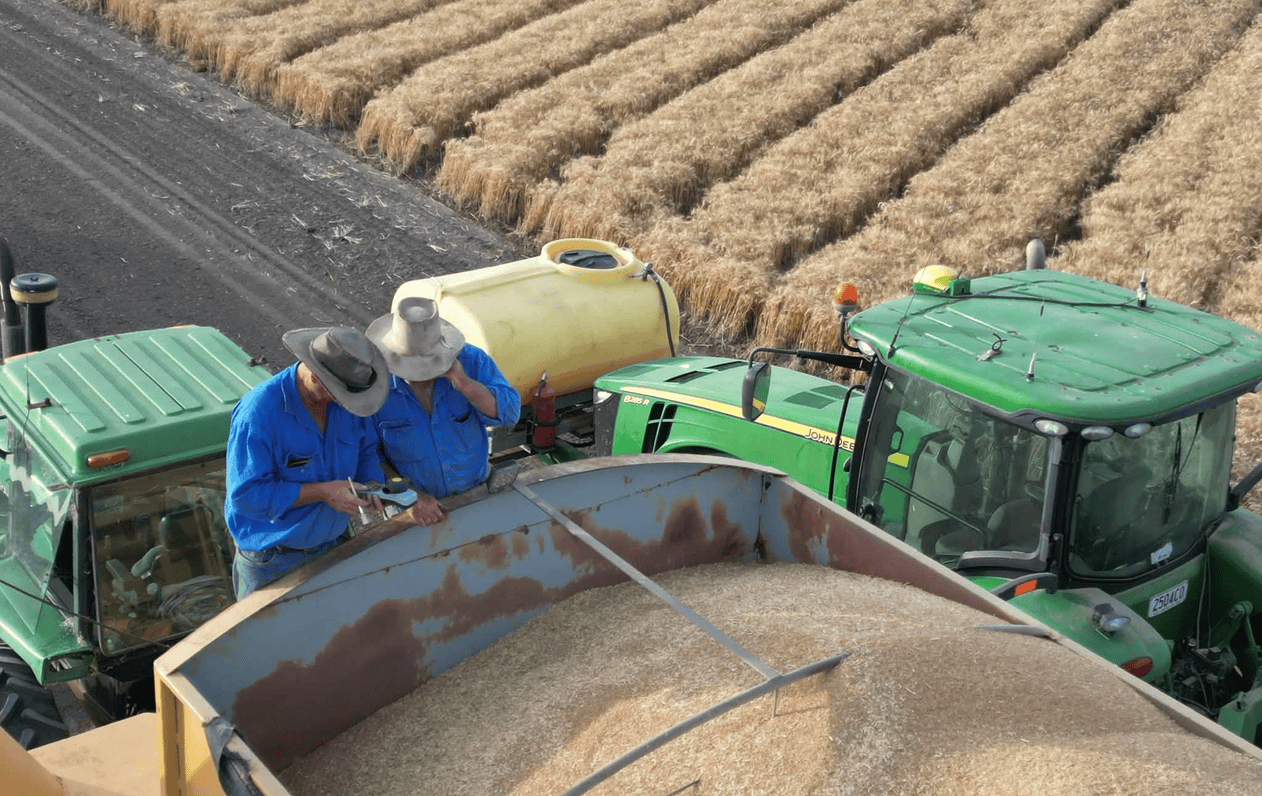
Grain moisture is a determinant for storage and marketing options across northern NSW and southern Qld after a rain-interrupted harvest. The pictured crop is Reliant wheat, irrigated on 2m beds, which yielded 5.5t/ha and graded APH2 for Kapas Farming at St George. Photo: Sasha Behrend, AGnVET Rural, St George
HARVEST is in full swing across the plains and outer slopes of New South Wales, and in southern Queensland, after rain delays, and ahead of more on the forecast.
Quality of wheat and barley being harvested varies hugely, and growers are therefore putting little into the cash market as they take time to consider their drying and blending options.
Consumers are largely comfortable thanks to old-crop loads, and new-crop ones received prior to the rain.
GrainCorp’s first update for the current harvest was released on 12 November, and the company’s outgoing head Robert Spurway told its annual general meeting that 1.3 million tonnes had been received in the past week alone.
“Just yesterday we received close to 200,000t into the network, so you can see how busy and how quickly things improve at this time of the year,” Mr Spurway told the forum.
| Nov 5 for prompt | Nov 12 for prompt | Nov 5 for Jan | Nov 12 for Jan | |
| Downs barley | $400 | $398 | $403 | $405 |
| Downs SFW | $420 | $415 | $423 | $425 |
| Downs sorghum | $380 | $380 | $360 M-A | $360 |
| Mel barley | $295 | $305 | $305 | $305 |
| Mel ASW | $345 | $350 | $350 | $360 |
Table 1: Indicative prices in Australian dollars per tonne.
North makes progress
At Narrabri, AgVantage Commodities broker principal Steve Dalton said harvest north and west of town was “fairly advanced” and around three-quarters done for many growers, despite rain of varying amounts that started in the second half of October.
He said the barley harvest was largely finished, and the wheat harvest was close to it, with chickpeas the next crop in line.
“With barley…we’re seeing everything from BAR3 to BAR1, and with wheat, it’s everything from APH1 to FED1 and SFW,” Mr Dalton said.
“Testweight and falling numbers are the main problem.”
He said some wheat harvested has protein of 13-16 percent, and screenings at 12-20pc, and trade sources generally have indicated growers will look at grading and/or blending to maximise value of protein wheat.
Mr Dalton said the variable quality was “creating some challenges” for bulk handlers.
“Larger sites seem to be able to manage better, and some sites say: ‘You deliver and we’ll take it’.”
Yesterday on the north-west plains of NSW saw some wind, and maximum temperatures of around 35 degrees Celsius, ideal for drying damp grain prior to harvest.
With northern NSW harvesting a smaller-than-average winter crop due to reduced planted area, growers seem to be handling any high-moisture grain by drying it in their own aerated silos.
In southern Qld, many growers have sorghum driers, and are using them for wheat and/or barley.
“Generally speaking, we haven’t had any phone calls or conversations re high moisture.”
Mr Dalton said consumers seem “pretty well covered”, which is just as well, as the farmer is not looking to out-turn much until harvest is over.
“Guys are using their storage and are focused just on harvest.”
Bureau of Meteorology forecasts point to 25-50mm of rain over the weekend for districts still harvesting.
Without the rain, Mr Dalton said most growers in north-west NSW, bar the Liverpool Plains, which is only just starting, would be finished harvest.
This harvest looks like producing little top-grade durum.
“I’m not speaking to growers north and west of Narrabri that have had DR1; there’s black tip, staining, and falling numbers.”
Chickpeas are looking like a cash sell, with Narrabri packers paying around $930/t, better value than $990-$1000/t being offered delivered Brisbane port because growers and carriers are loath to book long runs in the midst of a rain-interrupted harvest.
The spread between BAR1 with minimum testweight 62.5kg per hectolitre, BAR2 at minimum 60kg, and BAR3 with no minimum is around $20/t per hop.
Integrated Animal Production Tamworth-based nutritionist Rob Lawrence said his advice to feedlots which have harvested downgraded barley, or farmers who have cattle, is to use it in the on-farm ration if it does not present a health risk through the presence of mould.
Wheat and/or barley generally make up around 70-80pc of feedlot rations, and Mr Lawrence said a year like this with volume downgrades in the north generally has demand looking south.
However, the current climate, with expensive diesel jacking up the price of road freight to the Downs, means feedlots may be prepared to work more with downgraded local barley.
“To pull it from Parkes costs $160 a tonne in freight,” Mr Lawrence said.
After the rain, a large sorghum crop is being planted, but Mr Lawrence does not expect the red grain to replace white grain in many rations, and with good reason for all but the specialists.
“There’s a whole generation of feedmillers who’ve never touched sorghum.”
He said Australian varieties are less feedmill friendly than their US equivalents.
“They’re hard to get water into because Australian sorghum is bred for midge resistance.
“The grain can work quite well, but it needs a lot more management than barley and wheat.”
Mr Lawrence said larger feedlots can steam-flake sorghum, but mills at feedlots of all sizes are looking to maximise efficiency, which makes sorghum a hard sell.
“Everyone’s expanded, and they’re maxing out their milling capacity now; sorghum will reduce (efficiency) by 30pc.”
One exception is Central Qld’s Paringa feedlot, which has developed a fermentation process for sorghum.
Barley firms in south
Quality is equally mixed in southern and central NSW, with high screenings and low testweights featuring in plains crops that missed out on grain-filling spring rain.
“Quality is all over the shop; there’s no doubt about it,” Peters Commodities trader Peter Gerhardy said.
Some wheat is testing at up to 70pc screenings, but with protein as high as 14-15pc.
Mr Gerhardy said growers with samples like that are likely to store it while they finish harvest, and hope grading once the headers leave the paddock can get it into grades like H1 or H2.
Canola remains the cash sell for many growers, and oil content of 44-46pc in places is making up for disappointing yields of 2t/ha in some GM crops.
Barley prices have firmed in the south in the past week, with depot prices generally up $5-$7/t.
“Depot prices on barley are firming all the time; it tells me the growers aren’t selling.”
ASW heat into Hanwood in the Riverina is trading at around $340, enough to keep it up-country to satisfy feedmill demand.
In southern NSW west of the inner slopes, harvest has started to move at pace.
“The canola harvest is winding up in a lot of areas, barley is winding up, and the grower is getting on to wheat.”
Feedlot demand centred in southern Qld appears to have dropped its call for southern barley, instead opting to use locally sourced barley until road transport becomes available ex Vic and southern NSW when the harvest peak passes.
Grain Central: Get our free news straight to your inbox – Click here
HAVE YOUR SAY