
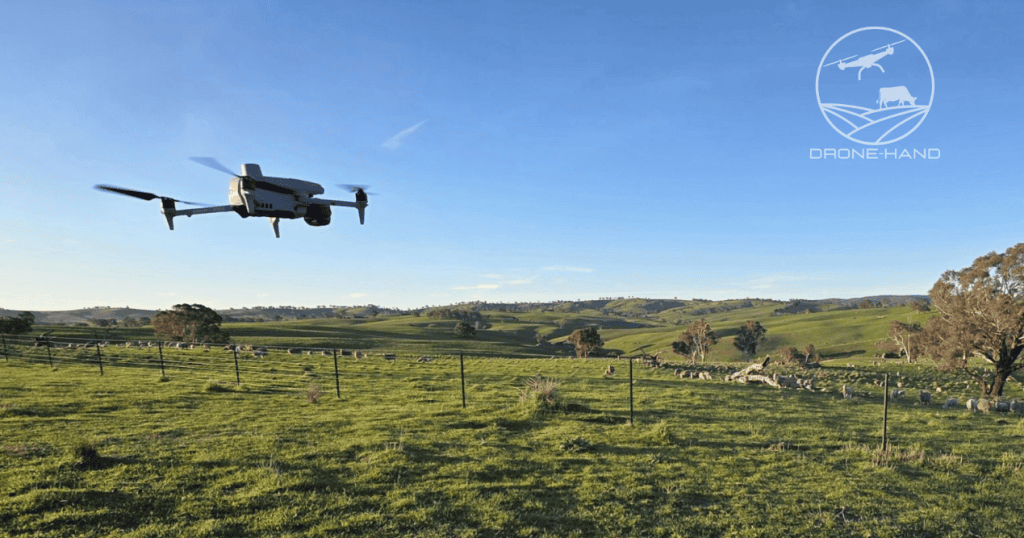
A Drone-Hand drone on the job on a sheep property. Image – supplied.
NORTH-WEST Victorian livestock producers are backing a new drone-based dingo exclusion fence monitoring trial as vital in preventing further attacks in the region.
Agriculture Victoria last week announced it would fund a trial using innovative drone technology to help livestock farmers reduce livestock predation on their properties.
The pilot project will assess whether autonomous drone-enabled monitoring can provide timely and accurate information to support proactive livestock protection activities to reduce impacts on private land.
Using advanced drone imagery and artificial intelligence, the pilot will investigate the feasibility of more efficiently monitoring wildlife exclusion fencing for digging and breach activity in north-west Victoria, Agriculture Victoria said.
In north-east Victoria, the project will also help to build, train and validate machine-learning models capable of detecting and identifying dingoes that move onto farmland.
The initial phase of the trial will run until June 2027. If successful, the next phase will focus on testing and refining the drone technology to support future deployment on Victorian farms.
North-west-west Victorian sheep producers have been frustrated by an inability to stop wild dog/dingo attacks on their flocks since the trapping and baiting around park areas was halted in March 2024 and the Department of Energy, Environment and Climate Action refused to issue Authority to Control Wildlife permits.
Lawloit sheep producer Alan Bennett said he supported drone monitoring of the proposed 70 kilometres of exclusion fencing and road crossings planned bordering five properties north of Yanac running east and west of the Nhill-Murrayville Road along the southern end of the Big Desert Wilderness Area and other state land.
He believed the exclusion fencing would have an impact on dog attacks as long as the integrity of the barrier fence could be maintained and the road crossings can be properly constructed and managed.
Mr Bennett said the checking of the fence is a major time issue and it would take half a day to check the 30km of exclusion fence he has constructed.
“If someone has a hole and the dogs are getting in then the whole fence is no good.
“If you got a drone that it can dock and charge itself and fly that fence a couple of times a day and then use artificial intelligence to report any suspicious digging; if it enable us to find a kangaroo hole or digging before it turns into a hole and we can drive straight to that point and fix it, it could be an absolute massive time-saver.
“It’s about maintaining the integrity of the fence; the kangaroos are the ones that will give it a hammering,” Mr Bennett said.
“It’s not about monitoring the dogs or looking for dogs, it is about monitoring the fence; if the fence is maintained properly then the dogs stay out and stay in state lands.
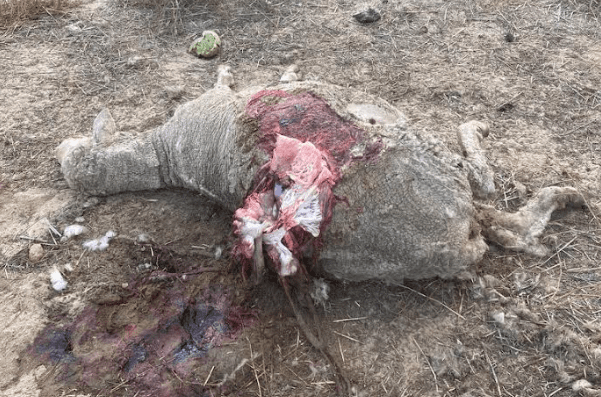
North-west Victorian sheep producers are hoping exclusion fencing aided by drone monitoring can help prevent dingo attacks on sheep.
“Everyone has jumped on board to make it happen because it’s the best thing we can do and so far with the fencing we’ve done; where we’ve been able to get a continuous fence, it is actually working (with fewer dog attacks),” he said.
“But that could be due to seasonal factors as well, with a breeding period and plenty of water in the landscape, so the real test will be after Christmas in the New Year, heading into that traditional period of high dog activity.”
Mr Bennett said the success of exclusion fencing and the drone trial was also key to restoring trust between the government and landowners, after authorities refused to share photographs of dingoes entering private property.
“The fence and these drones are the first physical signs we’ve seen of any form of support for affected landowners in 2.5 years.
“That’s why we’re happy to grab hold of it because we’ve been given nothing else.”
Mr Bennett said landowners had been “backed into a corner” on the issue of dingo attacks on livestock and he said the success of the exclusion fencing and sheep production in the area would depend on maintaining its integrity.
“The population of viable farmers depends on this fence.”
Beeac sheep producer Tom Alston uses drones to muster livestock and check fence lines on the family property in southern Victoria, recently finding a breach that sheep had used to access a neighbouring paddock.
“”With drones you can fly a fence line in no time and easily identify problems in a fence from the air.
“To get around that sort of thing I think it would be a no-brainer.”
Agriculture Victoria has commissioned a Victorian-based company Drone-Hand to explore and test drone technology as part of the Dingo Drone Pilot Project.
Agriculture Victoria program Manager Stephen Baud said the pilot project will see if the technology has the potential to provide farmers with additional tools to help minimise livestock losses and improve animal welfare outcomes.
“We recognise the challenges facing Victorian livestock producers and want to test this technology to see if drones can complement and strengthen existing livestock protection measures,” he said.
Agriculture Victoria said the project will be delivered in partnership with Drone-Hand, which specialise in autonomous drone and AI solutions to help producers monitor livestock, herd health and on-farm infrastructure.
Drone-Hand CEO Edward Barraclough.
Drone-Hand founder and chief executive officer Edward Barraclough said his team is excited to work with Agriculture Victoria to trial their drone systems to further support livestock farmers.
“This technology has the potential to provide a tangible new management tool that can be seamlessly incorporated into most livestock operations impacted by ongoing predation challenges.”
Agriculture Victoria said it has invested $15 million through the AgTech Regional Innovation Network (AgRIN) initiative to grow Victoria’s AgTech sector and support emerging companies to commercialise innovative solutions. Drone-Hand was a key participant in that program which helped the company to accelerate its growth and bring its autonomous drone and AI technologies closer to market.
Agriculture Victoria said the pilot project will initially focus on Victoria’s north-west and north-east to add additional support measures being introduced in this region, including the Yanac Dingo Exclusion Fence Program.
The proof-of-concept trial will evaluate the effectiveness of drone technologies in supporting livestock producers and inform future approaches to dingo management across Victoria, the agency said.
HAVE YOUR SAY