
VICTORIAN stock agents attribute a decline in sheep saleyard transactions in 2025-26 to the general flock decline and producers selling direct to abattoirs or via on-farm sales using online platforms.
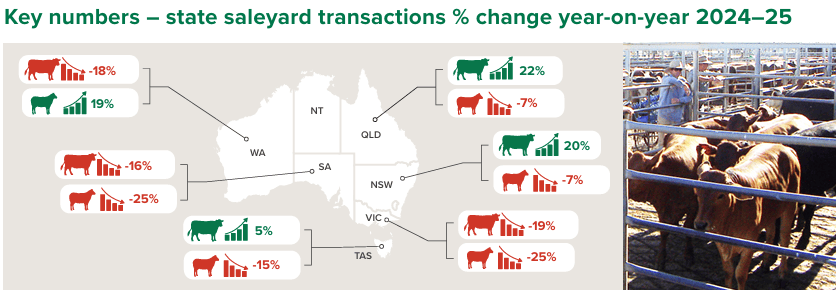
According to the The National Livestock Reporting Services annual saleyard survey, Victoria recorded the largest proportional decline among the major sheep saleyard states in 2025-26, with transactions falling 25.3pc to 3.61 million head, while South Australia experienced a 25pc reduction to 722,937 head.
And despite recent high prices, Victorian agents forecast a slower recovery in flock numbers due to the ewe sell-off in 2024-25, and into 2025-2026, with the switch to cropping and generational reluctance for handling livestock.
The NLRS saleyard survey reported that national sheep saleyard transactions fell 11.6 percent to 14.5 million head in 2025-26, with declines recorded across most states. Cattle transactions at Australian saleyards increased by 7.4pc.
New South Wales remained the largest state for sheep saleyard transactions, recording 8.66 million head, but still down 6.5 percent year-on-year.
Western Australia was the exception, recording a 19pc increase in sheep transactions to 1.28 million head, supported by increased throughput at Katanning and Muchea.
Wagga Wagga Livestock Marketing Centre remained Australia’s largest sheep selling centre, recording 2.27 million transactions, followed by Central West Livestock Exchange at Forbes with 1.86 million head.
MLA’s NLRS Manager, Stephanie Pitt said the decline in sheep saleyard transactions across Victoria and South Australia largely reflects the impact of prolonged dry conditions and elevated livestock turnoff in previous years, which reduced flock numbers and the availability of sheep for sale.
“NSW experienced comparatively more favourable seasonal conditions in some regions, helping to moderate its decline.
“Western Australia’s 19pc increase reflects a different set of market dynamics, with sheep producers adjusting their selling decisions amid declining live sheep exports and changing domestic market opportunities,” she said.
Victorian ewe flock is yet to recover
Ballarat Stock and Station Agents Association president Nick Gray said the industry has had a rough 2-3 years with a major sell-off of ewes.
“And through that dry period (in 2024-25) it was hard to get kill space for sheep and lambs and a lot of producers opted to go straight to the saleyards and then the seasons turned and they had options and didn’t have to go to a market.
“And our ewe flock is not there, because we killed them.”
Jamie M said a lot of ewes had gone to slaughter in previous years
“We put it down to continual tough season, more and more people offloading more and more sheep every year, there is a lot more cropping going in than most of us realise.”
He said the sucker season is tracking on the same path as last year because of the season with many lambs of only store quality “in no great numbers.”
“Normally by now we would be running hot, well we’re far from running hot.
“The numbers aren’t there, it is as simple as that.”
 Bendigo Stock and Station Agents Association president Nigel Starick the saleyard’s 2025-26 throughput was impacted by the dry season initiating the sale of ewes in 2024-25, and often direct to abattoirs, and fewer sheep and lambs coming out of NSW.
Mr Starick said when diesel prices peaked in early 2026 producers opted to consign stock direct to abattoirs.
But he said the saleyards were now the preferred option for selling stock.
“I just think the numbers aren’t there, it’s supply and demand, and the competition is there in the saleyards, we’ve just seen the worm turn again.”
Mr Starick said stock numbers out of NSW are just starting to come back due to the competition in the saleyard.
“We’ve had more out of New South Wales this year than we had last year … they went early because they wanted to avoid seed.”
Mr Starick said the centre’s lamb receivals are not slower than normal “they’re just not there.”
“But we’re going through them, if they’re ready to go, as agents and producers we’re not holding back.
“Potentially there might be a few more shorn this year, because there is grass about and the recent rain might retain a few, but with the prices where they are it’s a bird in the hand isn’t it?”
SGL director at Hamilton Heath Templeton said most Hamilton agent throughputs were 20-30pc lower last year due to the prior ewe sell-off and he estimated online sales of store lambs would have been stronger.
“And I think the same thing will happen this year.”
He believed any lambs ready for slaughter would be sold through saleyards this year and he didn’t expect to see any contracts from processors as there was last year.
AWN sheep specialist at Horsham Wayne Driscoll attributed the lower saleyard number in 2025-26 to increased ewe slaughter in 2024-25, not as many lambs going out for finishing in the Wimmera, and many of the feedlots bypassing the yards, selling direct to processors under contractual arrangements.
He said the current situation was due to the lack of ewes on farms, despite reports of higher lambing percentages.
“The simple response is that there are less ewes around.”
He said the industry took a hit in 2023-25 and sheep producers got out and put in more crop.
“And it has not recovered, so there has been no extra breeding going on, and the rebuild is going to take a while.
“We’ve got to people interested again – the workforce doesn’t want to handle stock and we’ve got to make that happen,” he said.
“We’ve got to see these prices to get the younger generation interested in being involved.”
Mr Driscoll said there has been increased interest in sheep recently, but high ewe prices are being paid mostly by established producers sourcing replacements, underpinned by the sale of sucker lambs for $25-$300 and old ewes for $250-$300, rather than by people building new flocks.
“The (ewe) demand is basically driven by people already in the industry and wanting to continue on, although there is a little bit of new purchasing by people getting back in.
“The other thing driving that is the fear of missing out on that ewe,” he said.
“I don’t know what would happen if there was a massive swing from cropping back to sheep because I don’t think it would be sustainable for ewe prices to go much higher than it is at the minute.”
Mr Driscoll said outside some spot prices from processors, the saleyards are still number one for prices at the moment.
Agora Livestock head of markets in Western Australia Dean Hubbard said saleyards are not a big indicator of price because most stock are sold direct to abattoirs.
“But given the prices we’ve seen in saleyards recently (in the last 12 months), there has been a growing appetite to go through the yards.
“It’s just people chasing a perceived better return through the saleyards,” he said.
“It’s not because there are more sheep available, because we know there is not, it’s because the saleyards have been well above, in many cases, what people are able to receive privately.”
Results show variability in saleyard activity
Ms Pitt said the survey results demonstrate that saleyard activity can vary considerably between regions, reinforcing the importance of having reliable and consistent reporting across the industry.
“Through the NLRS, MLA continues to provide transparent livestock market information that helps producers and other industry participants understand market activity and make informed decisions.”
The survey recorded more than 5.18 million cattle and 14.5 million sheep transactions across Australian saleyards in the financial year ending 30 June 2026.
Cattle transactions increased by more than 356,000 head compared with 2024–25, while sheep transactions declined by about 1.9 million head.
Ms Pitt said the annual survey provided an important snapshot of livestock movements through Australia’s saleyards, highlighting significant differences in activity between states and livestock categories.
“The latest results show contrasting trends across Australia’s cattle and sheep saleyards, with increased cattle transactions in several key producing states alongside reduced sheep throughput across much of the country,” Ms Pitt said.
“Saleyards remain an important part of Australia’s livestock marketing system, and the annual survey provides valuable insights into how transaction volumes are changing across different regions and selling centres.”
To view the full 2025–26 Saleyard Survey visit: 2025–26 Saleyard Survey
HAVE YOUR SAY