
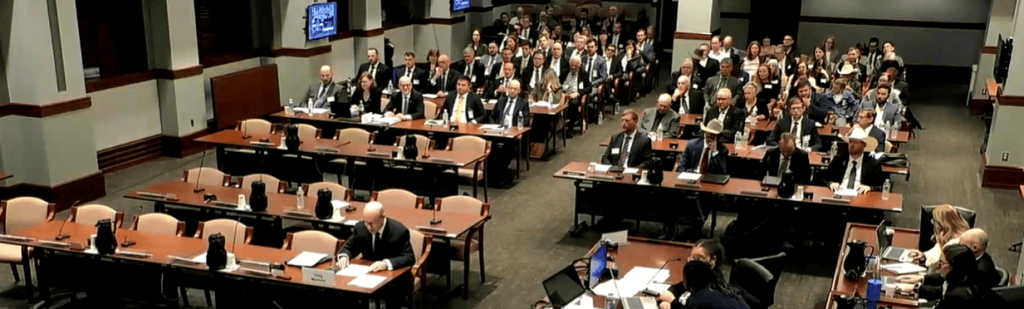
The US International Trade Commission global safeguard investigation hearing into lamb meat imports.
AUSTRALIA’S representatives at an American global safeguard investigation hearing into lamb imports have argued that United States processors and companies had to use imports meet demand and be successful.
The United States International Trade Commission public hearing in Washington DC on Friday was called to hear evidence from American processors and lamb producers trying to prove serious damage or threat to the US lamb industry from lamb imports, mostly from Australia and New Zealand.
US lamb producers and processors at the hearing blamed their poor profitability and declining sales on Australian and NZ lambs imports during a ‘period of investigation’ during 2024 and 2025.
Australian and New Zealand industry representatives, and several US lamb supply chain companies countered with evidence in favour lamb imports.
Australia’s ambassador to America, Greg Moriarty, told the commission the strong economic partnership between the two countries is underpinned by the Australia-United States Free Trade Agreement, with US goods enjoying tariff free access to the Australian market and accumulated trade surplus of $442 billion since entry into force.
“The United States has maintained a trade surplus with Australia every year since the Truman Administration dating back to the early 1950s,” he said.
“In 2025, the United States ran an $18.5bn trade surplus with Australia; the United States’ sixth largest trade surplus with any trading partner.”
He said Australian producers are not propped up by subsidies and compete on the merits of their products. Mr Moriarty said the Australian sheep industry had supported development of the US industry through genetics partnerships, technology transfer and collaborative research.
“The Australian industry has also invested heavily in activities to grow US consumer demand for lamb meat, including millions in joint initiatives and promotional activities over the past 25 years.”
This includes investment in US meat processing and distribution networks generating American jobs and strengthening the resilience and efficiency of the US lamb supply chain, he said.
He urged the commission to view the evidence of the mutually beneficial relationship between the Australian and US lamb industry.
“Australia also has a substantial interest in ensuring that the United States only imposes global safeguard measures in circumstances that satisfy the strict requirements of US law and which are in accordance with its obligations under international rules.
“Safeguard measures are an extraordinary remedy that should be reserved for exceptional circumstances where increased imports are a substantial cause of serious injury to the domestic industry producing a like product,” he said.
“A standard that is intentionally rigorous and difficult to meet.
In Australia’s view, the evidence before the commission does not meet the high legal threshold s for the application of of safeguard measures under United States law,” Mr Moriarty said.
“The decline in US lamb meat production reflects a long-standing reduction in the supply of domestically produced lambs for slaughter; that has been demonstrably driven by factors other than imports, including drought, the US Government’s removal of wool subsidies, reduced wool demand and the COVID-19 pandemic.
“Imports have filled the supply gap created by this decline in domestic production,” he said.
“They are a consequence of reduced output, not a substantial cause of it.
“To illustrate the lack of causation; there have been multiple periods during the last 30 years where imports and (US) domestic production have both fallen at the same time,” Mr Moriarty said.
“This demonstrates that domestic production does not improve even when there are fewer imports.”
Mr Moriarty said the USITC’s own Staff report indicates that US industry support for safeguard support is far from uniform, with almost tow thirds of responding producers taking no position.
“This mixed level of support undermines the suggestion that increased imports have caused the type of industry –wide emergency for which safeguard relief is warranted.
“Rather than harming the US industry, imports have provided a reliable source of supply that has helped preserve and grow the US lamb meat market,” he said.
“This been essential in keeping lamb on supermarket shelves, restaurant menus and American plates.”
“Imports have supported overall market viability and contributed to the growth of US consumption.”
US processors’ profits indicate serious injury
In his remarks in favour of relief to US producers, international trade lawyer with Kelley Drye & Warren LLP, Paul C Rosenthal, used an Meat & Livestock Australia report to indicate that Australia would have the ability to export more lambs. He said there was no doubt that lamb imports into the US had increased during the period of investigation.
He said the commission had heard evidence Wyoming sheep farmer and former American Sheep Industry Association president Brad Boner the Mountain States Rosen lamb processor in Colorado had closed in 2020 because of imports, and a replacement plant opened during “an import surge” also closed in 2025 due to cash flow issues because imports made it unable to sell product at prices necessary to survive.
Mr Rosenthal said the profits of US processors during the POI show “serious injury” and “certainly there is terrible capacity causation.”
He said the Carlos Barba, the vice-president of sales for California-based Superior Farms described Barber 2024 as its worse year in a 64-year history, when the employee-owned company lost 54pc of its value and has not recovered.
“And they are on the brink of closing one of their facilities and now the quote is – we’re facing a very real devastating prospect of closing a plant and laying off 140-150 employee owners, an outcome we were desperately trying to avoid’ – that is a current injury.”
“If you are losing sales to imports, isn’t that injury, isn’t that reduction in your revenues a result of those lost sales?
Mr Rosenthal said competition with lamb imports had resulted in lost sales to US processors. He said in the ITC’s own (Staff) report, four companies admitted to purchasing imports instead of domestic product because of price.
“One of the big companies increased its (imported lamb) purchases by 46.2 pc because of price, this is their admission.
“Again, direct evidence of head to head competition of available product,” he said.
“Again we can’t supply the whole market, but companies that are switching from domestic to imports shows you the most direct evidence that imports are taking away sales and those revenues.”
He said there was no question that drought and increased labour costs had been problems for the US industry.
“But this industry and virtually everyone that we talked to, (said) ‘yes it’s a problem but we can deal with that, but if we don’t get the revenues from sales, if we can’t actually get a price that covers those costs, it doesn’t matter what else is going on’.”
“We’ve got to get sales and we’ve got to get sales at a price that is reasonable and can be sustainable, otherwise we’re not going to be able to deal with anything.”
Mr Rosenthal said an ASI survey reinforced evidence from processors “which is ample to show serious injury due to imports.”
Declining US lamb market share not due to imports
Matthew Nicely from Akin and Barbara Medrado global trade attorney at King and Spalding LLP delivered the rebuttal in opposition to safeguard measures on behalf of Meat & Livestock Australia.
Ms Medrado said there has been a lot of discussion around causation, and the hearing had heard a lot of anecdotes, but not a lot of facts.
“I wanted to remind you that some of the producers that have appeared here have not provided an answer to the questionnaire that the ITC commission has sent, and also they rely on a lot of data that is not correct.”
She also questioned the reliability of US lamb production and labour estimates based on 40 replies to a survey sent to more than 700 processors. Ms Medrado said processors have said that profits of 3-6pc are expected – 3pc in a bad year 6pc a good year – and this had been met by all the US producers in the (POI) period of investigation.
Mr Nicely said the decline in US lamb market share and the availability of domestic lamb product is not caused by imports.
“There are innumerable examples in all the USDA reports that explain why that decline occurred over many many decades, including into the POI, and USDA has gone into that in significant detail.
“The imports were simply there to fill a void and then to service demand that changed, by the way, significantly since the 1999 case, and so Mr Rosenthal’s focus on the 1999 case, in our view, is completely irrelevant.”
Mr Nicely said between 2007 and 2013 when lamb imports fell “for five years straight and domestic supply did not improve, demand just declined OK.”
He said this was a “useful experiment” to demonstrate what would happen if imports withdrew from the market.
“What happens in fact is that demand declines and the domestics don’t gain.”
Mr Nicely said the commission had to look at the US processors and companies that use imported product.
“The fact is that those companies who use imported product are using it because again, back to the same point, they don’t have domestic supply that they can rely up and in order for them to be successful they have to use imported product.”
“So the issue then becomes really a question of, and I guess this is the ultimate battle that you are seeing between us today, is did imports push their way into the market or were they pulled in?
“And I think it is pretty clear that they were pulled in the lack of consistent availability of domestic lamb, which was in fact, made worse during the POI, and that’s ultimately what your’re supposed to focus on, is what happened during the POI and what happened during the POI was a fairly significant drought.
“By the way also, what happened during the POI, shows that prices did not decline as a result of the increase (in imports) that those supporting relief have talked about … again, prices increased and domestic lamb even increased market share for the some of the products that you analysed in your product pricing analysis,” he said.
“So it shows that products are selling into different markets …. It’s an example of how competition is attenuated between imports and domestic product.”
Australian lamb not the problem – AMIC
After the hearing, Australian Meat Industry Council chief executive officer Tim Ryan said Australian lamb is part of the solution for the U.S. lamb industry, not the problem.
“The evidence before the USITC demonstrates that imports are not driving the challenges facing the U.S. domestic industry, with drought overwhelmingly the largest driver of movements in U.S. wholesale lamb prices.
“Australian lamb provides the reliable, year-round supply needed to keep product on shelves, support processors and grow consumer demand,” he said.
“Restricting that supply risks making lamb less available, less competitive and less attractive to American consumers at precisely the time the industry should be focused on growing the category.”
The USITC will make its serious injury determination by 13 November 2026. If the commission makes an affirmative serious injury determination or is equally divided on the question of injury in the investigation, it will hold a hearing on the question of remedy on December 1, 2026.
The USITC will submit a report to US president Trump as required under section 202(f) of the Trade Act of 1974 within 180 days after the date of the USTR request, or by January 11, 2027. The imported articles covered by the investigation are defined as fresh, chilled, or frozen lamb meat. Live animals and mutton are excluded from the investigation.
HAVE YOUR SAY