
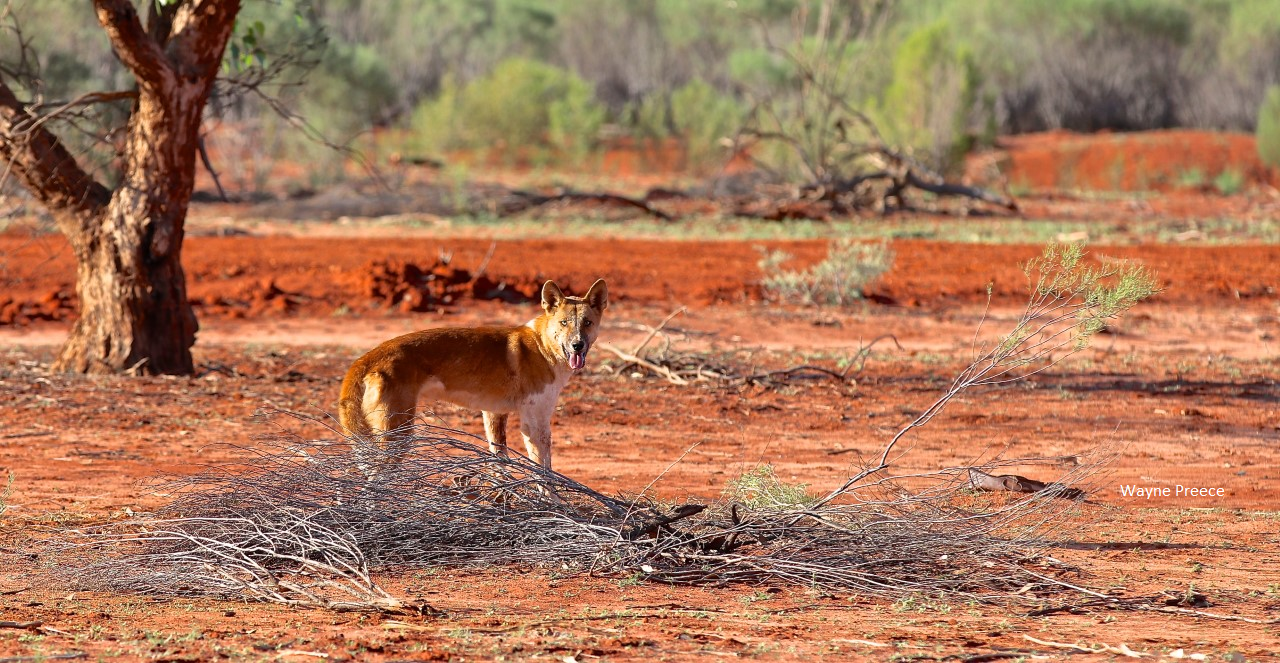
THE case for controlling wild dogs in national parks is the same for both farmers and environmentalists, or at least it should be according to the New South Wales Farmers Association.
Both groups want to reduce the number of deaths from wild dogs, whether it be of livestock or native animals.
“The people strongest on protecting wild dogs and dingoes are usually just as strong on wanting koalas protected, yet rarely acknowledge wild dogs are one of the main predators driving koala deaths,” Craig Huf, Cattle Committee Vice Chair with NSW Farmers Association.
“In my view you can’t credibly champion koala conservation while staying silent on a documented cause of koala mortality.”
As part of its submission to the NSW Government’s inquiry into dingoes in national parks, the farm lobby group outlined the need for coordinated management across farming and public land with the expansion of National Parks underway in NSW.
The cost of wild dog attacks to farmers
The Australian Bureau of Agricultural and Resource Economics and Sciences (ABARES) estimates wild dogs cost Australia’s agricultural sector up to $302 million per year, primarily due to stock losses.
“Wild dogs, including dingoes, feral domestic dogs, and hybrids, prey on livestock, spread disease, and cause significant economic and emotional harm to landholders,” the NSW Farmers submission to the inquiry stated.
“The impacts are multi-dimensional. Predation leads directly to stock losses, including sheep, goats, and calves, and can result in substantial financial losses for farm businesses.
“These losses are not limited to the immediate value of animals killed but extend to reduced breeding rates, disruption of production systems, and long-term changes in enterprise viability.
“In areas of sustained wild dog pressure, producers are forced to shift away from small stock enterprises completely, altering regional agricultural patterns and reducing enterprise diversity and economic choices.”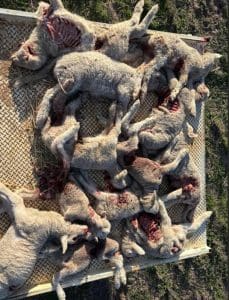
The farm lobby groups submission also detailed the psychological stress wild dog attacks cause landholders.
“The experience of repeatedly finding injured or maimed animals, often in distressing circumstances, has well-documented mental health consequences,” the submission stated.
“This emotional burden is compounded by the reality that effective control is beyond the capacity of individual landholders, requiring coordinated, landscape-scale action.”
Mr Huf runs cattle on a property bordering a five-thousand-hectare national park in the northeast of the state and said the park is a refuge for dingoes and wild dogs which regularly enter his property.
“Farmers take animal welfare seriously, and finding livestock torn apart by wild dogs, seeing the wounds and knowing how slowly and painfully it would have died, is traumatic,” he said.
“Speaking from experience, and from talking to others who’ve been through it, most farmers talk about the horror of what they saw before any focus is given to what it cost them. And the costs are huge in some cases.”
The impact of wild dogs on native animals
The NSW Farmers Association submission outlined research by Matthew Gentle and others in 2019 which used genetic sampling to identify canid predators of koalas in peri-urban areas.
Genetic samples were taken from the remains of 12 koalas suspected to have died from predation in south-eastern Qld and canine genotypes from wild dogs (not domestic dogs) were present in 11 of the 12 koalas.
The research supported the growing evidence wild dog predation is a significant cause of koala mortality and the researchers suggested strategies to reduce predation on koalas should focus on reducing the impact of free-ranging wild dog populations.
 “Wild dogs eat first and foremost, wild animals. They like to kill livestock as a reaction to their behaviours and that is why they will maim and not eat them and leave the stock to suffer significantly,” the submission stated.
“Inside National Parks they will be eating the possums, koalas, bandicoot’s, echidnas, lizards, snakes, ground dwelling birds, frogs and insects.
“Given that National Parks have been established generally in areas to protect habitat of endangered species this is undoing the good work if those species are not protected.
“With the expansion of National Parks underway in NSW, the losses of endangered species by protecting wild dogs will undermine the NSW threatened species program.”
Mr Huf said the association hopes the inquiry delivers outcomes that genuinely reduce attacks on livestock and native wildlife.
“Wild dog control isn’t just a numbers game about koala populations or livestock losses. It’s about being honest that this predator harms both livestock and koalas, and plenty of other native species,” he said.
“That’s not an argument for wiping them out, but it is a reason to manage their impact rather than treat them as untouchable.”
The importance of coordinated management
According to NSW Farmers, livestock predation by wild dogs remains one of the most significant unmanaged risks to agricultural production in parts of NSW and along its borders, particularly in the south-east where interaction with the Australian Capital Territory (ACT) and Victoria is most pronounced.
“NSW Farmers strongly supports the “nil tenure” approach to wild dog management, which has underpinned successful programs across south-east NSW for more than two decades,” the submission outlined.
“This approach recognises that wild dogs do not respect property or jurisdictional boundaries and therefore must be managed collaboratively across all land tenures, including private land, national parks, state forests, and adjacent jurisdictions.”
The Association’s submission outlined the most significant emerging issue for NSW Farmers is the divergence in wild dog policy between NSW and the ACT.
“Decisions by the ACT Government have the potential to undermine the agreed nil tenure approach to wild dog control and have catastrophic consequences for adjoining livestock producers,” it stated.
“Recent policy developments in the ACT, including proposals to formally recognise dingoes as a distinct native species, have generated significant concern among NSW landholders.
“While the ACT Government has indicated that control programs will continue, the reclassification of dingoes introduces a critical uncertainty around the future extent and nature of control measures.
“Farmers in border areas fear that increased protections for wild dogs will lead to reduced management intensity over time, particularly in conservation areas such as Namadgi National Park.
“Given the mobility of wild dogs, any reduction in control effort in the ACT will result in increased and persistent pressure on adjacent NSW properties.”
The submission outlined this increase in pressure would be another major blow for landholders in the south of the state after the Victorian Government stopped baiting in the Far Northwest in 2024.
Dingo vs wild dog – classification needs to be consistent
The NSW Farmers submission called for a consistent classification of dingoes and wild dogs between jurisdictions.
In NSW, wild dogs are defined broadly to include dingoes, feral domestic dogs, and hybrids, and are managed as a pest species where they cause harm
In contrast, the ACT is moving towards recognising dingoes as a distinct native species with ecological and cultural significance.
“NSW Farmers strongly disagrees with this recognition, and the introduction of dual classifications creates practical challenges for management,” its inquiry submission states.
“First, it complicates communication and coordination between agencies and landholders.
“Different definitions lead to different management objectives and regulatory frameworks, reducing clarity and increasing the risk of conflict.
“Second, it creates ambiguity regarding control responsibilities. Under NSW law, landholders have a general biosecurity duty to manage wild dogs and minimise their impacts.
“If neighbouring jurisdictions adopt different classifications or priorities, it becomes unclear how these duties are to be fulfilled in a coordinated manner.”
HAVE YOUR SAY