
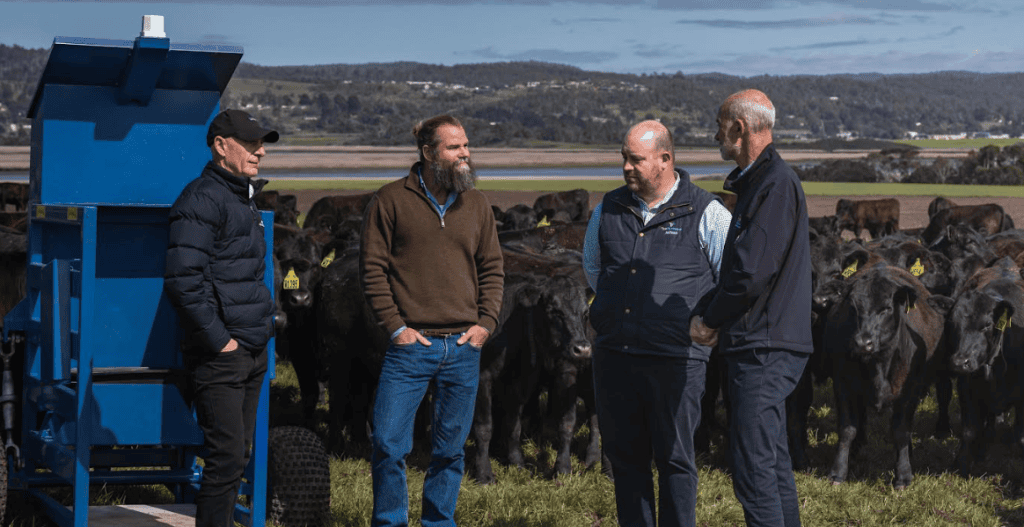
From left, Sea Forest advisor, Peter Gutwein, Sea Forest CEO, Sam Elsom, Tasfarmers CEO, Nathan Calman, and Deputy Premier Guy Barnett at Landfall Angus last Friday.
TASMANIAN Merino producers could have an opportunity to participate in the marketing of low emission wool as part of the state’s Low Emissions Livestock project.
TasFarmers last week announced it was expanding the previously cattle feedlot and dairy systems-based project into pasture-based beef and sheep operations.
The announcement on Friday coincided with Tasmanian Deputy Premier Guy Barnett visiting a demonstration farm near Launceston to see the project’s SeaFeed trial technology in action.
The Deputy Premier toured a working demonstration of the trial’s SeaFeed lick blocks and OptiWeigh monitoring equipment, used across the project to reduce methane emissions from grazing livestock while tracking animal performance in real time.
Low Emission Livestock Project lead and policy officer Jonathan Jones said the project aimed to start its Merino sheep cohort over the next months.
“For sheep producers to be involved it’s as simple as feeding out lick blocks – it’s a very simple process – Sea Forest produce the product and we just feed it out,” he said.
He said Sea Forest has connections in the fashion industry and the project will look at the possibility of accessing premiums for project participants’ wool based on its low emission production.
Mr Jones said there would also be opportunities to track the weight gain of sheep with Opti-Weigh machines, and the project has one unit that also measures cattle methane output, but the sheep component would be based mainly on lick intake levels.
SeaFeed™ is a methane-mitigating feed supplement made from Asparagopsis, a native red seaweed farmed by Sea Forest in Triabunna, Tasmania. Trials indicate the supplement can significantly cut livestock methane emissions.
“There is a lot of research that determines methane abatement based on intake levels, so that’s our biggest measurements, intake levels,” Mr Jones said.
“If we know that sheep are having 15-20gms a day of product then that’s good, and with the cattle we are looking at 150gms a day per head, and that will get you up to around 40 percent abatement which is currently where some of our farmers are at, which is great.”
Mr Jones said the criteria for sheep producers participating in the trial has not been clearly defined yet.
“We are still working on the foundations of what a wool cohort would look like, where the wool will be sent to, and what brands/retailers we can involve along the way.
“Having said that, similar to our beef cohort, producers that are interested in joining the trial are encouraged to reach out to myself, where we can begin early discussions about how they would fit into the project.”
Minister for Environment and Climate Change, Guy Barnett, said the Tasmanian Government was working in partnership with industry to realise the commercial potential of emission reducing supplements.
“Livestock is a significant contributor to Tasmania’s greenhouse gas emissions, and this is just one way we can reduce them to ensure we continue to meet our target of net zero emissions, or lower, from 2030,” Minister Barnett said.
“Importantly, the trial has already shown we can reduce methane emissions from grazing livestock by more than 20pc without compromising farm productivity.
“The investment we have made in this trial, along with TasFarmers, is testament to our commitment to making a real impact on reducing livestock emissions and providing surety to farmers.”
The project has been delivered by TasFarmers with Sea Forest and the Tasmanian Institute of Agriculture.
Mr Jones said the project expansion would allow the technology to be demonstrated in conditions more representative of Tasmanian livestock production.
“Expanding into pasture-based systems means we can show this technology working the way most Tasmanian farmers run their livestock,” Mr Jones said.
“Bringing more properties into the trial, and putting the data straight onto a public website, means farmers can see the results for themselves as they come in.”
TasFarmers chief executive officer Nathan Calman said the expansion of the project reflected growing confidence in the work being undertaken by TasFarmers, industry and the Tasmanian Government.
“Moving into pasture-based beef and sheep systems, and publishing our data in the open, keeps this trial grounded in what will actually work on Tasmanian farms,” Mr Calman said.
“This project is about giving farmers practical information they can use, while building a stronger understanding of how emissions reduction technologies can work in real farming systems.”
The Deputy Premier’s visit also marked the official launch of the project’s public website, giving farmers, industry and the wider community direct access to trial information and live data as it is recorded.
The Low Emissions Livestock project website is available at: taslowemissionslivestock.com.au
HAVE YOUR SAY