
CHANGES introduced to the Environment Protection and Biodiversity Conservation (EPBC) Act late last year do not amount to a ban on land clearing, National Environment Protection Agency (EPA) representatives told a series of producer information days in Queensland last week.

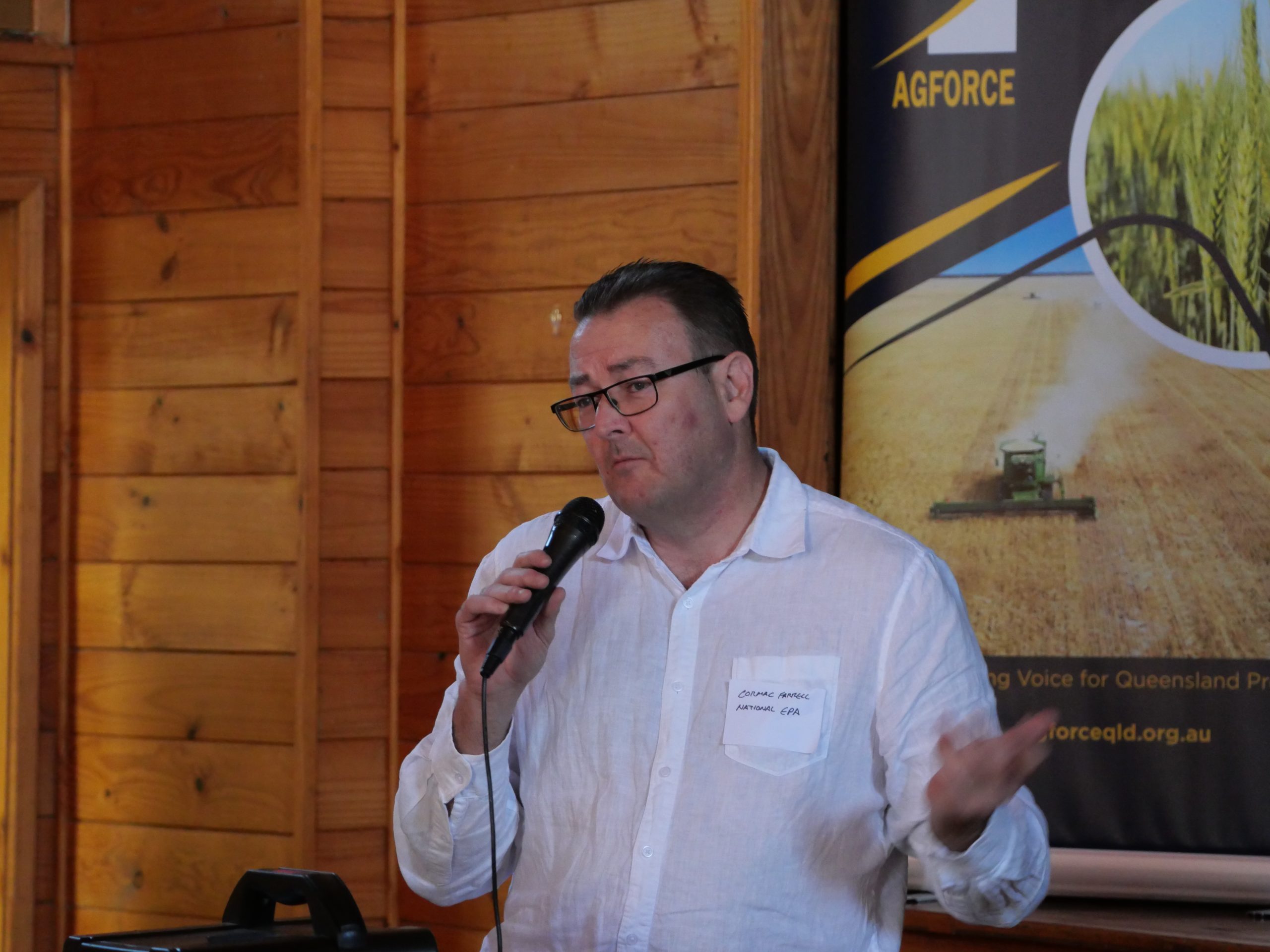
Cormac Farrell, Director – EPBC Implementation at National EPA, at Millmerran last week.
Director of EPBC Engagement and Referrals Gateway at the EPA, Cormac Farrell told an AgForce roadshow workshop in Millmerran that the EPBC Act and the amendments introduced late last year did not mean landowners can’t manage their vegetation or their weeds.
“What we’re asking is for people stop and check. Could there be habitat in here?,” he said.
When a formal referral is required
Landowners were being asked to self-assess whether a planned on-farm activity could significantly affect a nationally protected species, ecological community, wetland or other matter.
Under the EPBC Act, they will need to submit a referral for a formal assessment process by the National Environmental Protection Agency if their proposed action is likely to have a significant impact on any Matters of Environmental Significance (MNES).
The EPA’s expectation was that most people will not need a formal referral, he said.
Mr Farrell, who was part of the original team that developed the Federal EPBC Act in 1999, said the Act had always contained restrictions over what landowners could and could not do, but added that some people had not been aware of it.
“The continuing use provisions came in with the original legislation, and they were good, but they were also a little bit confusing,” he said.
“For instance, it always had a restriction: You couldn’t intensify, you couldn’t expand, you couldn’t change location.
“A lot of people were getting confused by that because they were moving into property that was never cleared before, for instance, which was never exempt. They were changing from grazing to cropping, which was never exempt, and in some cases – we’ve given guidance that we actually developed with AgForce around 15 years for Brigalow regrowth – that just really hadn’t been communicated effectively.
“People just weren’t aware of our legislation, so we’re paying catch up with this.”
Continuing-use exemption narrowed in two areas
He said the 2025 reforms narrowed the continuing-use exemption in two principal areas.
Within the Great Barrier Reef catchment, the exemption cannot be claimed for clearing within 50 metres of a watercourse, wetland or drainage feature.
Nationally, the exemption is also restricted where land has not been cleared or otherwise managed for at least 15 years.
 However, Mr Farrell stressed that losing an exemption did not mean an activity was prohibited.
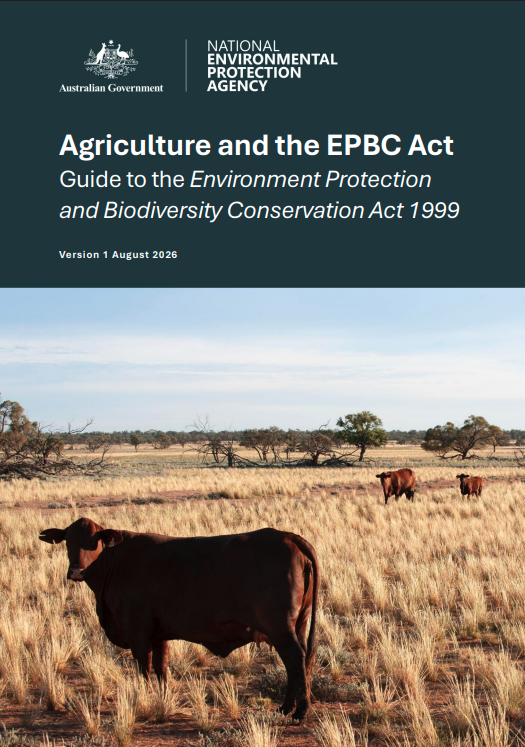
He said the recent guide developed by the EPA helped producers to self-assess whether an activity is low, medium or high risk.
Mr Farrell said the guide represented the EPA’s policy and would be used when considering whether a landholder had made reasonable efforts to meet the Act’s requirements.
“If you follow this guide, you are meeting, as far as we’re concerned, when you are meeting your obligations under our legislation. So, in terms of that compliance thing, when we’re figuring out have you done the right thing or have you made best efforts, people are following this have made best efforts, and we will give you absolute acknowledgement of that.”
Routine farm activities considered low risk
As tables on pages 12 and 13 of the Agriculture and EPBC Act Guide show, the guide places routine activities such as established grazing and cropping, maintenance of existing fences and firebreaks, declared weed control, removal of individual hazardous trees and erosion-repair work in the green “low-risk” category.
For low-risk work, the EPA said it recommends that landholders take and retain photographs showing the area and activity, and georeference those pictures if possible.
“Your existing cropping and your existing grazing rotation activities, they are low risk,” Mr Farrell said.
“You already just keep doing what you’re doing. We don’t need to see that.”
Existing firebreaks can still be maintained
Maintenance of existing firebreaks and fire-control lines could also continue, while emergency firefighting did not require an assessment under the Act.
“I really want to talk about fire breaks because there’s been a lot of myths about this, and it’s a safety issue. Maintain your existing fire breaks are fine to go.
“Please keep maintaining your existing fire breaks, existing fire control lines, existing control burning regime, continue along that line.”
However, he emphasised that cutting a new fire break would need self-assessment. “That’s actually never been exempt, that’s always needed to be assessed.”
Self-assessments would also be needed with other new or expanded activities, such as undertaking fodder harvesting in an area not previously harvested, managing older regrowth close to sensitive habitat or oversowing a potentially protected native grassland.
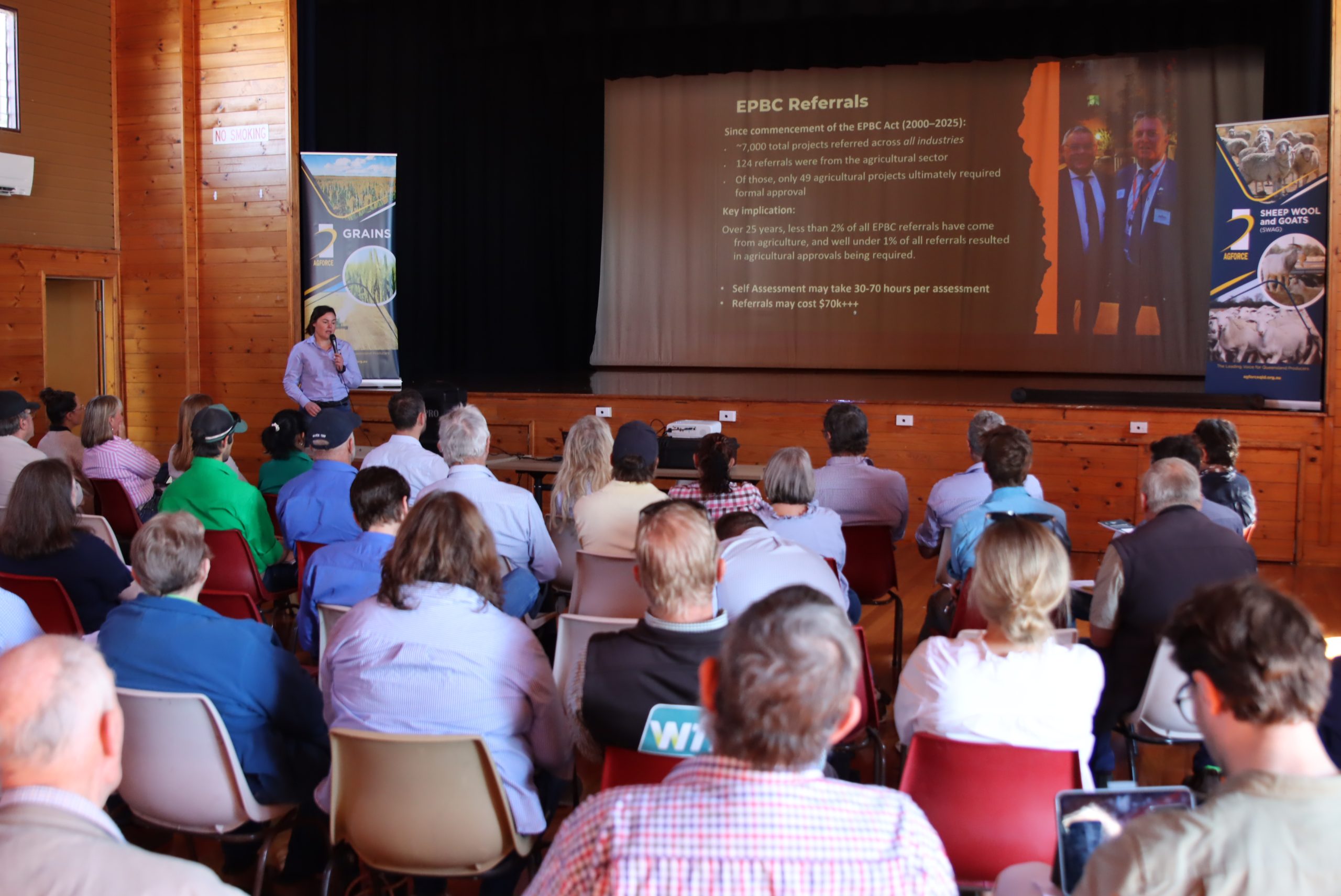
About 60 producers attended the AgForce roadshow at Milmerran, following another session at Durong two days earlier which attracted 80 people.
Declared weed control ‘low risk’
Another issue he said he received many questions about related to weed management.
“We want to be clear: weed control, where you are dealing with a declared weed, that is a low risk activity.
“Weeds are an enemy to habitat all over the place. That’s why they’re declared weeds. They also affect your productivity. We don’t want to get in the way of genuine weed control.”
“Where we sometimes have a pressure point, and we have had prosecutions in the past where someone said, “I found a weed, therefore I’m going to clear everything around it. That’s not legitimate.
“Where you are dealing with the weed, this is where a photo really helps.”
He said AgForce had pointed out that Queensland has accepted development codes for weed control and a system in place to manage that.
“So the first thing we do is look at those accepted development codes. They’re well written. Pretty much everyone understands them. In a lot of cases, they’re not broke, so you’re not trying to fix them.
“So things like fodder harvesting, things like accepted development code for weed control, they already require you to do a self-assessment. Check that you’re not removing hollow bearing or habitat trees. Check that you’re not interfering with damaging intact native vegetation. But if you’re addressing a declared weed, go for it. That’s the advice for you.”
Self-assessment began by determining whether an activity remained exempt. If it is not exempt, it is up to the producer to consider whether it is likely to have a significant impact on a matter of national environmental significance (MNES).
On-ground evidence can outweigh mapping
He said the EPA’s Protected Matters Search Tool can identify protected matters that may occur, are likely to occur, or are known to occur in the area.
Mr Farrell emphasised that landholder photographs would carry weight.
“What you see on the ground and what you are showing on the ground through your local knowledge and your photographs and your evidence takes primacy over our indicative mapping,” he said.
He said the significant-impact test considered whether an action would destroy or fragment an important habitat and disrupt a species’ breeding or feeding or remove it from the area.
Avoiding impacts can avoid a referral
In some cases it was possible to redesign an activity to avoid these impacts.
 Avoiding impacts was the key to avoiding a referral.
“We absolutely encourage people to avoid impacts, and then you don’t need a referral,” Mr Farrell said.
“You don’t need a formal process then if you’re avoiding it.”
He said that landholders can choose to make a formal referral, which provided a binding decision from the Commonwealth as to what they can and can not do.
“That persists into the future for quite a long time, basically forever, technically,” he said.
“It switches off compliance, even if someone makes a complaint about you, you’ve met your obligations, you’ve got that formal certainty.”
Major penalties for deliberate damage
In terms of compliance, Mr Farrell said many reports received by the regulator were closed after an initial assessment without contacting the landholder.
Where more information was needed, the EPA would contact the producer and discuss the circumstances.
Where a landholder had made an honest mistake, the regulator would generally seek to negotiate a voluntary restoration arrangement.
Larger penalties were directed towards “reckless or deliberate” environmental damage he said.
“Where there is reckless or deliberate damage, that is where we go for big penalties,” he said.
Mr Farrell also rejected claims that the EPA was secretly hiring consultants who were also working for landholders, saying Commonwealth contractors were required to disclose conflicts of interest and EPA officers were bound by public-service ethical standards.
He said the agency has established a contact service for producers who want to discuss their circumstances or work through a self-assessment. Landholders considering a formal referral could also seek a pre-referral meeting and assistance from an assessment manager.
Mr Farrell said the EPA guide is still being refined and would review feedback from the roadshows with AgForce to consider what changes or additional support may be required.
HAVE YOUR SAY