
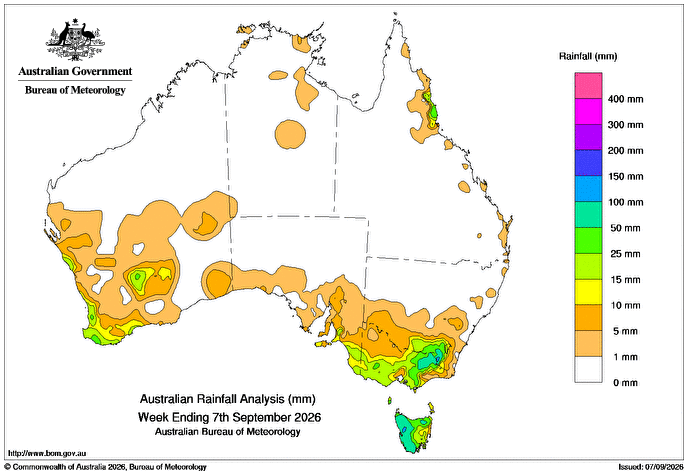
SEVERAL cold fronts moved across south-eastern Australia during the week, resulting in days of rainfall and flood warnings for catchments in northern Victoria and northern Tasmania.
Weekly rainfall totals greater than 15mm were recorded across Tasmania, south-eastern South Australia, south-eastern New South Wales and southern, central and north-eastern Victoria.
 Falls greater than 50mm were recorded in western Tasmania, and alpine regions of Victoria and NSW.
Several cold fronts crossed south-west Western Australia during the week, followed by a trough and low-pressure system supported by a slow-moving upper trough, which brought rainfall to inland parts of the state.
Weekly rainfall totals greater than 10mm were recorded along parts of the west coast of WA and in areas of the south-west and the interior.
Isolated falls of 25-50mm were recorded in the south-west and Goldfields districts of WA.
A high-pressure system in the Tasman Sea directed moist onshore flow to coastal areas of Queensland.
Weekly rainfall totals of 15-mm were recorded across Queensland’s North Tropical Coast and Tablelands and the Herbert and Lower Burdekin districts.
The highest weekly total at a Bureau of Meteorology gauge was 160mm at Mount Read in Tasmania.
The highest daily total at a Bureau gauge was 81mm at Perisher Valley AWS in NSW in the 24 hours to 9am on 6 September.
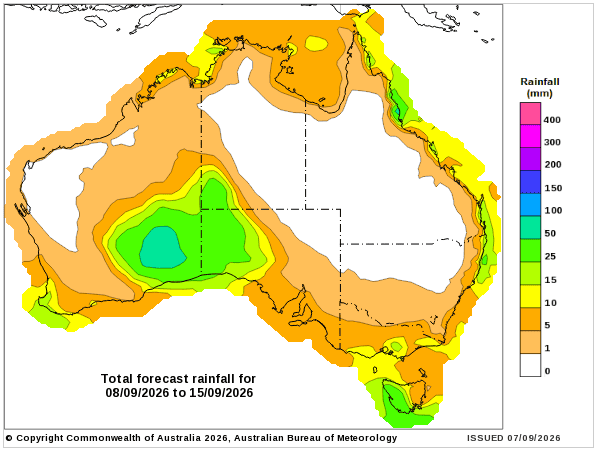
Outlook map
BOM drought statement 7 September
The bureau said August rainfall was above average in central and inland areas, but below average in Tasmania, parts of the west and south-east coasts, and large areas in eastern Queensland.
Long-range forecasts for four-month rainfall deficiencies to the end of September show rainfall deficiencies are likely for much of eastern Queensland, parts of eastern New South Wales, eastern Victoria, south-west Western Australia and parts of northern Australia.
Areas with 2026-to-date rainfall deficiencies expanded in the west of Western Australia and in Tasmania, and persisted in north-eastern New South Wales and southern Queensland.
Soil moisture remained below average in parts of western and eastern Australia, declining through areas of Western Australia and Tasmania, with extensive below-average conditions persisting across Queensland.
Evaporative stress remained elevated across parts of western and eastern Australia, increasing through much of Tasmania but easing within inland New South Wales, Victoria, and south-eastern South Australia.
Streamflow was lower than average at many sites across southern Australia, the south-west of Western Australia, parts of eastern Australia and southern Queensland. Some water storages in the eastern and southern states are at or below 50pc of their capacity. Groundwater levels were above average in northern Australia and below average across southern Australia.
Read the full BOM drought statement here.
HAVE YOUR SAY