
AUSTRALIA’S latest wool production forecasts indicate a potential rebound in grower turnoff this year, albeit depending on seasonal conditions.
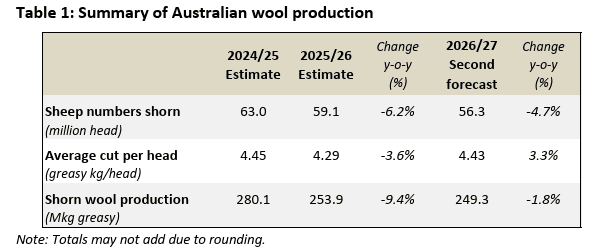
The Australian Wool Production Forecasting Committee’s second forecast of shorn wool production for the 2026-27 season is 249.3 Mkg greasy, representing a 1.8 percent decrease on the estimated 253.9 Mkg greasy produced in 2025/26.
The 2026-27 forecast represents an upward revision of 5.4 MKg from the committee’s April forecast.
The committee is estimating the number of sheep shorn in 2026-27 to remain historically low at 56.3 million head, down 4.7pc on 2025-26.
However, it said producer confidence has rebounded strongly, supported by improved wool market conditions. Seasonal conditions have improved across South Australia, Victoria and Western Australia, but remain mixed in New South Wales and challenging in parts of Tasmania and Queensland.
The committee said the national flock is stabilising, with future growth expected to come from breeding and greater retention of breeding stock, subject to favourable seasonal conditions.
Committee chairman Stephen Hill describing national wool production as “stabilised” although the recovery is patchy across the nation.
“But in WA and especially South Australia have come from two or three years of the worst drought in living memory to the last eight months of a boom season, so absolutely fleece weights are up and production is up, and their decisions to retain and run on stock are definitely changing.”
However, based on the change in the forecast rate of decline in wool production from 9.4pc in 2025-26 to 1.8pc in 2026-27, Mr Hill thought the industry had “seen the bottom.”
“Even though we are saying it is 1.8pc off at the moment, it’s only very early in the season; what’s critical is what happens in most areas with the growing season in the spring and how much rain we do or don’t get.”
“If we get a decent spring, I think we will show even an increase (in wool production) this year … only small,” he said.
“But if all things being equal, there might a slight increase by the end of the story this season and then we’ll start looking at some more reasonable increases going forward, subject to the market staying higher and the rest…”
Mr Hill said near-term wool production growth is likely to be driven by on-farm breeding programs rather than purchases of replacement ewes, as breeding stock prices remain high.
“Further spring rainfall will be critical to improving feed and water availability and supporting flock rebuilding intentions across key wool-producing regions.
“At the same time, ongoing cost pressures and the drier seasonal outlook are likely to temper producer confidence and encourage cautious decision-making in the months ahead,” he said.
Mr Hill said seasonal conditions have improved significantly since our April forecast, with widespread rainfall across South Australia, Victoria and key wool-producing regions in Western Australia boosting feed availability and producer confidence.
“However, conditions remain mixed in New South Wales, Australia’s largest wool-producing state, while Tasmania and parts of Queensland continue to face seasonal challenges.”
The outlook for 2026-27 follows an estimated shorn wool production of 253.9 Mkg greasy in 2025-26, which was 9.4pc lower than in 2024/25 and 1.5 Mkg below the April forecast.
Wool production recovering in some states
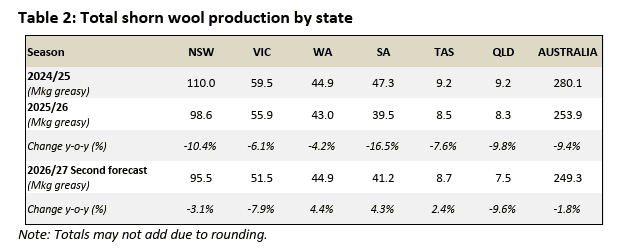
The committee has estimated year-on-year declines in shorn wool production across all states in 2025-26, but increases in Western Australia, Tasmania and South Australia in 2026-27.
These declines range from 16.5pc in South Australia (down to 39.5 Mkg greasy) to 4.2pc in Western Australia (down to 43 Mkg greasy). New South Wales produced 98.6 Mkg greasy (down 10.4pc), Victoria 55.9 Mkg greasy (down 6.1pc), Tasmania 8.5 Mkg greasy (down 7.6pc) and Queensland 8.3 Mkg greasy (down 9.8pc). Average cut per head was estimated at 4.29 kg greasy, 3.6pc lower than 2024/25.
The committee said the May 2026 Sheep Producer Intentions Survey indicated producer sentiment towards the wool industry rebounded strongly, with net sentiment rising 80 points year-on-year. The improvement was driven by stronger wool market conditions and a shift in producer focus from risk management and flock reduction towards stock retention and flock rebuilding. However, seasonal conditions and the weather outlook remained the dominant factors influencing on-farm decision making.
AWTA Key Test Data for the 2025-26 season show no change in mean fibre diameter or vegetable matter (20.5 µm and 2.3pc respectively), a 2 mm increase in staple length to 87.3 mm with reductions in staple strength (down 0.7 N/ktex to 33.0 N/ktex) and yield (down 0.5pc to 63.6pc). AWTA wool test volumes for the 2025/26 season were 271.7 Mkg greasy, down 8pc year-on-year. First-hand wool offered at auction during 2025-26 was down 1.7pc at 253.9 Mkg greasy.
The committee said sheep slaughter for 2025/26 was down 31pc to 8.04 million head with lamb slaughter at 22.07 million head (down 15p) compared to 2024-25. The 2025-26 sheep and lamb slaughter were both lower than the five-year average by 5pc and 6pc respectively.
The reduction in sheep and lamb turn-off during 2025-26 suggests the national flock is stabilising, while improved producer sentiment provides the potential for future growth, the committee said; however, seasonal conditions during spring and early summer will remain a key determinant of flock rebuilding activity.
The committee said despite ongoing cost pressures, wool producers appear increasingly focused on rebuilding flocks through on-farm breeding programs and greater retention of breeding stock. The AWPFC adopted the ABS flock estimates released in December 2025, which included revised national flock figures from 2016-17 onwards that reflect the change in scope to capture all sheep grown for commercial gain in Australia.
The full forecast report will be available on the AWI website at www.wool.com/forecasts from 4 September 2026.
Source – AWI.
HAVE YOUR SAY