
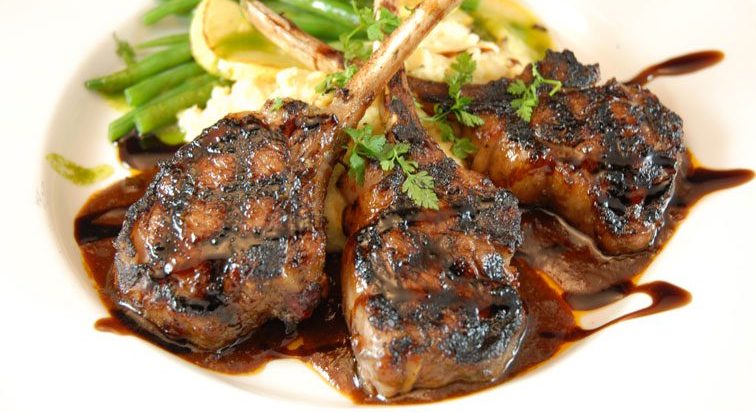
EVERY red meat lover has experienced it: the deeply-satisfying sensory experience of eating the burnt ends on a piece of slow-cooked brisket, or the crispy edge on a well-charred lamb loin chop.
Others will be familiar with the pleasurable indulgence of a cappuccino made from freshly-roasted coffee beans; or the dark, chewy crust on a loaf of sourdough bread from a wood-fired oven.
All are examples of one of the true miracles of food science: the Maillard effect, which produces characteristic browned, complex flavours in certain foods after the application of heat.
The phenomenon is named after French chemist Louis Maillard, who first described the chemical reaction in 1912.
While the Maillard effect is seen across a wide range of food and beverage items (think beer made with roasted barley), red meat is arguably its greatest love child. If you’re cooking meat protein tonight, chances are you’ll be using the Maillard reaction to transform your raw ingredients into a great sensory experience.
The application of heat to a piece of red meat is more than just a carbonising (charring) effect, like that which might apply to a piece of wood thrown on a fire.
Instead, the Maillard effect as it applies to red meat produces a vastly complex chemical and thermo-chemical reaction on hundreds of fatty acids, proteins, sugars and other compounds found in beef and lamb, that leaves the typical consumer hungry for more.
It’s one of the fundamental reasons why humans find barbecued meat so moreish.
While much-appreciated for its effect, the Maillard reaction is little understood in the red meat industry, judging by recent conversations we’ve had with stakeholders.
What’s going on?
Without turning this article into a full-on chemistry lesson, it’s important to understand a bit more about what’s going on when a Maillard reaction takes place.
A 2017 summary written by US molecular biologist Eric Shulze provides an excellent summary of what happens when red meat is kissed by heat.
“The Maillard reaction is complex – so complex, in fact, that it’s only in the last few decades that scientists have begun to figure out what it actually is,” Dr Schulze suggested.
“While they still don’t entirely understand it, scientists do know the basics: The Maillard reaction is many small, simultaneous chemical reactions that occur when proteins and sugars in and on a piece of food are transformed by heat, producing new flavours, aromas and colours.”
A beef burger or sirloin steak is composed of a basic set of building blocks: proteins, fats, sugars and water. The Maillard reaction is what can happen to the proteins and sugars when heat and time are added to the equation.
“With the right amount of heat, moisture, and time, those specific proteins and meat sugars will result is an increasingly complex array of flavour and aroma molecules, along with a darker colour courtesy of newly-formed edible pigment molecules called melanoidins,” Dr Schulze wrote.
“By cooking a steak in a ripping-hot skillet, you can dehydrate its surface thoroughly enough that the temperatures on that surface will begin to climb, to upwards of 150°C (300°F). At that point, the Maillard reaction will start to kick-in, creating new flavours, aromas, and the characteristic brown colours that give the reaction its more commonplace name, the ‘browning reaction’.”
Heat, moisture and time may be key to getting the Maillard reaction going, but without proteins and sugars to work with, it simply won’t happen.
“Proteins are long chains of amino acids, crumpled up like wads of paper,” Dr Schulze wrote. Some of them are Maillard-susceptible, meaning they really love to bond with sugars. But not just any sugar will do. Molecules of complex sugars, like starches or table sugars, are too big to react with Maillard proteins. Instead, these proteins require “reducing sugars,” which are essentially simple sugars that attract amino acids at certain moisture and temperature levels.”
“That’s a critical point: The Maillard reaction starts with a somewhat limited set of proteins and sugar molecules, and, as these bond and mix over the cooking period, more and more new molecules are added to the equation.”
“The Maillard reaction isn’t the only reaction that can happen to those building blocks of protein, sugar, and water—and, depending on the ratios of those building blocks, different effects can come out of the Maillard reaction itself.”
The term caramelisation is sometimes used to describe cooked meat, but that process applies specifically to meat sugars contained in a piece of food, not the proteins. Caramelisation is what occurs when sugars are heated and begin to react with water in a process known as hydrolysis, breaking down and reforming into a complex, sweet, nutty, and slightly bitter substance ie caramel or toffee.
“Biscuit dough, for example, is made up of similar building blocks as a steak. The difference is in the proportions: A steak is obviously much higher in protein, while cookies have a lot more sugar. This has a profound effect not only on the way in which the Maillard reaction occurs, but also on the degree to which these foods experience other, related reactions, like caramelisation,” Dr Schulze said.
“I like to think of caramelisation as a first cousin to the Maillard reaction. Keep in mind that, though different, these reactions are not mutually exclusive. Both the Maillard reaction and caramelisation can and do take place in both a steak and a biscuit, but they produce markedly different, often complementary, flavours and aromas in each.”
Click here to read Eric Schulze’s full article:
Impact under-appreciated
Meat & Livestock Australia’s executive chef Sam Burke said he had only really become aware of the Maillard effect and the benefit it provides for red meat in the last ten or eleven years.
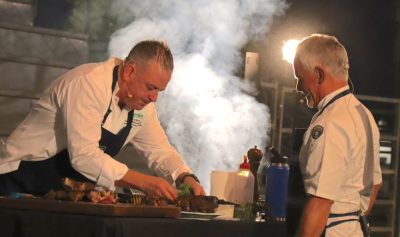
MLA executive chef Sam Burke, left, with MSA corporate butcher Doug Piper
“The first time I had ever heard of it was around 2015, and I’ve been cooking professionally since 1994,” he said.
“It’s impact on the eating experience with beef or lamb is still under-appreciated, but it is a huge asset to the red meat industry,” he said. “It doesn’t work quite the same on fish or chicken.”
“The growing popularity of reverse sear on steak cuts (doing the primary cooking in the oven at lower temperature, followed by a short blast at high temperature on the grill) is really all about chasing that Maillard reaction. Its adding layers of flavour, while getting the desired degree of doneness in the centre,” Sam said.
“Consumers pay good money for a nice piece of red meat protein. How do you get the very best out of it? The Maillard effect is often part of the answer, and once a consumer has nailed a cooking method, there’s a good chance they will use it again and again.”
Sam agrees that the Maillard effect can vary dramatically, depending on breed type, feeding history and other factors.
“For example a highly marbled piece of Wagyu performs better on a flat hotplate, at moderate heat, while a leaner piece of grass or grainfed yearling wants the (bar) char grill, to enhance the flavour.”
“Equally, it depends on the cut. The results can be very different. I demonstrated this to our group of visiting Aussie Beef Mates international chefs only yesterday.”
Recent Australian research
Beyond tenderness and juiciness, beef flavour is a critical determinant of consumer satisfaction, purchasing behaviour, and product differentiation in global meat markets.

Dr Thomas Hay
A recently completed research study compiled by QAAFI sensory scientist/chemist Dr Thomas Hay and others, titled “Articulating terroir in beef: Integrating breed, diet, and environment to predict beef flavour chemistry”, highlights the importance of the Maillard effect on beef flavour.
“As eating quality remains central to both consumers and producers, there has been increasing emphasis on understanding the chemical basis of beef flavour,” the report said.
“This shift is reflected in growing research attention toward fatty acid composition and volatile organic compounds found in beef, generated during cooking.
“Beef flavour and aroma is shaped by a complex interplay of factors, including genetics and breeding, muscle and fat composition, production systems, post-mortem handling, biochemical precursor availability, and cooking method.
“At the molecular level, beef flavour arises primarily from volatile compounds generated during cooking through Maillard reactions, thermal degradation and other factors,” the report said.
“These reactions yield a diverse array of aldehydes, ketones, pyrazines, sulfur compounds, and other volatiles that define the characteristic sensory identity of cooked beef. In parallel, water-soluble non-volatile compounds, including amino acids, peptides, and nucleotides, contribute to taste attributes such as umami and bitterness.”
In a passage discussing flavour formation in beef during cooking, the paper says the Maillard reaction is a fundamental pathway in cooked meat flavour development, initiated by the reaction between amino compounds (free amino acids, peptides, and proteins) and reducing sugars during heating. These transformations generate a wide array of heterocyclic compounds, including pyrazines, thiophenes, thiazoles, and other nitrogen and sulfur-containing molecules associated with roasted, nutty, and meaty sensory notes.
We’re not expecting readers to follow the flow chart below in detail, but we’ve included it simply to illustrate the sheer complexity of these reactions and how they interact.
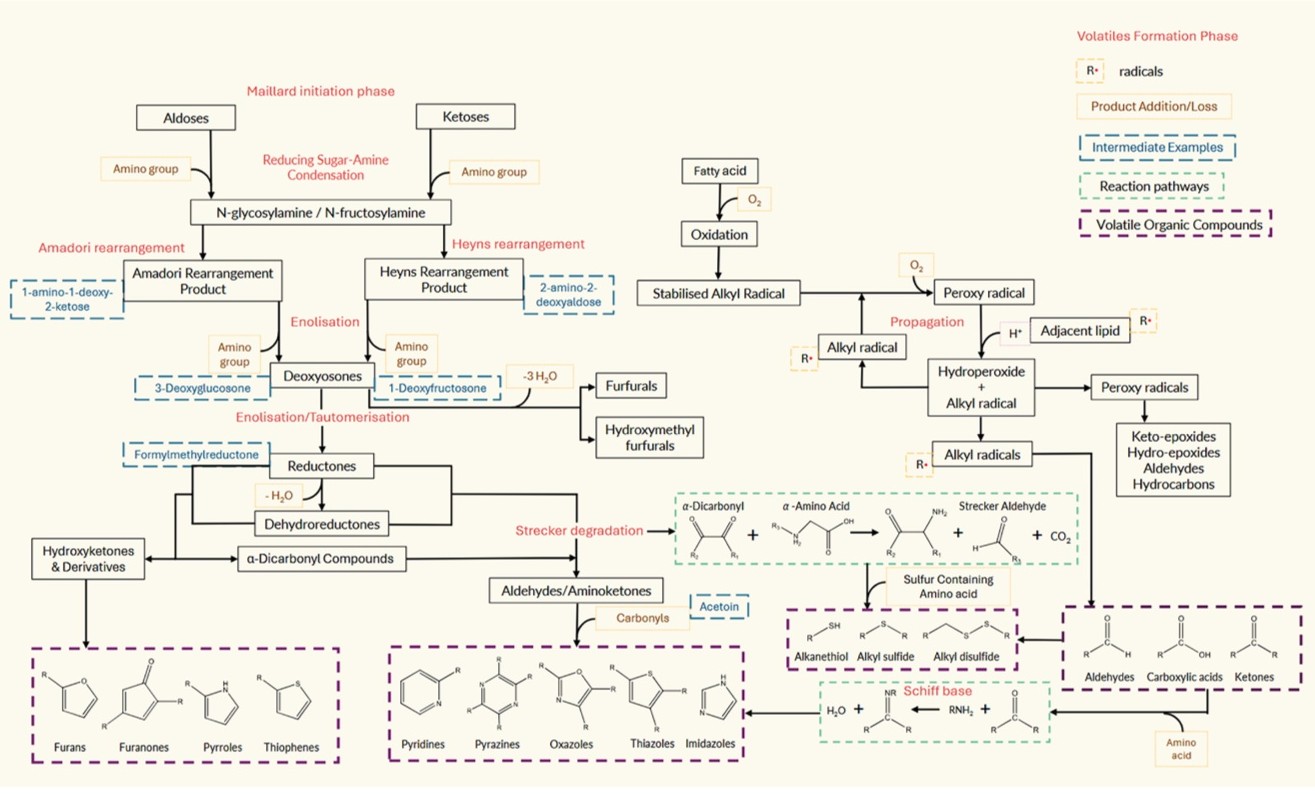
Volatile Organic Compound (VOC) class formation by Maillard reaction and lipid oxidation interactions. Click on image for a larger view.
The extent and composition of Maillard-derived volatiles are highly sensitive to cooking conditions, Dr Hay’s study found.
Elevated temperatures accelerate reaction rates and promote the formation of more intensely roasted flavour notes, whereas lower-temperature or moist-heat systems may favour earlier-stage Maillard intermediates.”
Subsequently, variations in the concentrations and balances of compounds in different prices of beef and cooking temperature, method and duration significantly influence the sensory outcome.
The internal endpoint temperatures and the choice of cooking method profoundly affected physicochemical and sensory properties of meat. Different cooking technologies, from roasting and grilling to sous-vide and boiling, produce distinct temperature gradients, rates of moisture loss, and degrees of protein denaturation, all of which influence the balance of volatile and non-volatile flavour-active compounds formed during heating.
Sulfur-containing volatiles, such as thiophenes and thiazoles, are potent contributors to meaty, umami and cooked meat notes. Their generation often occurs through Maillard-lipid interactions during cooking.
“The formation and relative abundance of these volatiles are influenced by breed, diet (particularly grass versus grain-finishing), muscle type, and intramuscular fat content, making them powerful molecular markers for characterising beef origin, production system, and perceived quality,” the report said.
HAVE YOUR SAY