
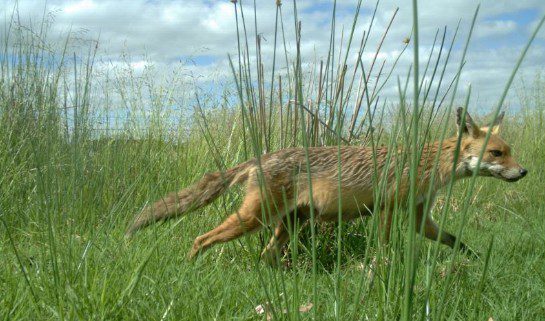
A fox on the move. Photo – Lisette Mill.
FOX shooters and landholders have been reminded of the potential role pest species can play in the spread of H5 bird flu by a south-west Victorian pest controller and conservationist.
Biodiversity Inno9vation AU principal Lisette Mill’s warnings come as Australia confirms its second case of H5 bird flu in seals after reports of mass deaths in sea birds along the coastline.
In LinkedIn posts she said red foxes and other mammalian carnivores and carnivorous omnivores like feral pigs are highly susceptible to catching H5 avian influenza by feeding on species already infected, including their own kind.
“So while the fox may have died from a wound you cannot see or from eating a bait, for your property biosecurity as H5 spreads across Australia, treat it as a suspect H5 death.
“Keep your pets and working dogs away from the body,” Ms Mill posted.
“It sounds obvious, but this is really a time for a reset on how owned dogs are able to interact with foxes on every farm.”
She posted that a slow fox in the sights of a shooter may already be dying.
“You cannot tell by looking at it whether it has H5.
“Wear PPE (personal protection equipment) and bury the fox so other scavengers cannot access it. Keep your dogs away,” she said.
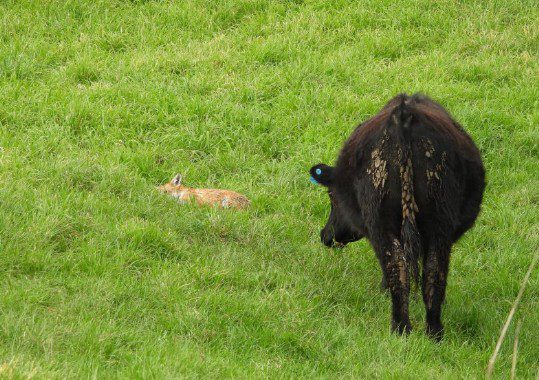
A dead fox and a curious heifer. Photo – Lisette Mill.
Ms Mill said foxes represent a risk to livestock farms on a number of levels, not just in terms of bird flu, but also mange and hydatids.
“They are a carnivore, they eat species that are dying or succumbing to bird flu, on the beach, in the towns, everywhere; they are in every habitat pretty much.”
Ms Mill said she anticipated that sick foxes will be seen, although the causes can vary.
“But it isn’t possible to tell what a fox has died from unless you test it, so just take precautionary measures …wear PPE, keep your dogs away.”
She said the advent of H5 bird flu represents an opportunity for people to reconsider how their dogs engage with foxes.
“Do you let them hunt foxes, do you let them roll in a dead fox?
“What do you let them do and does that put your other farm assets at risk?” she asked.
“This is an opportunity for a reset.”
European research confirms fox H5 risk
A 2008 Netherlands study found that red foxes are susceptible to infection with a wild bird isolate of HPAI virus (H5N1) from clade 2.2, can become infected after feeding on infected bird carcasses, and can excrete the virus for as many as five days without severe disease developing.
“Surveillance and monitoring of HPAI virus (H5N1) infections may therefore be beneficially expanded to red foxes, and potentially to other free-living wild carnivores, in influenza-endemic areas and in areas experiencing outbreaks of HPAI virus (H5N1) infections in wild bird populations,” the study concluded.
South Australia’s Department of Primary Industries and Regions today reported five new suspect H5 bird flu events in the state. These included an Australian raven at Robe, a little penguin at Southend, a greater crested tern at Coonalpyn, a Pacific gull on Kangaroo Island and a red fox in metropolitan Osborne, north-west of Adelaide. Samples from these have been sent for confirmatory testing.
Farm biosecurity starts with you
In her National Biosecurity Week post, Ms Mill reiterated that foxes can carry and spread bird flu across land and to water, on farms and around towns. She said farmers could also be more biosecure by fast burial of dead stock and offal to stop the feeding of foxes, feral cats and pigs.
“Biosecurity starts before the hazmat suits & sicknesses.
“Before the burn heaps & market losses & limits,” she posted.
“It starts with you and how you frame your actions to be more biosecure.
“At your place. In your control.”
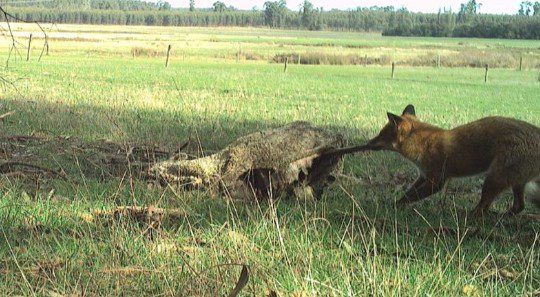
A fox on a sheep carcase. Photo – Lisette Mill.
Ms Mill said it is not known what the impact of H5 bird flu would be on farms, but she cautioned against thinking there would be no impact “because there will be.”
“Why put your farm assets at a greater risk just because you couldn’t change some behaviours that you’ve allowed to happen?”
Ms Mill said she had asked Agriculture Victoria how the landholders and fox controllers she worked with on farms across south-west Victoria could assist in reducing the spread of H5 bird flu.
She was told by Agriculture Victoria biosecurity manager Jason Wishart that anyone finding a sick or dead animal they suspect has H5 bird flu can report it here.
People authorised to use 1080 and PAPP can find information on carcase disposal here.
Participants in the Victorian fox bounty program can view the acceptable fox body parts page for requirements on fox carcase disposal here.
Thanks for keeping us informed about the bird flu and what to do.